For the people of Zaporizhzhia, the sound of explosions has become a grim fixture of daily life. The city sits just 20 kilometres from the front line, and Russian forces continue to strike civilian areas with drones, glide bombs, and missiles. In early November, a series of glide bombs hit an underground school in the nearby village of Komyshuvakha, where residents had gathered for humanitarian aid distribution. At least 50 people were killed.
Such attacks are not isolated. In October, a Russian drone struck a minibus at a stop in the city centre, injuring three people, according to the independent outlet Ukrainska Pravda. Days later, another drone hit a bus, wounding four. The pattern is systematic, says Regina Kharchenko, the acting mayor of Zaporizhzhia since April 2024.
But the most acute threat looms just outside the city: the Russian-occupied Zaporizhzhia nuclear power plant, seized by Moscow's forces in March 2022. This year alone, the plant's external power supply has failed 16 times, the latest only days ago. Each failure forces the facility to rely on emergency generators for cooling, raising the spectre of a nuclear accident that could affect all of Europe.
Mayor's mission in Berlin
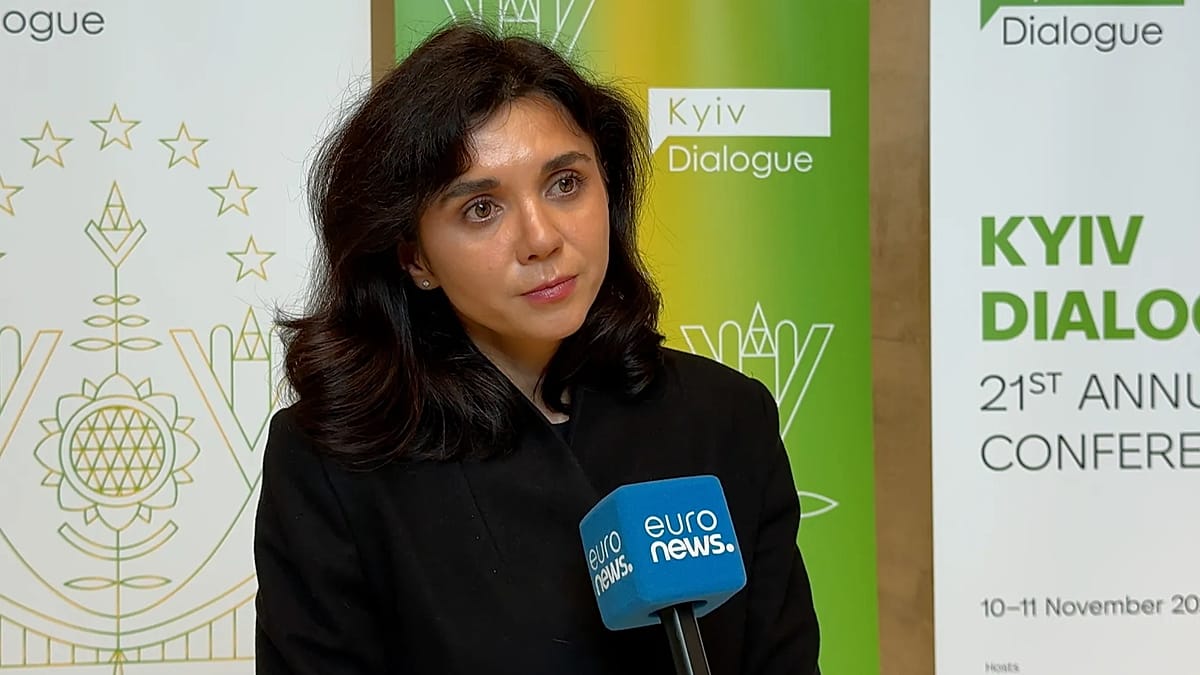
Kharchenko, a lawyer born in Crimea who moved to Zaporizhzhia as a child, was in Berlin for the 21st Kyiv Dialogue, a cross-party German-Ukrainian platform bringing together politicians, media, and civil society. In an interview with Euronews, she spoke about the coming winter, the resilience of her city, and the urgent need for European support.
“I consider it a great honour to be able to represent Zaporizhzhia,” she said. “I can talk about real life in wartime and explain to people that this is a very difficult life experience that many Ukrainians would gladly do without.” Even while on the panel, she remained in constant contact with her team. “Just today, a residential building in our city was badly damaged; its structure is at risk of collapse, and unfortunately, one person was injured. But all municipal services are already on site.”
Kharchenko's visit had a concrete purpose: to secure humanitarian aid and share lessons with German and Polish municipalities. “We have already received concrete offers of humanitarian aid so that people can get through this winter,” she said.
Resilience under fire
Resilience, Kharchenko explained, is not abstract. It is built through preparation. “Every municipality has to prepare its area for winter. The city has to guarantee heating and water supplies and try to get the problems with the power supply under control,” she said. Zaporizhzhia also hosts more than 200,000 internally displaced people, adding strain to already stretched resources.
The mayor acknowledged the work of Ukraine's defence forces, whose efforts allow the city to function at all. “Countless attacks, countless drones, missiles and Shaheds are being repelled. Only thanks to their superhuman work can we lead a more or less normal life,” she said.
As winter approaches, the threat of renewed strikes on critical infrastructure grows. Reports suggest Russia intends to intensify attacks on the energy grid, a tactic that has already cut power for hundreds of thousands of Ukrainians. Kharchenko condemned these attacks as “terrorism and terror against the peaceful civilian population.”
The situation in Zaporizhzhia is a stark reminder of the war's human cost. While European leaders debate further aid, cities like Zaporizhzhia are living the consequences daily. The mayor's message is clear: without sustained support, the coming months could be the hardest yet.