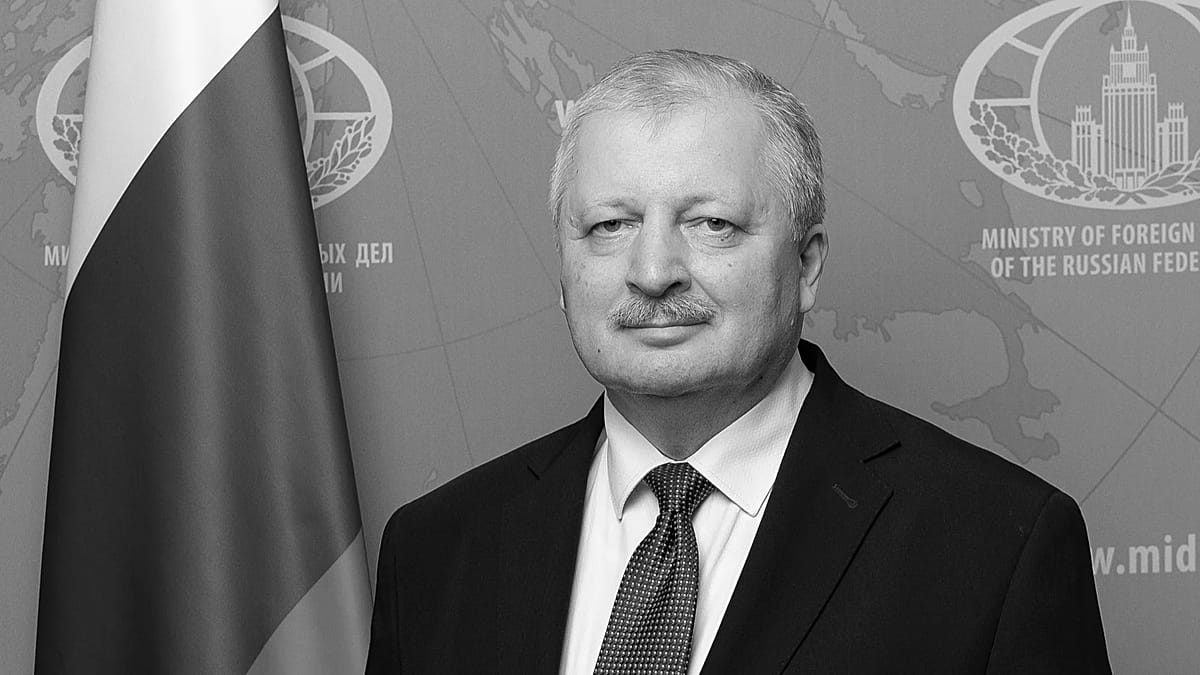
Alexander Darchiev, Russia's ambassador to the United States, died on Wednesday at the age of 66, according to an announcement from the Russian Foreign Ministry. The ministry said he "passed away suddenly" in a statement posted on X, without elaborating on the circumstances.
Darchiev was a career diplomat who had served in senior roles within the Russian Foreign Ministry for decades. He took up the Washington post in early 2025, succeeding Anatoly Antonov, and had previously been stationed at the Russian embassy in Washington in the late 2000s. Before that, he spent six years as Russia's ambassador to Canada.
The Foreign Ministry's statement mourned the loss of "an outstanding diplomat, an experienced leader, a kind colleague and a mentor," and extended "deepest and most heartfelt condolences" to his family and loved ones.
A diplomat in turbulent times
Darchiev's appointment came at a moment of extreme tension between Moscow and Washington, with diplomatic channels strained over the war in Ukraine and a series of expulsions on both sides. His death removes a key figure from an already thin Russian diplomatic presence in the United States.
The news also lands as European capitals watch closely for any shifts in Russia's foreign policy posture. The Kremlin has recently sought to push its own security architecture proposals, which European governments have largely dismissed as a distraction from ongoing aggression.
Darchiev's career spanned a period of dramatic change in Russia's relations with the West. He was known in diplomatic circles as a hardline but professional voice, often tasked with delivering Moscow's positions on arms control and regional conflicts.
His sudden death raises questions about succession at a critical embassy, though the Russian Foreign Ministry has not yet indicated who might take over. In the meantime, the embassy in Washington will likely operate under a charge d'affaires.
The cause of death has not been disclosed, and no further details are expected in the near term. The ministry's brief statement offered no hint of foul play or health issues, leaving the diplomatic community to speculate.
For European observers, the loss of a seasoned ambassador is a reminder of how fragile Russia's diplomatic corps has become, especially after years of expulsions and staff reductions across the continent. Several EU member states have expelled Russian diplomats in recent months, and Moscow has retaliated in kind, as seen in its ban on four French figures.
Darchiev's death also comes amid broader concerns about the health and morale of Russian officials abroad, with some reports suggesting that many are under immense pressure. The hacked Russian data suggesting over 390,000 war deaths has added to the somber mood in Moscow's foreign service.
As tributes pour in from Russian state media, the diplomatic community in Washington and European capitals will be watching to see how the Kremlin handles this unexpected vacancy. The next ambassador will inherit a portfolio that includes nuclear arms control, the fate of detained Americans, and the ongoing fallout from the invasion of Ukraine.
For now, the Russian Foreign Ministry has given no timeline for a replacement, and the embassy's day-to-day operations are expected to continue without interruption.