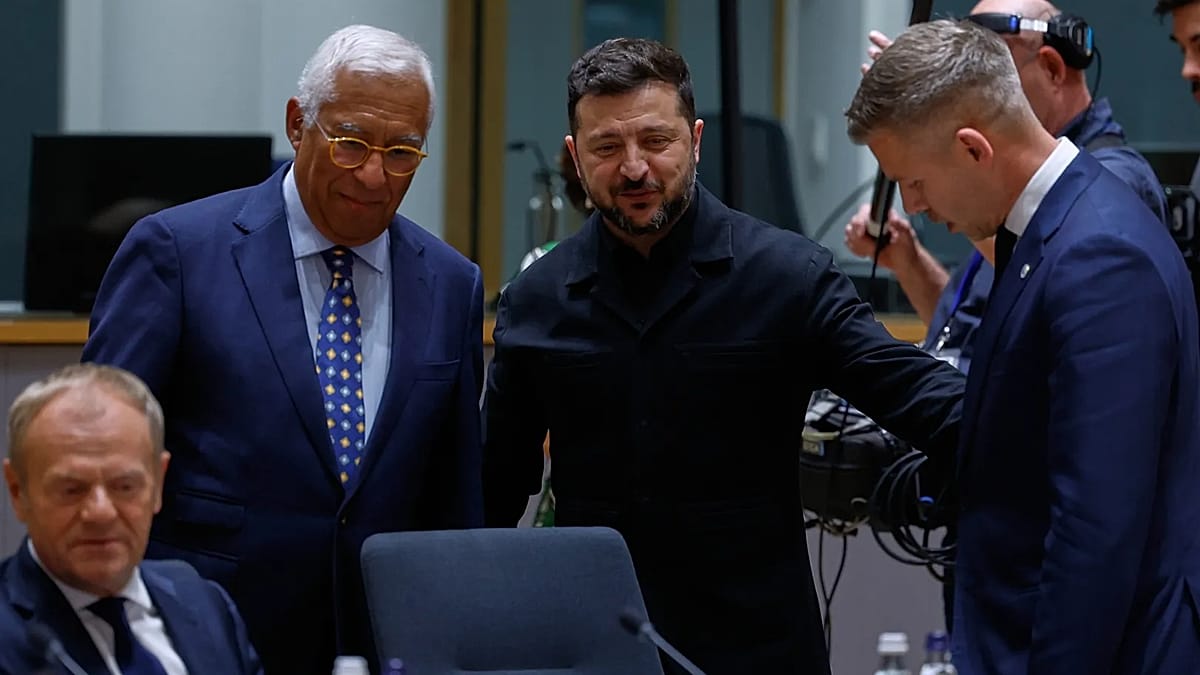
President Volodymyr Zelenskyy addressed EU leaders at a summit in Brussels, making a forceful case for Ukraine's accelerated accession to the European Union. He argued that no other candidate country has sacrificed as much for the right to be European, and that Kyiv's military experience is now an asset the bloc cannot afford to ignore.
“Ukraine merits it because it has paid more than any other European country for its right to be free, independent and European,” Zelenskyy told the assembled heads of state and government. He framed the membership bid not just as a reward for Ukraine, but as a strategic necessity for the continent's future security.
In a voice message shared with journalists after the closed-door meeting, Zelenskyy elaborated on Ukraine's military standing. “Ukraine is today, de facto, NATO’s second-strongest army, rivalling the world’s second-strongest army. And that is why we — and we alone — are needed by NATO de jure,” he said. He added that all leaders recognised Ukraine's armed forces as the strongest in Europe, and that the EU would benefit from its expertise.
Pushing for a European Ballistic Missile Programme
Zelenskyy also revived a proposal for a European ballistic missile programme, describing it as a Ukrainian initiative that remains a priority despite obstacles. “Europe will build its own ballistic capabilities. This is an urgent matter. Ukraine is not giving up, so we will get this done. It was our initiative, and now it is a joint effort with our partners,” he stated.
The Ukrainian president called on EU leaders to open all accession clusters in the coming weeks, a move that would signal a clear commitment to Kyiv's fast-track membership. He argued that the future of a free, united, and peaceful Europe is being decided on the battlefield in Ukraine.
A Shift in Budapest: “We Have Survived Orbán”
Zelenskyy noted a significant change in Hungary's stance following the April elections, which brought Prime Minister Péter Magyar to power. He said there is “clearly a new opportunity to strengthen relations both within the EU and between the EU and Ukraine.” In his voice message, Zelenskyy declared that Ukraine had not “compromised its dignity” and had “survived Orbán,” a reference to former prime minister Viktor Orbán's veto policy on Ukraine-related matters, from financing to enlargement.
While Zelenskyy did not hold a bilateral meeting with Magyar, they exchanged a brief conversation. He thanked neighbouring countries — Hungary, Poland, Romania, and Slovakia — for their support, assuring them that “Ukraine is committed to mutual respect.” In a clear nod to the sensitive issue of Hungarian minorities in Ukraine, he added that for Kyiv, “being a good neighbour has never been just words.”
Zelenskyy also met with Slovakia's Robert Fico and Bulgaria's minister Rumen Radev, who rejected sanctions on Russia that would harm his country. These interactions underscore the complex web of bilateral relations within the EU that Ukraine must navigate.
“Putin Is a Madman” Who Wants “Ukraine to Go Up in Flames”
On the broader war, Zelenskyy was blunt. He told journalists that Vladimir Putin does not want to end the conflict, a view now shared by all partners. “Everything he says about wanting peace is a lie. All partners, all Europeans, feel this,” he said. Despite this, Zelenskyy reiterated his readiness for negotiations with the Kremlin, even as he accused Putin of wanting “everything in our country to go up in flames.” He called the Russian leader “a madman,” adding that “our partners feel that.”
The summit in Brussels was part of a broader diplomatic push by Kyiv to secure concrete commitments from European allies. As EU leaders also grappled with issues like China trade imbalances and a €2 trillion budget, Ukraine's membership bid remained a central topic. The coming weeks will test whether Zelenskyy's arguments translate into accelerated accession talks.