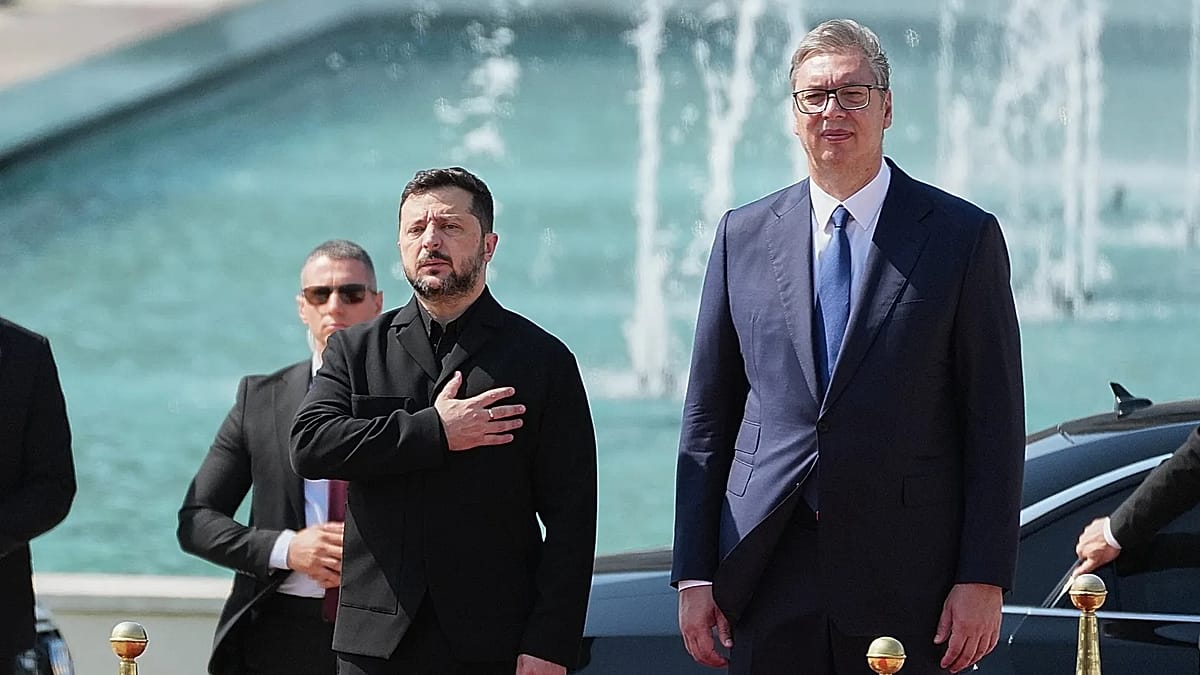
Volodymyr Zelenskyy’s first visit to Belgrade was always going to be a delicate affair. But his comments on Kosovo during a joint press conference with Serbian President Aleksandar Vučić have provoked a sharp reaction in Prishtina, where officials accuse Kyiv of disregarding Kosovo’s right to self-determination.
Speaking on Saturday, Zelenskyy said Ukraine supports the territorial integrity of its partners and international law, responding to a question about whether Serbia could still count on Ukraine’s firm position regarding Kosovo. “Our position … remains unchanged. We have always stressed this, and Ukraine’s policy has not changed,” he said.
Ukraine has never formally recognised Kosovo’s 2008 declaration of independence, a stance rooted in Kyiv’s own struggle to defend its borders against Russian aggression. Since the annexation of Crimea in 2014 and the full-scale invasion in 2022, Ukrainian officials have been wary of any precedent that could undermine their territorial claims.
Vučić, for his part, has repeatedly voiced support for Ukraine’s sovereignty over all its lands, including Crimea, even as Belgrade refuses to join EU sanctions against Moscow and maintains close ties with Vladimir Putin. On Saturday, he reiterated that position, and Zelenskyy thanked him.
But in Prishtina, the message landed badly. On Sunday, authorities removed a large Ukrainian flag bearing the slogan “Free Ukraine” from the city’s main boulevard, where it had hung since early 2022. Mayor Perparim Rama said on social media: “The state of Kosovo must be respected. When Kosovo is not respected, the capital Prishtina always responds in the same way.”
Rama added that Kosovo’s citizens fully understand other people’s struggle for freedom and dignity. “Our empathy and solidarity will always be with peoples facing war, violence and persecution. Because we, better than many others, know what it means to fight for freedom, dignity and the right to exist as a state,” he wrote.
Kosovo’s Foreign Minister Glauk Konjufca said Prishtina “takes note with regret” of Zelenskyy’s remarks, while reaffirming that Kosovo would continue to support Ukraine’s sovereignty. He rejected the argument that territorial integrity should preclude Kosovo’s independence, noting that Kosovo’s status emerged from a UN-administered process and internationally mediated negotiations, not annexation or conquest.
Belgrade’s balancing act
Since Russia’s full-scale invasion of Ukraine, Serbia has walked a tightrope between its traditional ties with Moscow and its ambition to join the European Union. Belgrade depends heavily on Russian gas and has refused to align with EU sanctions, despite repeated calls from Brussels to side unequivocally with Kyiv.
Vučić made his first official visit to Ukraine in June 2025, attending the Ukraine–South East Europe summit in Odesa. He condemned the invasion and called for the withdrawal of Russian forces, but declined to sign the joint declaration, a move that underscored the limits of his support.
Moscow has also accused Serbia’s defence industry of indirectly supplying arms to Ukraine. In May 2025, Russia’s foreign intelligence service SVR claimed Serbian weapons were “stabbing Moscow in the back,” a charge Vučić denied. While Belgrade does not publicly send arms to Ukraine, substantial quantities of Serbian-made ammunition have reportedly reached Kyiv through third countries, with the Serbian government saying it neither authorised nor controlled such transfers.
Zelenskyy’s visit to Belgrade was part of a broader diplomatic push to shore up support among Western Balkan nations. His comments on Kosovo, however, have complicated that effort, at least in Prishtina. The incident also highlights the enduring sensitivity of Kosovo’s status, which remains unrecognised by five EU member states and by Ukraine, despite Prishtina’s vocal backing for Kyiv in its war against Russia.
For now, the diplomatic fallout seems contained. But the episode serves as a reminder that even as Europe unites against Russian aggression, unresolved disputes from the 1990s continue to shape alliances and loyalties across the continent.