While the Balkans have become a popular travel destination, the crowds are unevenly spread, with most visitors heading to the Adriatic coasts of Croatia and Montenegro. Bulgaria, however, is starting to attract more attention, partly thanks to its recent Eurovision win and the upcoming hosting of the competition in Burgas. But beyond the Black Sea, the country offers plenty of other draws, including Plovdiv, often called Europe's oldest continuously inhabited city, and Varna, the hometown of this year's Eurovision winner.
The natural entry point for any Bulgarian itinerary is the capital, Sofia. Founded as Serdica and conquered by the Romans around 29 BC, it once rivaled Constantinople for the title of Byzantine capital—Constantine the Great himself considered making it his seat. That layered history is still visible today, alongside the stark lines of postwar architecture and the marks of more recent decades.
For those visiting in winter, Sofia is a gateway to skiing in the nearby mountains, while the city's mineral-rich springs feed public baths that offer a relaxing break. But even in a short stay, there's plenty to fill 48 hours.
Ancient and modern side by side
Start at Serdica Metro Station, where you can step off the train and directly into the remains of the Roman city. The ruins are scattered across the center—the eastern gate near the National Assembly, or the amphitheater tucked into the basement of the Arena di Serdica hotel. It's a literal layering of eras that defines Sofia.
One of the most remarkable sites is the Saint George Rotunda, a 4th-century building that has served as a church, a mosque during Ottoman rule, and again a church since the 19th century. Inside, Byzantine and Bulgarian medieval frescoes cover the walls, a rare survival of centuries of change.
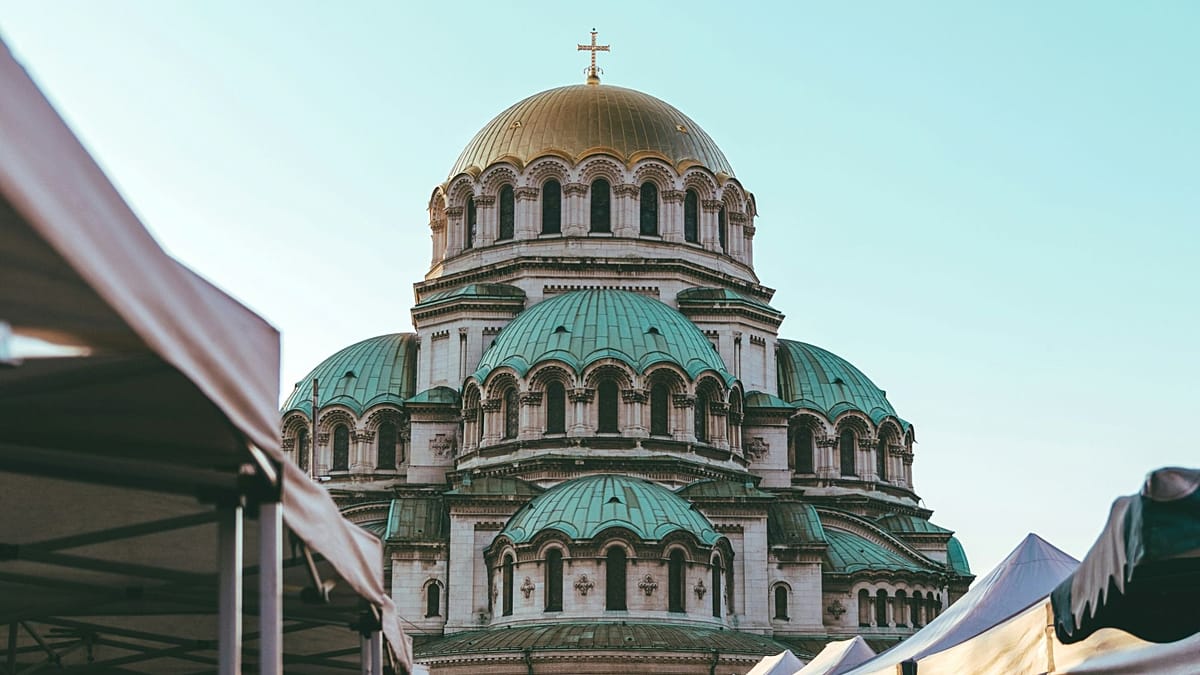
Nearby, the Square of Tolerance brings together four major houses of worship within a few minutes' walk: the Alexander Nevsky Cathedral (Bulgarian Orthodox), the Banya Bashi Mosque (Sunni Islam), the Cathedral of St Joseph (Roman Catholic), and the Sofia Synagogue (Orthodox Judaism). It's a fitting symbol for a city that issued the Edict of Serdica in 311, which legalized Christianity in the Eastern Roman Empire—a copy of that edict stands outside Saint Sofia Church.
Beyond the center: Boyana Church and Vitosha
On the outskirts of the city, Boyana Church is Sofia's only UNESCO World Heritage Site. The complex comprises three churches built between the 10th and 19th centuries, but the highlight is the 13th-century frescoes, described by UNESCO as "one of the most complete and perfectly preserved monuments of east European medieval art."
From Boyana, you can head straight into the hiking trails of Vitosha Mountain. The Visit Sofia website lists routes, including a popular one that leads from the church to Boyana Waterfall. For those with more time, longer treks offer panoramic views over the city.
Street art and socialist-era architecture
Back in the center, Sofia's walls are covered in murals. Pick up a street art map from the tourist information office to find them, from the St. George and the dragon mural near the Arte Sofia Hotel to works in a car park by Serdica metro station.
For a different perspective, a walking tour of the city's postwar architecture reveals the imprint of the communist era. A free downloadable map from Visit Sofia guides you to hotels, housing blocks, and other buildings from that period. Love it or hate it, brutalism left a lasting mark on Sofia's skyline.
Markets, food, and craft beer
For a taste of local life, head to the Women's Market (Zhenski Pazar), established in 1878 and the oldest open-air market in the city. You'll find fresh produce, spices, sweets, and clothing. The name dates back to Ottoman times, when women were only allowed to shop at markets designated for them.
Bulgarian cuisine is still relatively unknown internationally, so a visit to Sofia is a chance to discover it. Traditional taverns like Manastirska Magernitsa serve hearty dishes such as shopska salad, kavarma, and banitsa. For a more modern take, the city's craft beer scene is booming—a bar crawl through Sofia's top breweries is a great way to sample local IPAs and stouts.
With its mix of ancient ruins, religious diversity, outdoor escapes, and a vibrant contemporary culture, Sofia offers a compact but rich 48-hour itinerary. And as Bulgaria steps into the European spotlight, the city is ready to welcome more visitors.