Electrification is often hailed as a planetary ice pack, a way to slow global warming. But the debate over how to generate that electricity often overlooks another uncomfortable truth: the minerals that make it possible are dug from the ground, frequently in vulnerable countries far from the consumers who benefit.
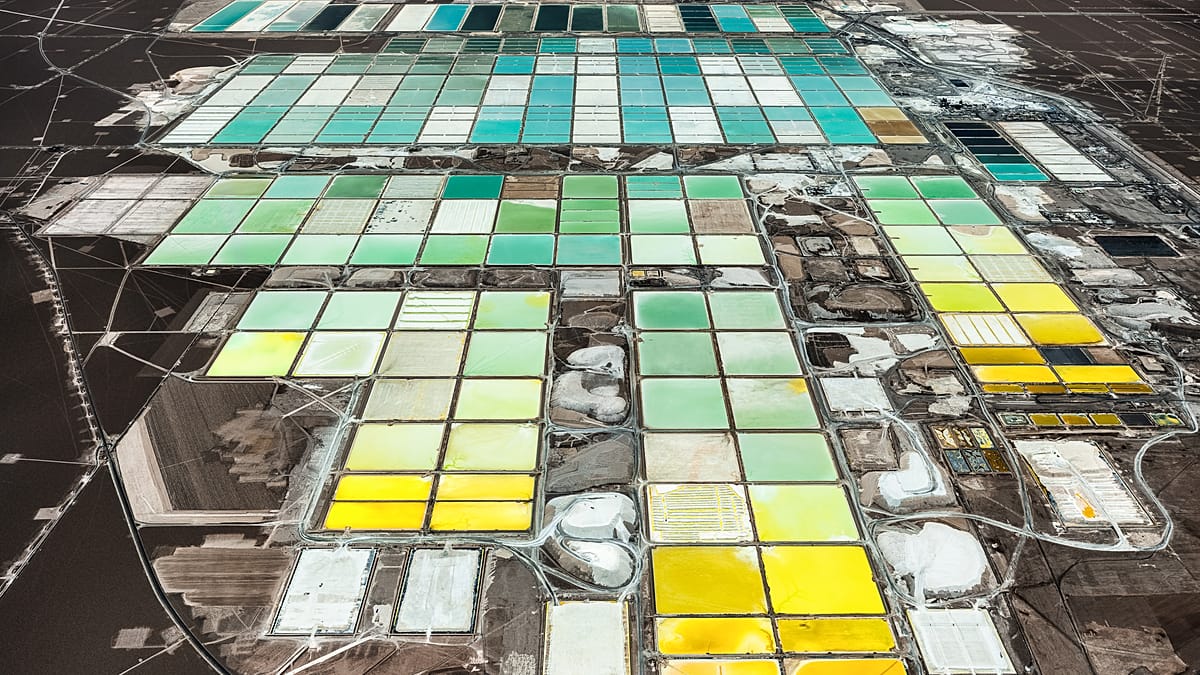
German aerial photographer Tom Hegen has spent years documenting this reality from the sky. His new book, The Mineral Age, brings together images from Chile's lithium-rich Atacama Desert, Indonesia's nickel-processing complexes in Sulawesi, and copper mines in the US and Spain. The goal, he says, is to close the gap between the products we buy and the places they come from.
“From the ground, you can’t really see much. They’re fenced off, and it’s such a huge area you don’t get the overview… When I’m up in the air, the entire landscape opens up,” Hegen told Euronews Earth in an exclusive interview.
Critical minerals: the backbone of clean tech
Critical minerals are essential for modern technologies, from electric vehicles (EVs) and batteries to wind turbines and defence systems. Lithium, nickel, cobalt and graphite are indispensable for EV batteries. Bolivia, Argentina and Chile – the so-called 'Lithium Triangle' – hold more than half of the world's known lithium reserves. Indonesia accounts for about 42% of recoverable nickel, while the Democratic Republic of Congo (DRC) is home to roughly half of global cobalt, with one in six children in mining communities there subjected to child labour.
Rare earths, a group of 17 chemically similar elements, are crucial for the powerful magnets in EV motors and wind turbine generators. China holds 50% of global rare earth reserves and controls 76% of processing. Copper, valued for its conductivity, carries electricity through wiring and chips.
Demand for these materials is soaring, driven not only by clean energy but also by AI data centres, consumer electronics and defence. The International Energy Agency (IEA) projects demand could nearly double by 2040, with lithium demand more than tripling. The '35-by-35' Global Electrification Pledge, debated at COP31, could push those numbers even higher. Benchmark Mineral Intelligence forecasts that at least 384 new mines will be needed by 2035 to meet EV and battery demand alone.
A 2022 study found that more than half of energy transition mining projects are on or near Indigenous peoples' lands. These regions are often also the most vulnerable to climate impacts, compounding risks for local communities.
‘Sacrificed for the rich’: the human cost
For those living near South America's lithium fields, the DRC's cobalt and copper mines, and Indonesia's nickel and tin operations, the dark side of our electric future is all too clear. On the sidelines of COP31, Indigenous leaders are sounding the alarm.
“They want to accelerate new technology and mining, but not at the speed of rights,” Edson Krenak, an advocacy coordinator at Indigenous-led nonprofit Cultural Survival, told Euronews Earth. “One of the doctrines created to lead this energy transition is called 'just transition', but it is not 'just' on the ground. We are seeing the rights of communities sacrificed, violated, for the rights of the rich… to have their so-called clean energy.”
Krenak's people, from Minas Gerais in Brazil, are still living with the aftermath of the 2015 Mariana and 2019 Brumadinho dam disasters, which killed hundreds and unleashed toxic sludge that continues to poison survivors. Now lithium mines are moving into the Jequitinhonha Valley, where communities report dust, water contamination and blasting near schools and villages. Krenak notes that impact assessments are often submitted by the mining companies themselves.
“The legacy is forever, because it usually takes 200, 300 years to recover the environment,” he says. Communities are rarely told that tailings dams, which store mining waste, must be managed indefinitely after operations end. Hegen's book documents these human-made landforms, from the US to Spain to Chile.
Europeans, who are among the largest consumers of these minerals, are largely shielded from these impacts. As the EU pushes for a competitive edge in electrification, the question of where the minerals come from becomes more urgent. Hegen's work is a stark reminder that the energy transition is not just a technological challenge, but a moral one.