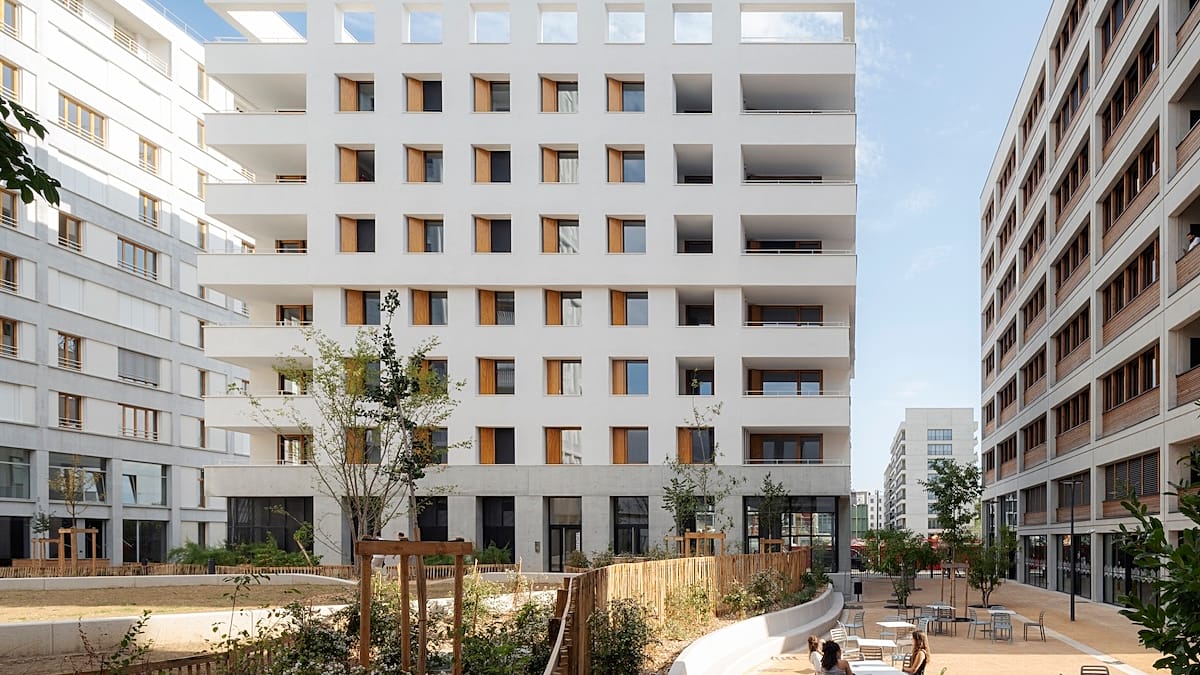
In Lyon's rapidly changing Confluence neighbourhood, a new seven-storey residential building stands out with its stark white, cubic form. But its most remarkable feature is invisible: the 23 apartments inside are designed to maintain a comfortable temperature year-round without any conventional heating or air conditioning.
French developer Nexity and Austrian architecture firm Baumschlager Eberle presented the project on Tuesday, billing it as a first for France. The building, named "22-26" after its target temperature range, aims to keep interiors between 20°C and 22°C in winter and 26°C to 28°C during summer heatwaves.
An Austrian concept adapted for France
The design was pioneered by Austrian architect Dietmar Eberle as a response to the twin challenges of energy costs and climate change. The key lies in the thermal inertia of the building materials. Anne Speicher, director of Baumschlager Eberle's agency, told French online media Vert that the materials were chosen for their "ability to store and release energy."
The building envelope is constructed from Monomur bricks—a hollow-core terracotta system—along with concrete and a lime render. Walls and floors are roughly twice as thick as the French average: 61 centimetres compared to around 30. Two layers of hollow bricks sandwich glass wool insulation, giving the building its chunky, almost brutalist appearance while also shielding interiors from direct sunlight through deep recesses.
An automated system of wooden slats, controlled by sensors monitoring temperature, humidity, air quality and weather, opens and closes to ventilate each apartment. Residents can also override the system manually. As required by French regulations, auxiliary heaters are installed, but they are designed to activate only during extreme weather or after a long period of vacancy.
Residents as radiators
The heavily insulated apartments capture heat generated by everyday activities—cooking, showering, even the warmth of the occupants themselves. "We are the heaters of the home—us and what we do," Cédric Hatat, programme manager at Nexity Auvergne Bourgogne, told BFM Business.
Nexity's CEO, Véronique Bédague, estimates that this approach will cut energy bills by 80%, saving each resident of a three-room apartment around €380 per year. The company also claims the building reduces energy consumption related to thermal comfort by 73% and carbon emissions by 65% over 50 years.
Each unit still includes a double-flow mechanical ventilation system, as mandated by French law. Nexity says connecting the building to the city's heating network raised construction costs by 15%.
Cost and scalability questions
Baumschlager Eberle has already built two similar "22-26" buildings in Switzerland and Germany, but this is the first in France. Its wider adoption, however, remains uncertain due to high construction costs. Renaud Payre, an ecologist metropolitan councillor at the Métropole de Lyon, told Vert: "This project cannot be replicated on a large scale. The cost of materials, the highly sophisticated home automation system on which it is based… The 22-26 is quite simply too complex to establish itself as a standard model for construction."
Payre sees the building as a "showcase for sustainable housing" that could encourage local supply chains, but he argues that renovating existing buildings remains the most effective way to improve energy performance. "Of course, you can pick up a few techniques or ideas here and there, but as things stand, you cannot turn a draughty building into an energy-efficient one using state-of-the-art, very expensive home automation systems," he said.
Despite the scepticism, Nexity is pressing ahead. A similar 22-26 project with 80 housing units is planned for La Garenne-Colombes, near Paris, with completion expected in 2028. That project will serve as a larger test of whether the concept can work beyond a single showcase.
The Lyon building is part of a broader trend in Europe towards passive and low-energy housing. While the 22-26 model may not become the standard, it offers a glimpse of what is technically possible. As France grapples with budget pressures and energy costs, innovations like this could inform future building codes. The concept also resonates with urban experiments elsewhere that use design to slash energy demand.
For now, the residents of Lyon's Confluence district will be the first in France to live without a thermostat—relying instead on thick walls, smart slats and their own body heat.