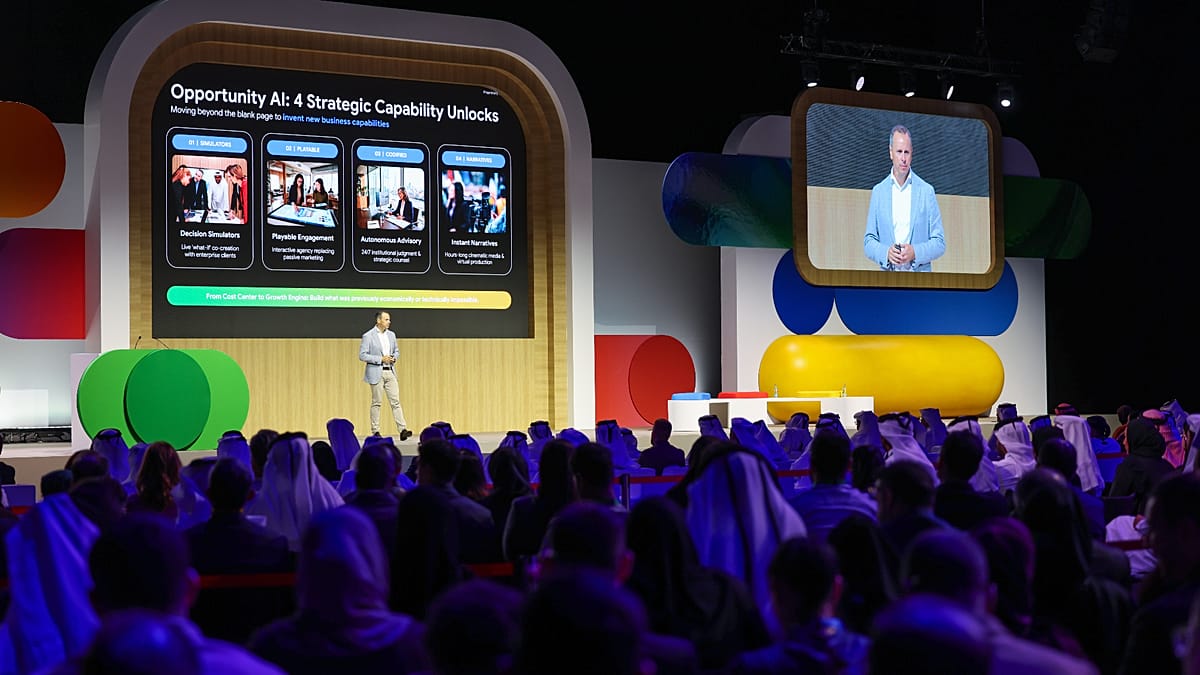
Artificial intelligence is entering a new phase. Instead of merely generating text, images, or answers, developers are now building systems that can act on a user's behalf—completing multi-step tasks without constant human input. This shift toward autonomous, or “agentic,” AI was the central theme at the Google Cloud Summit in Doha, where the company marked three years since opening its cloud infrastructure in Qatar.
Generative AI creates content in response to a prompt. AI agents go further, working through the steps needed to accomplish a goal. “Generative AI effectively is where you use AI through large language models to create net new content,” explained Alex Rutter, Managing Director of Google Cloud’s AI business across Europe, the Middle East, and Africa. “Agentic is much more focused... on the business process workflow,” he added.
From answering questions to carrying out tasks
Businesses are particularly interested in using AI agents for repetitive work that involves checking information across different systems. Rutter gave the example of invoice reconciliation, where an invoice must be verified against payment and supplier records before approval. “An agent is very well suited to that sort of highly repetitive database work, where it would drive a significant level of efficiency,” he said.
But as AI is allowed to do more on its own, the need for human oversight grows. Rutter said Google currently advocates keeping people involved in checking the results produced by AI agents. “We still always advocate to having at this stage a human in the loop to verify for the business the results they're looking at, but the humans are looking at the exception rather than the entire data stack,” he noted.
The level of oversight depends on the task and an organisation’s tolerance for risk. In fields like medicine, Rutter stressed that AI should support—not replace—a clinician’s decision-making. This cautious approach mirrors broader European debates about AI regulation, as seen in Brussels’ push for phased rollout of frontier models.
Qatar expands AI training and testing
Google Cloud used the Doha summit to announce a new national skilling programme with Qatar Digital Academy. The initiative aims to provide more than 50,000 learning opportunities in Qatar by 2030, targeting workers, executives, and developers. Ghassan Kosta, Regional General Manager for Google Cloud in Qatar, Oman, Bahrain, and Iraq, said the company is also expanding its services to support more advanced AI systems. “We are doubling down on our services to accommodate this agentic AI era,” Kosta told Euronews. “In our data centres, to cope with how the technology and how the AI is moving, you need also the right infrastructure in place.”
Another initiative unveiled at the summit is an innovation lab developed by Qatar’s Ministry of Communications and Information Technology (MCIT) in partnership with Google Cloud. Amna Al-Kaabi, Head of Emerging Technologies at the ministry, said the lab would allow AI projects to be tested before deployment. “The core value of this partnership lies in linking technology experimentation within the lab to real sector needs,” she said, adding that the goal is to help projects move “from proof-of-concept stage to sustainable real-world implementations.”
These developments come as cloud providers face growing scrutiny over their environmental footprint. In Europe, for instance, an Austrian town has pushed back against a Google data centre over water use and transparency—a reminder that infrastructure expansion is not without local friction.
What happens to the workforce?
The ability to hand more work to AI inevitably raises questions about jobs. Rutter cautioned that predicting those changes remains difficult, but he expects managing AI agents to become part of some people’s roles. “I think what is very real is we're going to have non-people managers, we'll then have agent managers, and then we'll have people that manage people and agents together,” he said.
That could mean some workers eventually supervising AI agents as part of their daily duties. But Rutter acknowledged it is hard to predict how quickly that might happen. For now, companies are still figuring out where AI agents are useful and how much human oversight they need.
As AI becomes more autonomous, the conversation is shifting from what machines can do to how humans should supervise them. The balance between efficiency and accountability will define the next phase of AI—not just in Doha, but across Europe and beyond.