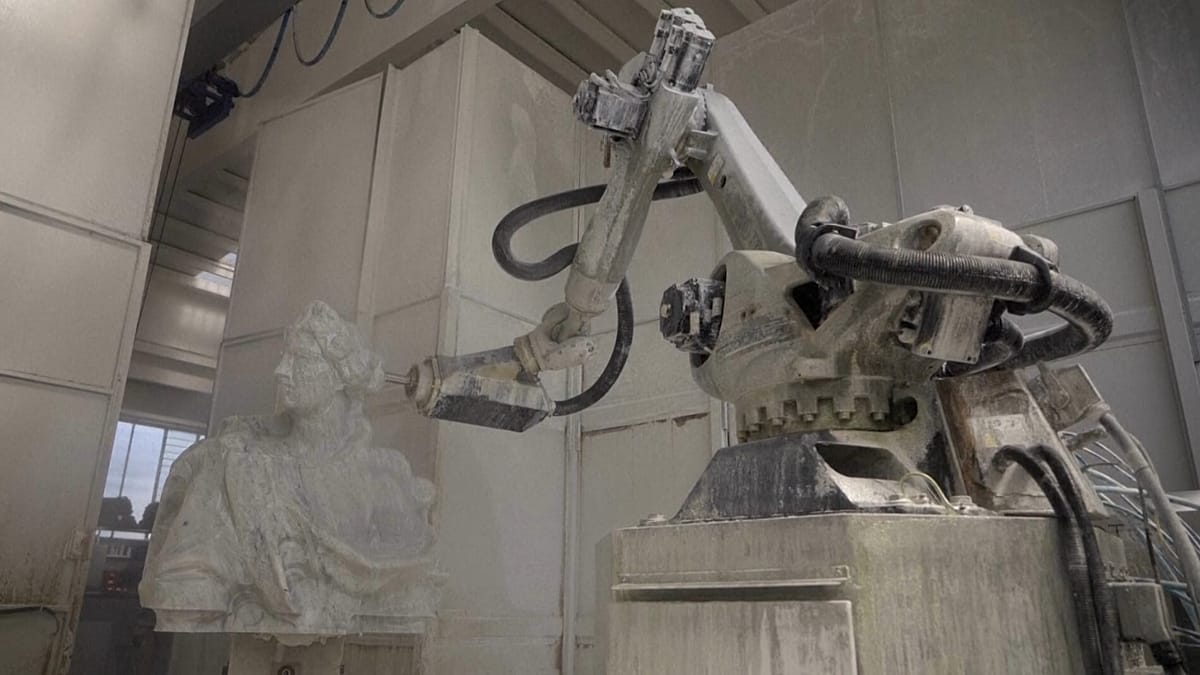
In the quarries of Carrara, where Michelangelo once selected blocks for his David, a new kind of sculptor is taking shape. Robotic arms, guided by algorithms, now carve intricate forms from marble with a precision that would have been unthinkable a generation ago. The technology, developed by Italian companies LITIX and ROBOTOR, is transforming a craft that has defined this Tuscan town for centuries.
The process begins with a digital image, converted into a 3D file. Software then generates the toolpaths that guide the robot's movements. The machine can execute up to 99% of the carving, leaving skilled artisans to refine the final details. Giacomo Massari, founder and CEO of both companies, argues that this does not eliminate jobs but evolves them. "You're not killing a job, you're just evolving that job," he says. "The goal is to be able to create something out of your idea, even if you don't have the skill to do that."
A changing role for sculptors
Not everyone in Carrara welcomes the machines. Traditional sculptors, who have spent years mastering the chisel and mallet, view the robots with unease. Some fear that the physical mastery of stone, honed over a lifetime, will become obsolete. Massari counters that the technology makes the craft safer and less physically demanding, allowing artisans to focus on the creative finishing touches.
The debate, however, extends beyond employment. As machines translate digital concepts directly into physical objects, artists are forced to reconsider what constitutes the creative act. If a robot carves the marble, is the artist the one who conceived the design, or the one who programmed the machine? Or is the machine itself an author?
Italian artist Davide Quayola, who works with algorithms and robotic machines, offers a nuanced perspective. He describes the robot not as an independent creator but as an extension of his own artistic gesture. "I am actually feeling that I'm completely in control," he says. Quayola calls his method "algorithmic sculpting," a process in which he and his studio program the machine's every movement. The machine performs the physical work, but the artist decides how it operates and what the finished work is intended to become.
This distinction is crucial for Quayola. The robot is a tool, albeit a sophisticated one, much like a brush or a chisel. The artistry lies in the conception, the programming, and the vision—not in the mechanical execution. This view challenges the romantic notion of the sculptor as a solitary figure battling the stone, replacing it with a collaborative process between human and machine.
Carrara's white marble has been a medium for some of history's most celebrated sculptors, from Canova to Bernini. The quarries themselves are a testament to centuries of human labor and ingenuity. Now, the same material is being shaped by technology that earlier generations could not have imagined. The change does not necessarily spell the end of traditional craftsmanship. Instead, the role of the sculptor is shifting from physically removing stone to designing, programming, and refining the final work.
This evolution is part of a broader trend across Europe, where automation and artificial intelligence are reshaping industries from space exploration to defence. The question of whether a robot can create art is not merely academic; it speaks to the very nature of creativity and the role of human intention in an increasingly automated world.
For now, the robots in Carrara are not replacing the human touch entirely. They are augmenting it, offering new possibilities for expression. As Massari puts it, the technology makes marble sculpture more accessible, allowing anyone with an idea to see it realized in stone. Whether that is art or craft, or something in between, remains an open question—one that will be answered not by machines, but by the artists and audiences who engage with the work.