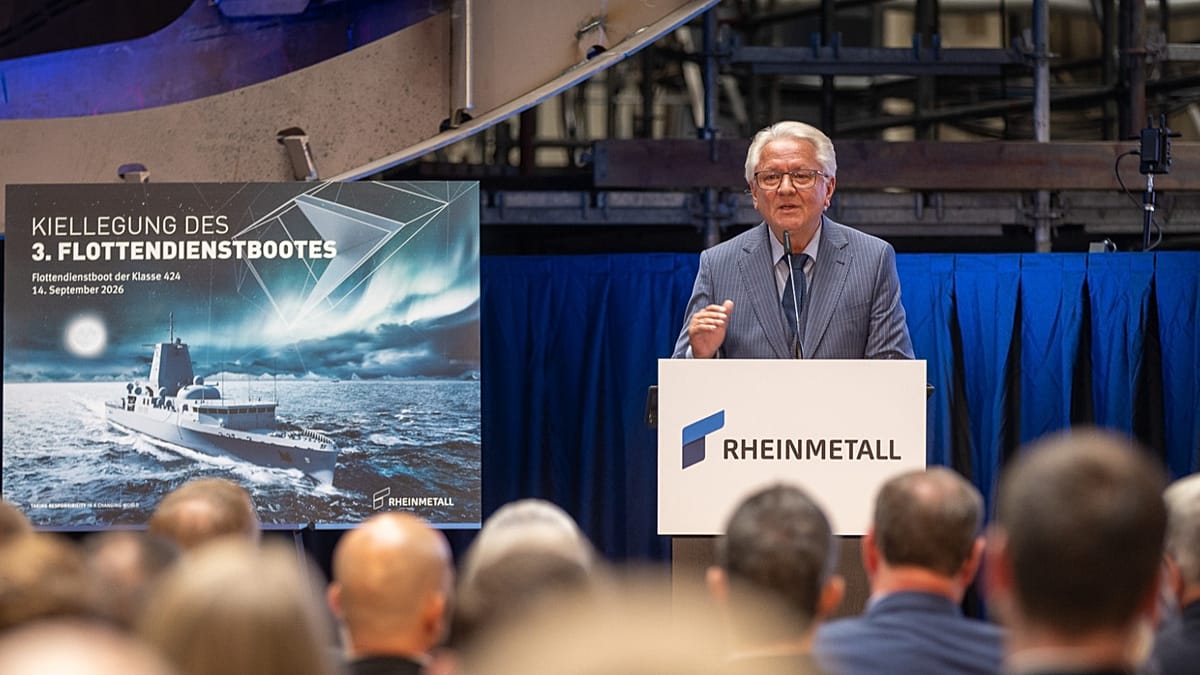
Germany's defence industry is undergoing its most significant transformation since the Cold War, and Rheinmetall chief executive Armin Papperger is at the centre of it. In an interview at the keel-laying ceremony for the third class 424 fleet service vessel in Wolgast, the Düsseldorf-based company's boss laid out a vision that goes far beyond simply refilling empty ammunition stocks.
Papperger acknowledged that missile production cannot be accelerated overnight. "You simply cannot produce missiles that quickly," he said, pointing to a major investment programme not just at Rheinmetall but across the sector. The bottlenecks are acute: rocket motors and warheads are in short supply, and Europe and NATO need to rebuild their inventories to credible levels if the continent is to deter further aggression.
Skyranger: a multi-layered answer to aerial threats
One of the flagship systems is the Skyranger, a mobile air-defence platform designed to counter everything from small drones to supersonic missiles. Papperger confirmed that series deliveries are due to start in 2027, with only minor delays so far. "We are massively ramping up Skyranger capacity," he said. "From the end of next year we will build, or be able to build, up to 400 a year."
The system's versatility is key. It can shoot down a missile flying at Mach 3, something neither interceptor missiles nor simpler gun systems can do reliably. The German Army's Inspector has warned that the threat landscape will look completely different in two years, and Papperger argues that a sustainable, multi-capability solution is the only sensible answer. For lighter threats, Rheinmetall also offers .50-calibre guns that can take out category 1 drones, though jet-powered drones remain a challenge.
Deep strike and joint ventures
On long-range precision strikes, Rheinmetall is finalising two joint ventures: one with Lockheed Martin for artillery rockets, and another with Destinus for cruise missiles. Both are in the final stages before signing, and Papperger expects the first cruise missile order by the end of this year or early next. These systems are part of a broader push to give European forces the ability to strike deep behind enemy lines, a capability that has been neglected for decades.
Jobs and industrial scale
Rheinmetall is also a major employer. Excluding civilian operations, the company currently has around 34,000 staff, growing by roughly 10,000 net per year. The target is 70,000 by 2030, with a supply chain employing another 210,000 people. "If you add that up, it's almost 300,000 people," Papperger said. "That is a jobs engine."
The scale-up in ammunition is already visible. Medium-calibre production has risen from under one million to four million rounds; artillery output has jumped from 70,000 to 1.5 million rounds; tank ammunition is now at 240,000 rounds, up from around 50,000. The company is also doubling its production of logistical and tactical vehicles. Rheinmetall's six-year investment programme is worth €30 billion, and Papperger stressed that the presence of Defence Minister Boris Pistorius at the Wolgast ceremony was a signal that the federal government is committed to using this capacity sustainably.
Robots, space, and the future mix
Looking further ahead, Papperger is unequivocal: "Robots will come, that is absolutely clear." Rheinmetall has a research centre in Bremen focused on humanoid robots, though no series-production products are ready yet. The company is also investing heavily in space, both in satellite construction and in processing the communications data those satellites provide. Drones, he said, will remain a core part of the arsenal.
For combined-arms combat, Papperger argues that a mix of artillery, armoured vehicles, conventional ammunition, drones, and missiles is essential. The question is not whether to have these capabilities, but in what proportions. "The quantities in the individual areas will shift," he said, as threats evolve and new technologies mature.
This industrial push comes as Europe faces a security environment that has changed dramatically since Russia's full-scale invasion of Ukraine. The EU is preparing a multibillion-euro package for Ukraine's air defence as Patriot stocks dwindle, and Rheinmetall's expansion is part of a broader continental effort to rebuild deterrence. The company's focus on robotics and space also echoes developments seen at trade fairs like IFA, where humanoid robots have been stealing the show.
For Papperger, the message is clear: Europe must be ready for a future where robots, space systems, and precision munitions are as important as tanks and howitzers. The investment is massive, but so is the threat.