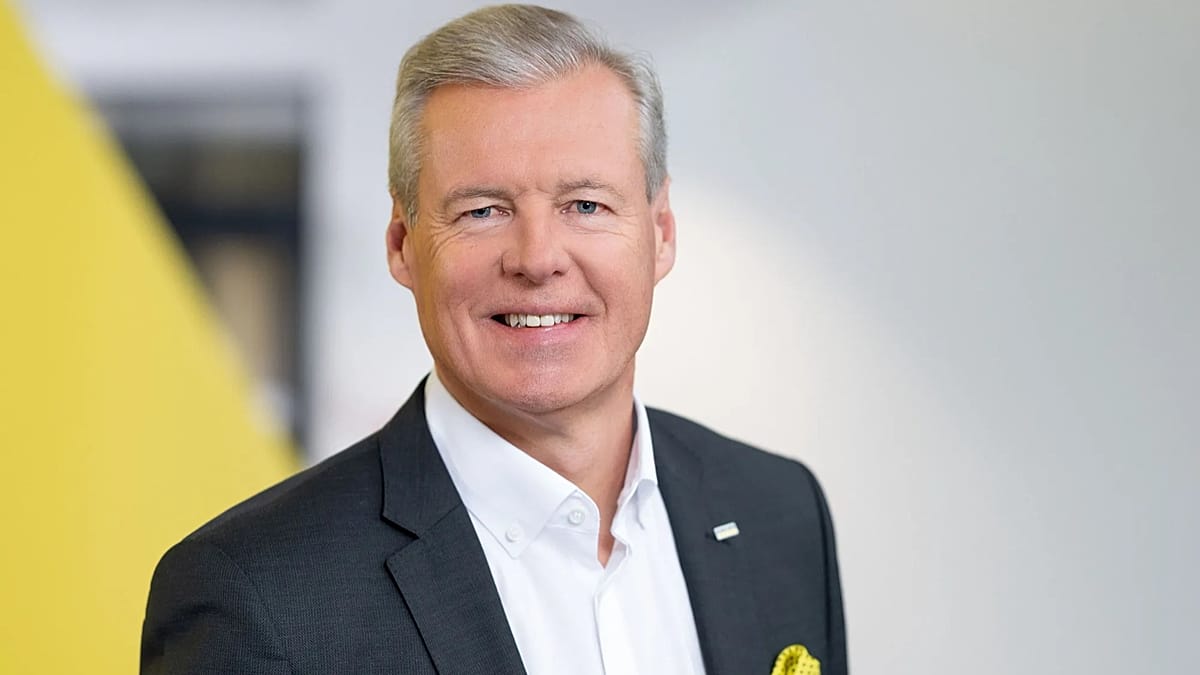
Hartmut Jenner, the chief executive of the German cleaning-equipment maker Kärcher, has issued a stark warning about the economic trajectory of Germany and the wider European continent. In an opinion piece written for Euronews, Jenner described the current situation as a “perfect storm” that threatens to push Europe into deindustrialisation.
“Geopolitical crises are casting a shadow over the European economy,” he wrote. “The unpredictable trade policy of the U.S. keeps threatening, without warning, to raise tariffs and erect trade barriers – a toxic scenario for free global trade and export-oriented companies.”
Jenner, who has led Kärcher since 2001 and has tripled both its workforce and turnover during his tenure, pointed to two major external pressures. The first is the erratic trade stance of the United States, which he says undermines the rules-based trading system. The second is China’s rapid technological ascent.
“China is no longer merely a low-cost manufacturer but has become a highly aggressive technological competitor that, with its tremendous speed, threatens to outpace key European industries in future-oriented fields,” Jenner argued. He attributed China’s success to a deliberate state industrial policy, including massive subsidies in strategic sectors and a currency policy “artificially focused on competitiveness.” These measures, he said, create “noticeable market distortions and overcapacity,” making fair global competition “almost impossible” for privately owned companies like Kärcher.
Deindustrialisation is already happening
Jenner, 61, is blunt about the state of Germany’s industrial base. “The loss of tens of thousands of industrial jobs and the decline in production volume show that deindustrialisation is not an abstract threat – it is happening right now,” he said. He pointed to ongoing plant closures and production relocations in key sectors such as automotive and manufacturing as evidence that the country is at a “critical turning point.”
Kärcher, headquartered in Winnenden in Baden-Württemberg, has so far weathered the storm. The company invests heavily in research and development, with more than 1,000 employees worldwide working on cleaning robots, battery technologies, and digitalisation. Founded in 1935, Kärcher generated nearly €3.5 billion in turnover in 2025, 86% of it abroad. The family-owned firm operates in 87 countries and employs 17,000 people globally.
Yet even “innovation leaders” like Kärcher cannot escape the deteriorating business environment. Jenner noted that sharply rising structural and labour costs are making new production facilities and additional jobs in Germany and Europe barely economically viable. He is therefore taking the German government to task.
While forecasts of 1.3% economic growth in Germany are “cautiously optimistic,” Jenner warned against complacency. He dismissed the projected expansion as “borrowed growth,” artificially driven by government debt, defence orders, and subsidies. “A short-term boost fueled by debt is no substitute for a real, self-sustaining recovery in private investments,” he wrote.
Jenner traced the root of the problem to domestic policy failures. “The causes of the ongoing weakness are largely homegrown: a creeping reform fatigue and a regulatory frenzy on the part of government institutions that hinders rather than facilitates investment,” he said. “Instead of promoting entrepreneurship, regulations from Brussels to Berlin are suffocating the courage to embrace change.”
His own biography reflects a belief in hard work. Growing up on his parents’ farm in Winnenden, he studied business administration and engineering while continuing to work the land. “Success doesn’t just fall from the sky; for me, it consists of 97% hard work and dedication, 2% talent, and 1% luck,” he said. His conclusion is stark: “If we want to secure our prosperity and our social standards, we must once again recognize that value creation is the precondition for prosperity – and not the other way around. If you rest, you rust – that applies to people just as much as it does to economies.”
To counter the drift, Jenner is calling for “a real fitness programme for Germany.” He wants to see a drastic reduction in bureaucracy, incentives for people to work longer hours, and a firm EU trade policy that defends European interests against both the United States and China. He argues that excessive red tape, high energy costs, and steadily rising non-wage labour costs are “poison” for Germany as a business location.
Jenner’s warnings come at a time when other European leaders are also grappling with similar challenges. The EU has been trying to bolster its economic resilience, but progress has been slow. As Germany and Japan deepen their economic-security ties, the need for a coherent European strategy becomes more pressing. Jenner’s message is clear: without decisive reform, Europe risks falling behind in the global race for innovation and competitiveness.