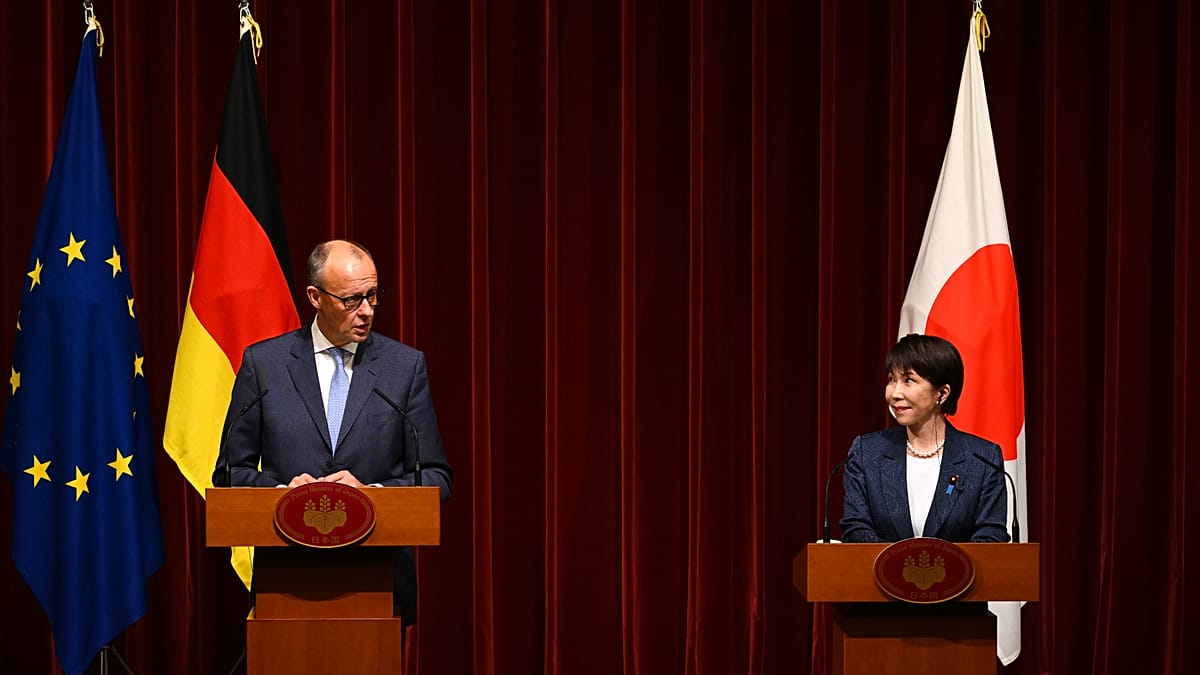
German Chancellor Friedrich Merz and Japanese Prime Minister Sanae Takaichi met in Tokyo on Wednesday, agreeing to intensify cooperation on economic security and advanced technologies. The meeting, Merz's first in Japan since taking office in May 2025, produced a joint statement that, while not naming Beijing or Washington, clearly targeted the growing use of trade restrictions as a geopolitical weapon.
“Both heads of state and government expressed their deep concern about the growing use of economic coercion, for example through arbitrary export restrictions and retaliatory measures affecting critical raw materials,” the statement read. “They also rejected non-market-based measures and practices that lead to overcapacity and market distortions and thereby undermine our economic security and resilience.”
The two countries plan to step up monitoring and assessment of supply chains to prevent economic dependencies from being exploited as leverage. They also agreed to explore closer collaboration in sectors such as critical raw materials, semiconductors, batteries, electric vehicles, industrial AI, robotics, pharmaceuticals, and wind power.
Rare earths and strategic minerals
On critical minerals, Merz and Takaichi welcomed a joint declaration of intent to broaden supply sources and improve the substitutability of rare earths in their automotive industries. Japan has faced supply bottlenecks after China restricted exports of several key materials. In November, Takaichi told Japan's parliament that Tokyo could intervene militarily in a crisis over Taiwan, a claim Beijing rejects as interference in its internal affairs.
Germany, for its part, is bound by EU targets to source no more than 65% of critical raw materials from China by 2030. But as Merz's Asia trip underscores, diversification away from Beijing remains at an early stage.
The two leaders also agreed to establish a high-level dialogue on artificial intelligence and to deepen cooperation against cyberattacks. AI-driven cybercrime is rising sharply in Japan, making this a priority for Takaichi's government.
In their joint statement, Merz and Takaichi voiced concern about the situation in the East and South China Seas, rejecting unilateral attempts to change the status quo by force or coercion. They stressed the importance of peace and stability in the Taiwan Strait and called for a peaceful resolution of cross-strait differences.
Shared values, shared challenges
Amid rising geopolitical tensions, Germany and Japan reaffirmed their commitment to freedom, democracy, fair trade, the rule of law, and human rights. Military cooperation in the Indo-Pacific is also set to expand. This year, German forces took part for the first time in the Japanese-American exercise “Keen Sword,” which runs until Thursday in waters and airspace around Okinawa, where China has intensified military activity.
Speaking at an economic forum in Tokyo on Wednesday morning, Merz called for a new political alliance to strengthen rules-based global trade. Such an alliance, he said, would defend and develop trade based on international agreements, “provide political impetus, and also respond jointly when the rules-based order comes under threat.”
Germany plans to invest €2 billion in AI and high-tech by 2029, while Japan aims for around €18 billion in private investment in these areas by 2040. During his visit, Merz toured the start-up Kyoto Fusioneering, a flagship of German-Japanese high-tech collaboration with Siemens Energy, focused on generating electricity from nuclear fusion.
Japan is heavily subsidising its semiconductor industry, a strategic priority. Germany, meanwhile, is still in the early stages of diversifying its partners, a goal that is central to Merz's Asia agenda. The two economies, both heavily reliant on exports and vulnerable to supply-chain disruptions, see in each other reliable partners in an increasingly fragmented global order.