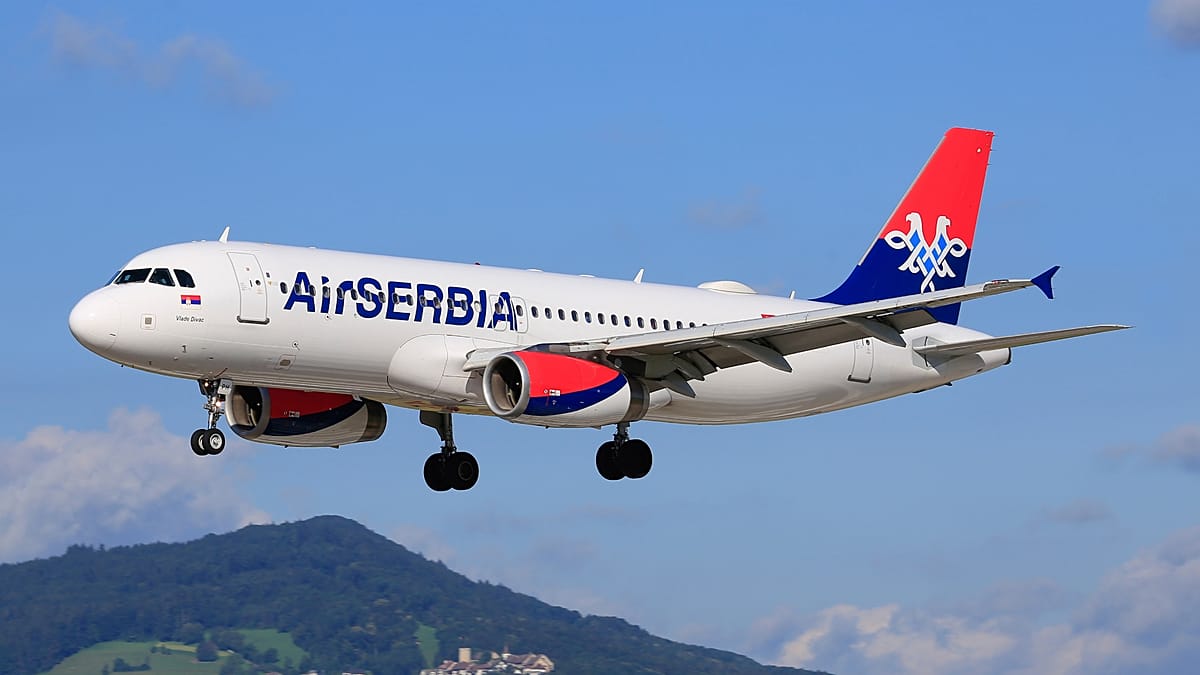
Flying between Baku and Belgrade on Air Serbia’s new direct service feels like discovering a corridor still finding its rhythm. The cabin is noticeably less crowded than the well-worn paths through Istanbul or Doha, and passengers boarding in Azerbaijan’s capital seem aware they are part of a quieter but increasingly significant link.
Since launching earlier this year, the route has begun to bridge two regions that, despite growing political and economic ties, have long been awkwardly connected for travelers. For years, moving between the Caucasus and the Balkans meant navigating long layovers or indirect flights. Air Serbia’s direct connection changes that calculus.
“Launching the Baku-Belgrade route represents a natural step in expanding Air Serbia’s network toward fast-growing and strategically important markets,” says Jiří Marek, the airline’s CEO. “Azerbaijan is a dynamic economy with increasing outbound travel demand, and we identified a clear opportunity to strengthen connectivity between the Western Balkans and the Caucasus region.”
Onboard: A Mix of Passengers and a Calm Atmosphere
The passenger mix tells the story. Business travelers heading to meetings in Belgrade sit alongside Serbian tourists exploring Azerbaijan, while others use the Serbian capital as a transfer point deeper into Europe. The flight feels less like a traditional tourist route and more like a corridor gradually defining its purpose.
“We are seeing a very diverse mix of passengers on the Belgrade-Baku route,” explains Selena Naumović, Manager Cabin Crew Operations and Training at Air Serbia. “There are leisure travellers eager to discover new destinations, business travellers strengthening ties between Serbia and Azerbaijan, as well as passengers connecting through Belgrade to other European cities within Air Serbia’s network.”
Air Serbia occupies an unusual space in European aviation. It carries some of the familiarity of a traditional national carrier while maintaining a more relaxed, approachable atmosphere than many larger airlines. On the Baku route, this translates into an onboard experience that feels practical, calm, and noticeably unhurried.
“Our goal is to make every journey comfortable, welcoming and authentically Serbian,” says Naumović. “From the moment passengers step on board, our cabin crew is dedicated to providing attentive service, genuine hospitality and a memorable travel experience.”
The flight itself is manageable—within a few hours, the landscape shifts from the shores of the Caspian to the rivers and plains surrounding Belgrade. For travelers accustomed to exhausting layovers, the simplicity of the direct connection quickly becomes its greatest luxury.
Cabin service remains straightforward but personable. There is a distinct Balkan style of hospitality onboard: less polished than some Western European airlines, but warmer and more conversational. Crew interactions feel human rather than scripted, which is increasingly rare in modern short-haul travel.
Mesut Geçgel, originally from Türkiye and living in Azerbaijan, took the flight for the first time. “The crew was professional but still genuinely warm,” he says. “The flight felt comfortable and well organised, and everything ran with a calm, premium vibe that’s becoming rare these days. You can really feel the balance between Balkan hospitality and modern service quality.”
Belgrade’s Growing Role as a Regional Hub
The route also underscores Belgrade’s quiet expansion as a regional aviation hub. Over the past few years, the Serbian capital has extended its reach across Eastern Europe, the Balkans, and parts of the Middle East. For Azerbaijani passengers, it offers convenient connections, shorter transfer times, and access to a broad network of destinations served by Air Serbia.
“Belgrade is increasingly becoming a competitive and efficient hub for passengers travelling between Southeast Europe, Western Europe, and beyond,” says Marek. Recently, Air Serbia signed a codeshare agreement with Azerbaijan Airlines, further strengthening connectivity between the two countries.
Arrival into Belgrade Nikola Tesla Airport reinforces the sense of efficiency. The airport remains compact enough to move through quickly, and within a short drive, passengers enter a city that has become one of southeastern Europe’s more energetic urban destinations. For first-time visitors, Naumović recommends exploring Kalemegdan Fortress and the lively pedestrian avenue of Knez Mihailova Street before experiencing the traditional restaurants and music of Skadarlija. “What makes Belgrade particularly special is the contrast between its historical heritage and contemporary development,” she says.
The route works in both directions. Azerbaijan remains relatively unfamiliar to many Balkan travelers, despite offering a blend of futuristic architecture, mountain landscapes, and Silk Road heritage. For travelers arriving in Baku, Naumović highlights the contrast between the city’s old and new quarters.
This direct connection also fits into broader trends in European connectivity. As the EU considers enlargement momentum in the Western Balkans, improved transport links between the region and the Caucasus could support deeper economic integration. The route offers a practical alternative to the crowded hubs of Western Europe, and for now, it remains a corridor with room to grow.