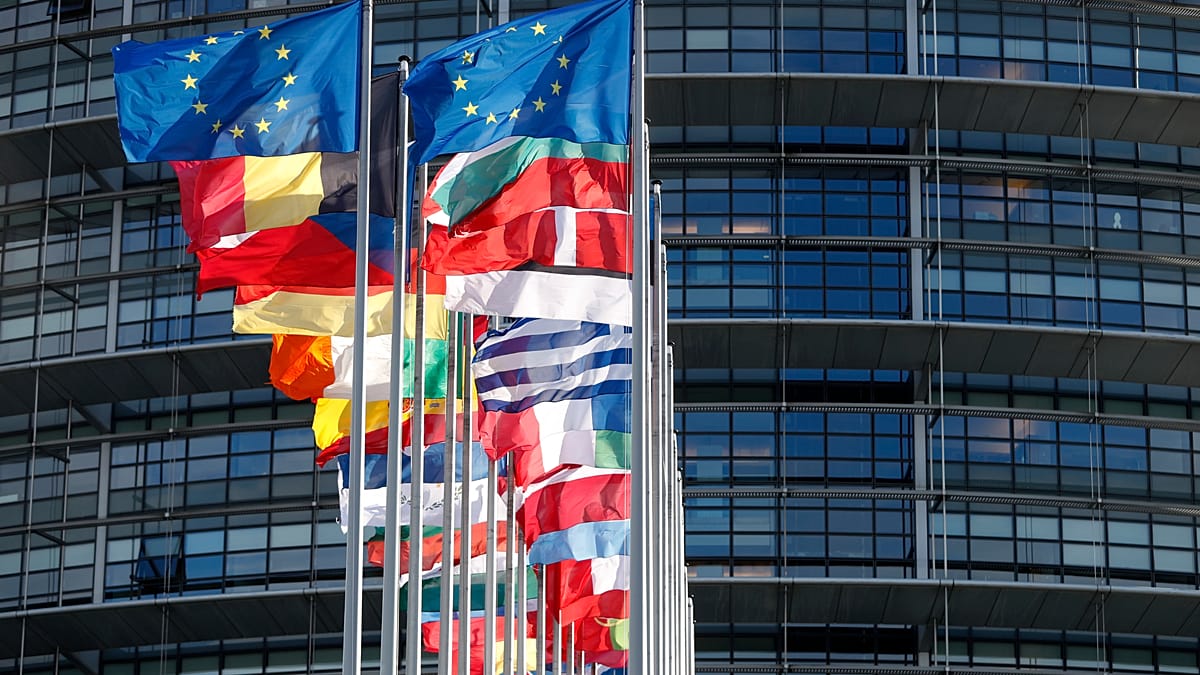
Dozens of European heads of state and institutional leaders are converging on the Montenegrin coastal town of Tivat today for a bi-annual summit with the six Western Balkan nations. The meeting, hosted by European Council President António Costa, is designed to inject fresh momentum into the long-stalled enlargement process. In an exclusive interview with Euronews, Costa expressed optimism, noting that Montenegro — widely seen as a frontrunner alongside Albania — demonstrates that membership is achievable with sustained reforms.
“Montenegro shows that effectively it's possible to move forward on this enlargement, that the member states want this enlargement and the candidate states want to and can effectively make the necessary reforms to enter in the European Union,” Costa said, speaking against a backdrop of yachts and the Adriatic Sea.
The summit follows a five-day tour by Costa through all six Western Balkan partners: Bosnia and Herzegovina, Albania, North Macedonia, Kosovo, Serbia, and finally Montenegro. The host country has set an ambitious target of joining the EU by 2028, billing itself as the bloc’s 28th member state. Yet the path is uneven. Albanian Prime Minister Edi Rama has drawn criticism for approving a Trump-linked resort on a fragile stretch of coastline. Serbian President Aleksandar Vučić continues to defend close ties with Beijing while publicly chiding Brussels, raising questions about Belgrade’s alignment with EU security frameworks. Serbia also faces scrutiny over judicial independence, media freedom, and a crackdown on protests.
Hungary’s Veto Lifted, Ukraine’s Path Clears
Eighteen hundred kilometres north, in Brussels, a significant breakthrough occurred on Wednesday. Hungary’s new government under Prime Minister Péter Magyar lifted its veto on Ukraine’s accession process. The decision followed a comprehensive agreement on the rights of the Hungarian minority in Ukraine, which Magyar announced via a Facebook video. “We have reached a comprehensive agreement with Ukraine on the expansion of the linguistic, educational, cultural and political rights of the 100,000-strong Hungarian minority,” he said.
Ukraine submitted its EU membership bid in 2022, shortly after Russia’s full-scale invasion, and sees accession as a strategic bulwark against ongoing aggression. The opening of negotiations had been repeatedly blocked by former Hungarian Prime Minister Viktor Orbán. The shift in Budapest’s stance has been welcomed across the bloc. “All Brussels was waiting for this,” one diplomat told Euronews. “It's unbelievable. It's good news.”
Costa noted that the delay did not go to waste: “Fortunately, we didn't lose time during this period because the Commission and Ukrainian authorities started last year, these negotiations.” For a deeper look at how the diplomatic logjam finally broke, read our exclusive report: Costa Exclusive: EU Enlargement Debate Intensifies at Western Balkans Summit in Montenegro.
Trade Chief Balances Washington and Beijing
While enlargement dominates the agenda in Montenegro, EU Trade Commissioner Maroš Šefčovič is navigating a different kind of negotiation in Brussels and Paris. On Friday, he will deliver a keynote speech at the Brussels Economic Security Forum, focusing on mobilising Europe’s economic strength for security. The address comes a day after he met with US Trade Representative Ambassador Greer at the OECD conference in Paris, where both sides reaffirmed a “shared” commitment to “keep moving forward in good faith”.
That diplomatic language masks growing friction. On Tuesday, US President Donald Trump proposed additional tariffs of 10% or 12.5% on imports from 60 economies, including the EU — a move the European Commission swiftly denounced. Šefčovič also met with Chinese trade envoy Li Chenggang in Paris, where he described the EU’s trade deficit with China as “unsustainable”. In the first quarter of 2026, the Commission estimates that deficit reached €98 billion, approaching the record €107 billion set in 2022.
Lithuanian Foreign Minister Kęstutis Budrys warned that China’s dominance of critical raw material supply chains is compounding Europe’s defensive challenges. “China's dominance of critical raw material supply chains and its willingness to weaponise them already restricts our defence industry,” he told Euronews. The EU’s balancing act between Washington and Beijing is becoming increasingly precarious, as the bloc seeks to protect its economic interests without alienating either superpower.
For more on the shifting geopolitical landscape, see our analysis: Belgian Poll: US Seen as Bigger Threat Than China for First Time.



