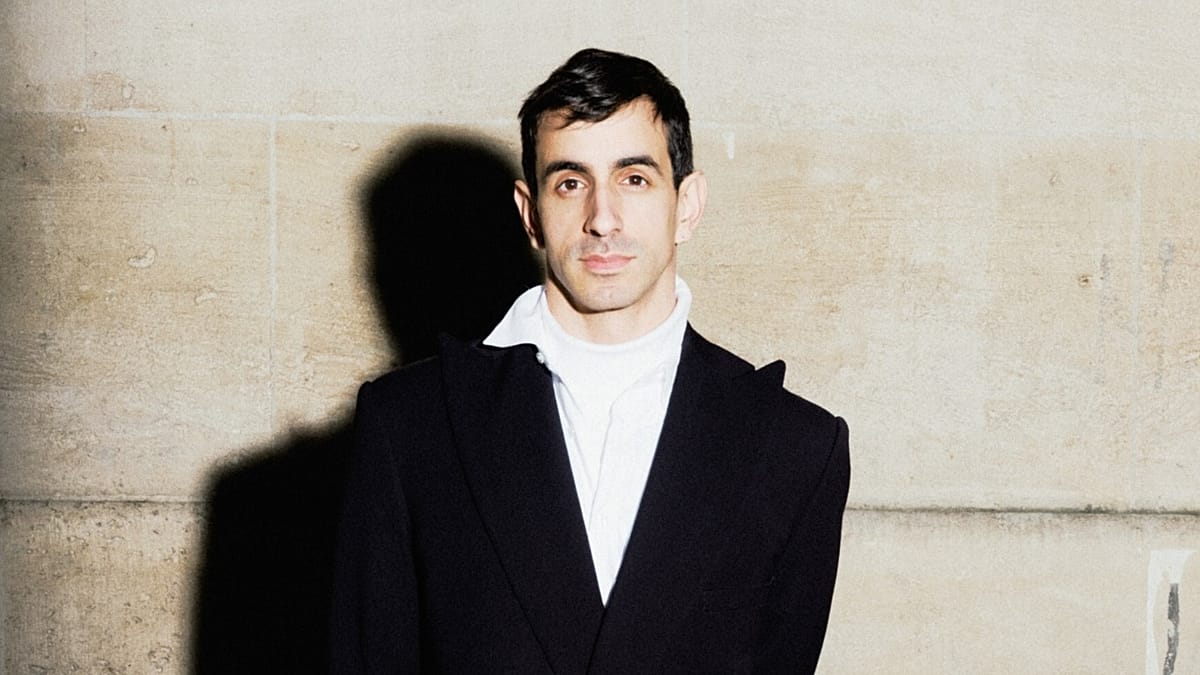
Among the most anticipated debuts at this year's Paris Fashion Week is a name still unfamiliar to many: Steven Passaro. The French-Portuguese designer has already earned recognition from LVMH, the Fédération de la Haute Couture et de la Mode, and the French Ministry of Culture. A graduate of the Duperré School of Applied Arts in Paris and the University of the Arts London, Passaro refined his skills at Hermès, Loewe and Christian Dior before launching his own label.
In an exclusive interview, Passaro discussed his creative process, the role of technology in his work, and the broader challenges facing the fashion industry.
From architecture to fashion
Passaro originally studied architecture, a background that continues to shape his designs. “Architecture was kind of my first love,” he said. “I really developed my mindset around visualising 3D thanks to the constructions we do in architecture. It was natural to keep the skills of what I've been learning in architecture and translate them into fashion.”
His collections are known for strong, structured silhouettes and rigid forms. Passaro explains this as a deliberate dialogue between Western and Eastern approaches to dressing the body. “In the West, they cut fabric to shape a body, and in the East, they have more of this approach to wrap the body with fabric. I really wanted to have this conversation in duality in the silhouette design.” The architectural training, he says, allows him to create tension between sculptural strength and fluidity.
Digital-first, but not AI-first
Passaro’s design process differs from many traditional fashion houses. He relies heavily on digital 3D modelling before creating physical prototypes. “At the London College of Fashion, we had a Department for Technology in Fashion, where you can learn about all this technology around the industry, and what people will use in the future,” he recalled. “I came across the software and it was like, ‘Oh, that feels like what I was doing in architecture, but for fashion.’”
The efficiency gains are significant. “I can make a pattern in two hours compared to by hand, when it takes me two to three days, or even more.” But Passaro is clear that technology serves craft, not replaces it. “I like the craftsmanship a lot, so to me it was like, ‘Okay, I'm going to save time on the pattern, to be only digital, and then have the time and the resources for the craft.’”
He is equally emphatic about not replacing human models with artificial intelligence. “I do not want to replace models with AI,” he stated. “When you do couture and bespoke tailoring, you need time, and be hands on the machine and fabric.”
Sustainability through precision
Innovation and sustainability are central to Passaro’s approach. By using Style3D software, he reduces waste through virtual sampling and pattern cutting on digital avatars. “The entire phase of product development is thought with this idea in mind of how we can do less harm to the environment,” he said. Fabrics are sourced in Europe, often from LVMH suppliers.
Passaro’s collections follow a continuous narrative. The Spring-Summer 2026 collection, Moonlit Lover, explored toxic love and secret obsessions. The Fall-Winter 2026 collection, Ethereal Shift, dealt with personal transformation. His most recent presentation, which he calls “the glimpse,” captures a moment of hesitation before stepping into something new. “It's the feeling I have towards the world right now, with all the political aspects, where there's a very good thing happening in the world, but also a very bad thing. It's this in-between tension of ‘I want to, but I'm afraid to.’”
Critique of ultra-fast fashion
Passaro also weighed in on the controversy surrounding ultra-fast fashion brands entering traditional retail spaces. In 2025, Shein opened a pop-up inside BHV in Paris, a move that sparked public backlash and was later described by BHV as a “strategic mistake.” Passaro argues that the problem is partly a lack of consumer education. “People don't know how to consume actually good,” he said. “If you buy a t-shirt for €3, which I don't even know how it's possible to make as even the fabric does not cost this price per metre, after three washes it's going to be dead. If you buy a t-shirt for maybe €15–20, you're going to have, perhaps, 10–20 washes, so it's going to be cheaper in the long run.”
He sees his own work as part of a broader push for quality and longevity. “There is a lot of education that has to be done today for the consumer,” he added.
Passaro’s approach — blending digital precision with hands-on craftsmanship — offers a model for how European fashion can innovate without losing its soul. As he prepares for his next show, the industry will be watching closely.