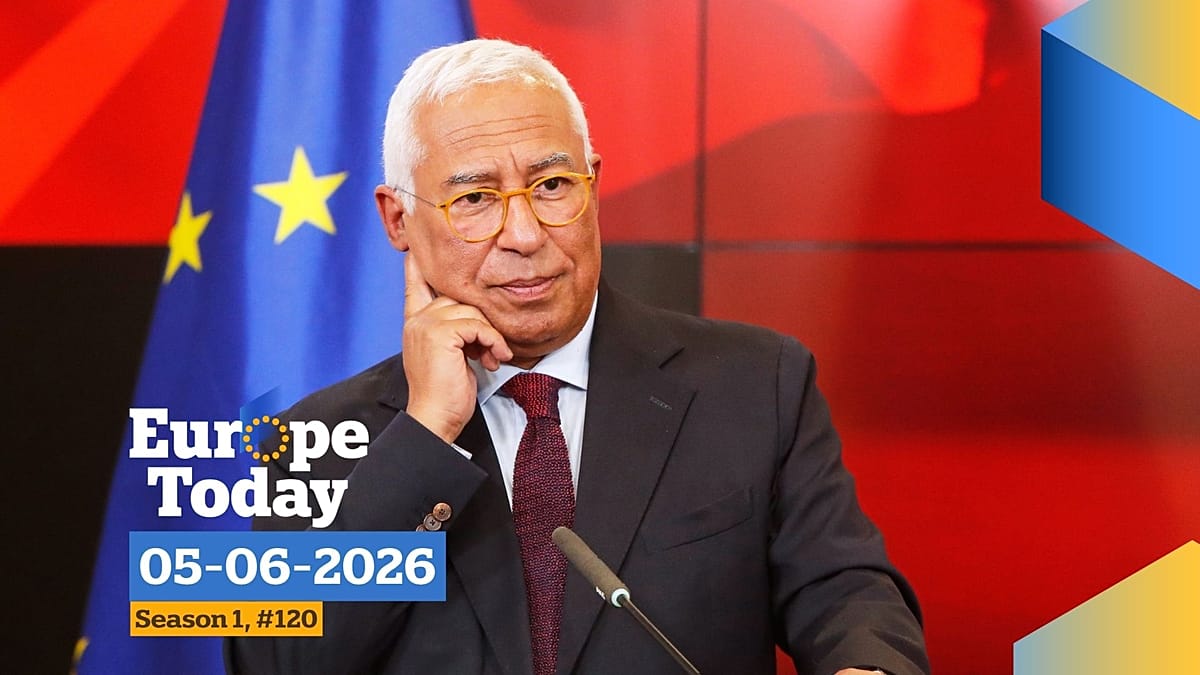
European Council President António Costa has given an exclusive interview to Euronews from the EU-Western Balkans summit underway in Montenegro, where enlargement policy is the central focus. The summit brings together leaders from the twenty-seven member states and their counterparts from the Western Balkans—Albania, Bosnia and Herzegovina, Kosovo, Montenegro, North Macedonia, and Serbia—as well as representatives from the wider continent, including the UK, Switzerland, and Norway.
Costa’s remarks come amid a renewed push for EU expansion, with France and Germany advocating for a more gradual path to integration. The Franco-German proposal, which has been circulating in Brussels for weeks, suggests a step-by-step accession process that would allow candidate countries to benefit from certain EU policies—such as the single market or research programmes—before full membership is achieved. This approach aims to maintain momentum while addressing concerns about the bloc’s absorption capacity.
The summit in Montenegro is the latest in a series of high-level meetings designed to reinvigorate the enlargement agenda, which has stalled in recent years due to disputes over rule-of-law reforms and bilateral issues. EU and Western Balkans leaders meet in Montenegro as enlargement talks gain momentum, with discussions also covering economic cooperation, security, and energy.
Defence, Peace Talks, and Investment
Alongside the enlargement debate, the summit has featured a major European defence event in Brussels, reported by Euronews’ Shona Murray. Defence ministers and industry leaders are gathering to discuss joint procurement, military mobility, and the EU’s strategic autonomy—a topic that has gained urgency since Russia’s full-scale invasion of Ukraine.
In a separate development, Ukrainian President Volodymyr Zelenskyy has published an open letter to Russian President Vladimir Putin, proposing face-to-face peace talks. Euronews’ Sasha Vakulina reports that the letter, which was released on the eve of the summit, calls for a direct dialogue to end the war. The proposal has been met with cautious optimism in European capitals, though many officials remain sceptical about Russia’s willingness to engage in good faith.
European Investment Bank President Nadia Calviño also gave an interview during the summit, outlining the EIB’s plans to increase lending for green transition projects in the Western Balkans. The bank has committed €6 billion to the region over the next four years, focusing on renewable energy, digital infrastructure, and small business support. Calviño emphasised that investment is a key driver of integration, as it helps candidate countries align with EU standards and regulations.
The summit’s agenda also includes discussions on the EU's €87 billion trade surplus drives Western Balkans enlargement push, highlighting the economic benefits of closer ties. Trade between the EU and the Western Balkans has grown steadily, with the bloc now accounting for over 70% of the region’s total trade.
Meanwhile, in Madrid, the South Summit has called for a unified European AI strategy, as reported by Euronews. The event brought together tech entrepreneurs, policymakers, and investors to discuss how Europe can compete with the United States and China in artificial intelligence. The summit’s final declaration urges the European Commission to create a single regulatory framework for AI, balancing innovation with ethical safeguards.
As the EU-Western Balkans summit continues, Costa’s exclusive interview is expected to set the tone for the next phase of enlargement negotiations. The European Council president is likely to stress the need for tangible progress on reforms in candidate countries, while also acknowledging the political will in Brussels to move forward. The coming months will be critical, as the European Commission is due to publish its annual enlargement reports in October.
For now, the focus remains on Montenegro, where leaders are trying to translate rhetoric into action. Whether the gradual integration model gains traction will depend on the ability of both sides to compromise—and on the broader geopolitical context, which continues to shape Europe’s priorities.