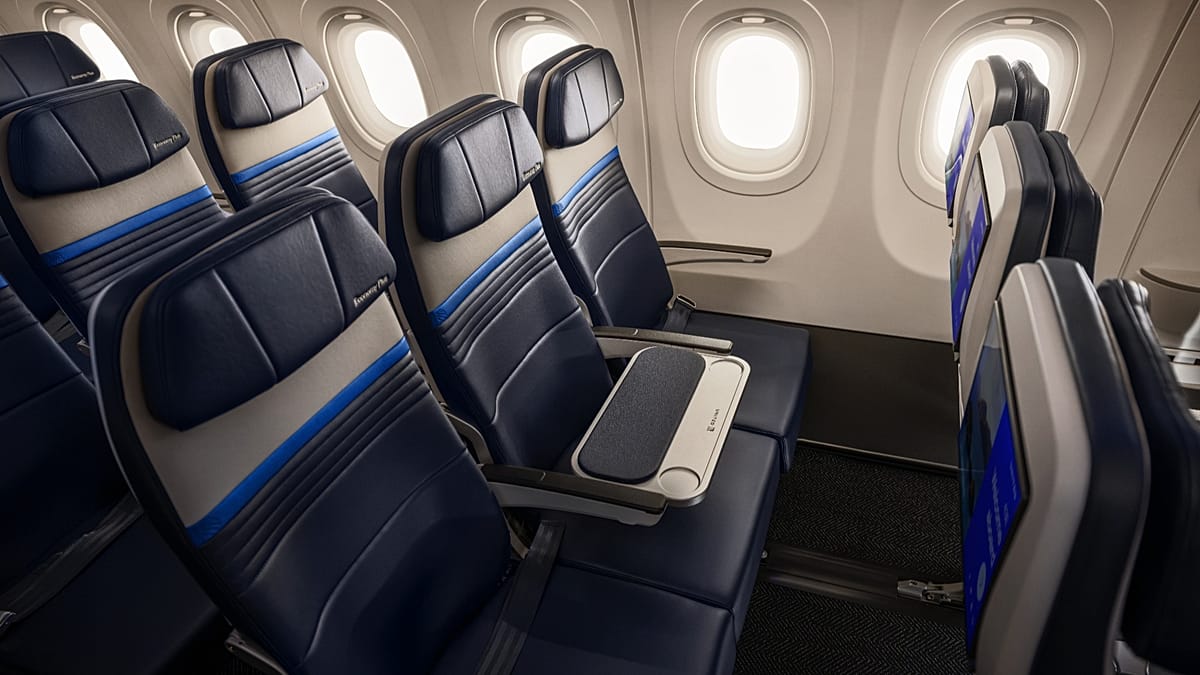
From shared tables in economy to double beds in first class, airlines are rethinking the cabin experience. Carriers across Europe and beyond are fitting roomier seats, partnering with Michelin-starred chefs, and investing in lavish airport lounges—all in a bid to persuade more passengers to pay for an upgrade.
The strategy is driven by economics. Business-class seats occupy roughly four times the floor space of a standard economy seat, yet can be priced five or six times higher, according to Volodymyr Bilotka, a professor at Purdue University and an aviation economics specialist. “Airlines have traditionally been investing quite a lot into the premium offerings because the profit margins are significantly higher,” Bilotka told AFP.
Fuel costs, pushed up by the conflict in Iran, have squeezed margins, but carriers see premium travel as a long-term profit engine. American Airlines reported an 18.5% year-over-year increase in premium revenue in its most recent quarter, outpacing the main cabin by four percentage points. The airline noted that premium products now generate roughly half of its ticket revenue on about 30% of seats.
Premium growth accelerates
The shift is not limited to the US. Since 2020, the number of premium seats on US flights has risen 33%, more than double the growth of mainline seats, according to travel news site Skift. United Airlines more than doubled its premium-seat capacity between 2015 and 2026, and plans further expansion.
United’s upcoming “Relax Row,” launching in 2027, will let economy passengers on certain Boeing widebodies convert a row of three seats into a couch for sleeping or lounging after takeoff. The airline also unveiled an Economy Plus option that allows customers to avoid the dreaded middle seat, starting on select flights in late 2026.
JetBlue has introduced BlueFirst, a new first-class service on domestic routes. “Customers are increasingly looking for more premium experiences,” said CEO Joanna Geraghty. Delta, meanwhile, has revamped its Delta One luxury option, featuring premium wines, a Wagyu burger, and larger entertainment screens. The airline partnered with Simon Hulstone, chef of Michelin-starred The Elephant in Torquay, UK, and sommelier Andrea Robinson. Delta plans to roll out the service on new Airbus A350-1000 aircraft, with about 150 premium seats and 161 in economy.
“Twenty years ago, 90% of the seats were main cabin,” said Ekrem Dimbiloglu, Delta’s managing director for onboard strategy and experience. He added that premium seats could soon represent as much as 70% on some Delta flights.
European carriers are following suit. In October, British Airways announced that the upper deck of its two-tier A380 would be entirely premium. Singapore Airlines revealed a €1.4 billion investment to upgrade its long-haul cabins, including the largest double bed in commercial aviation first class. Some carriers, like BeOnd and La Compagnie, operate all-business-class flights, while Jet2 has announced a new charter service with a specially configured Boeing 737-800NG featuring 76 business seats.
Consultancy Cirium estimates that premium seats among the 42 carriers in the three major alliances (SkyTeam, Oneworld, Star Alliance) and Middle East carriers now represent 19% of total volume, up from 17.1% in 2019.
Beyond seating, airlines are adding pre-boarding meal choices, free Wi-Fi, and upgraded lounges. Southwest Airlines, once a discount carrier, has announced new lounge facilities. The trend is reshaping the economics of flying, with carriers betting that a growing share of passengers will pay for a more comfortable journey.
For European travelers, the expansion of premium options means more choice—and potentially fewer standard economy seats on many routes. As airlines focus on higher-margin products, the classic economy experience may become a smaller part of the mix. For insights on how airlines handle compensation, see which European airlines pay out flight delay compensation fastest. And for a look at how carriers are investing in other areas, check Singapore Airlines' cabin revamp.