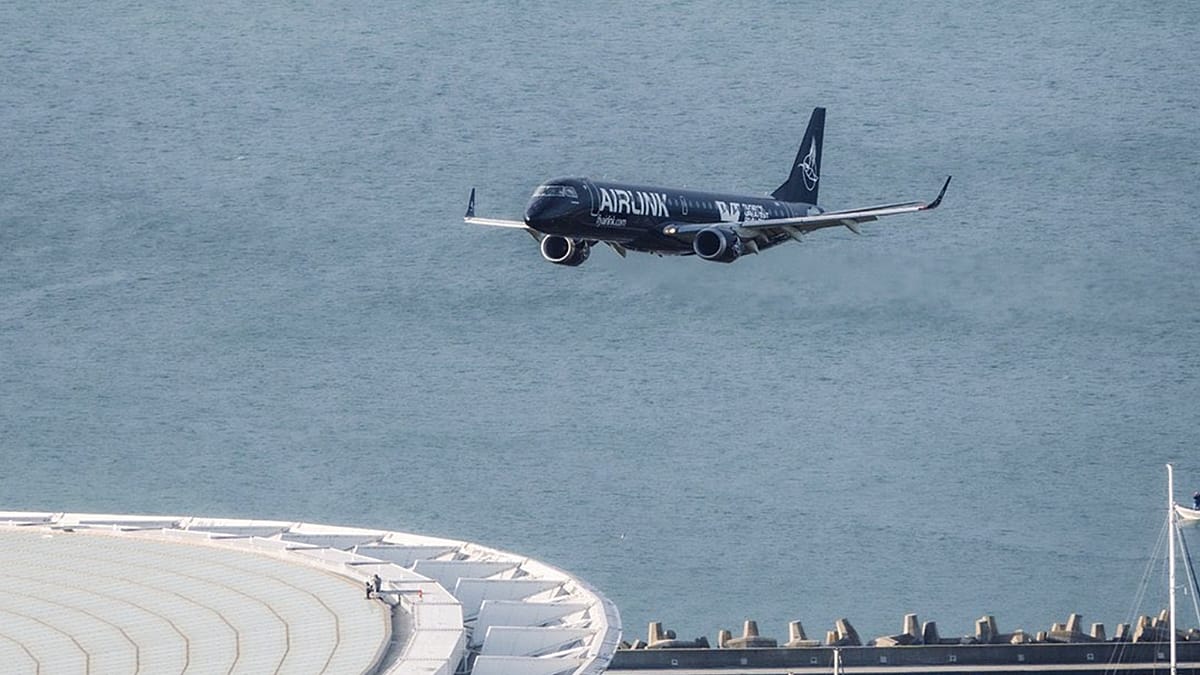
South Africa's regional carrier Airlink has defended a dramatic low-level formation flyover above Cape Town's DHL Stadium during Saturday's rugby Test between the Springboks and New Zealand. The two Embraer jets passed just metres above the stadium roof, thrilling the reported crowd of more than 50,000 but drawing sharp criticism from some aviation professionals.
Flight-tracking data from Flightradar24 indicated the lead aircraft cleared the stadium roof by roughly 41 to 46 feet (12–14 metres). Video of the stunt spread quickly on social media, with reactions split between admiration for the pilots' skill and concern over the risks involved.
Airline cites planning and approvals
In a statement on Sunday, Airlink acknowledged the public debate. “Airlink notes the concerns expressed in various social media and online forums regarding yesterday’s formation flyby over Cape Town’s DHL Stadium,” the carrier said. “The flight demanded careful planning and rehearsal, as it required navigating at low altitude at around 150 knots. The South African Civil Aviation Authority and Air Traffic Navigation Services provided valuable guidance, approval and support to ensure a safe flyby.”
The airline also shared footage and images on X, with the caption: “Planning. Precision. Performance.”
South Africa's Minister of Sports, Arts and Culture, Gayton McKenzie, praised the manoeuvre as “spectacular.” He added: “It’s a well known fact that we have the best pilots in the world, that was spectacular, next time I will ask the pilots to land on the field, prepare to be amazed further.”
Not everyone was impressed. Scottish pilot Scott Bateman, who has flown commercially for decades, said the stunt left him “aghast.” In a social media post, he wrote: “The lead aircraft reportedly cleared the stadium roof by around 40–50 feet. Hundreds of professional aviators around the world have looked at those images and expressed concern. That deserves more than 'nothing to see here'.” He added that aviation did not “become one of the safest forms of transport by defending everything that worked.”
The incident echoes debates in Europe over the balance between spectacle and safety in aviation. In recent years, European regulators have tightened rules on low-altitude displays, particularly after the 2015 Shoreham Airshow crash in the UK, which killed 11 people. While the Cape Town flyover was approved by South African authorities, some observers argue that the margin for error at such altitudes is minimal, and that even the most skilled pilots can be undone by an unexpected gust or mechanical issue.
Airlink, a privately owned carrier that operates regional routes across southern Africa, has a strong safety record. The company said the flyover was part of a pre-match ceremony and that all procedures were followed. It also noted that the aircraft were flown by experienced captains who had rehearsed the route in advance.
The debate comes as the aviation industry worldwide continues to scrutinise risk-taking in the name of entertainment. While military and display teams routinely perform low-altitude manoeuvres, civilian airliners are rarely cleared for such stunts. The Cape Town flyover, however, was conducted with the blessing of the South African Civil Aviation Authority, which has not commented publicly on the criticism.
For now, the flyover has become a talking point not just in South Africa but among aviation enthusiasts and professionals globally. Whether it will lead to tighter regulations in the country remains to be seen. But the incident highlights the tension between the public's appetite for aerial drama and the industry's commitment to safety—a balance that European regulators have long grappled with.