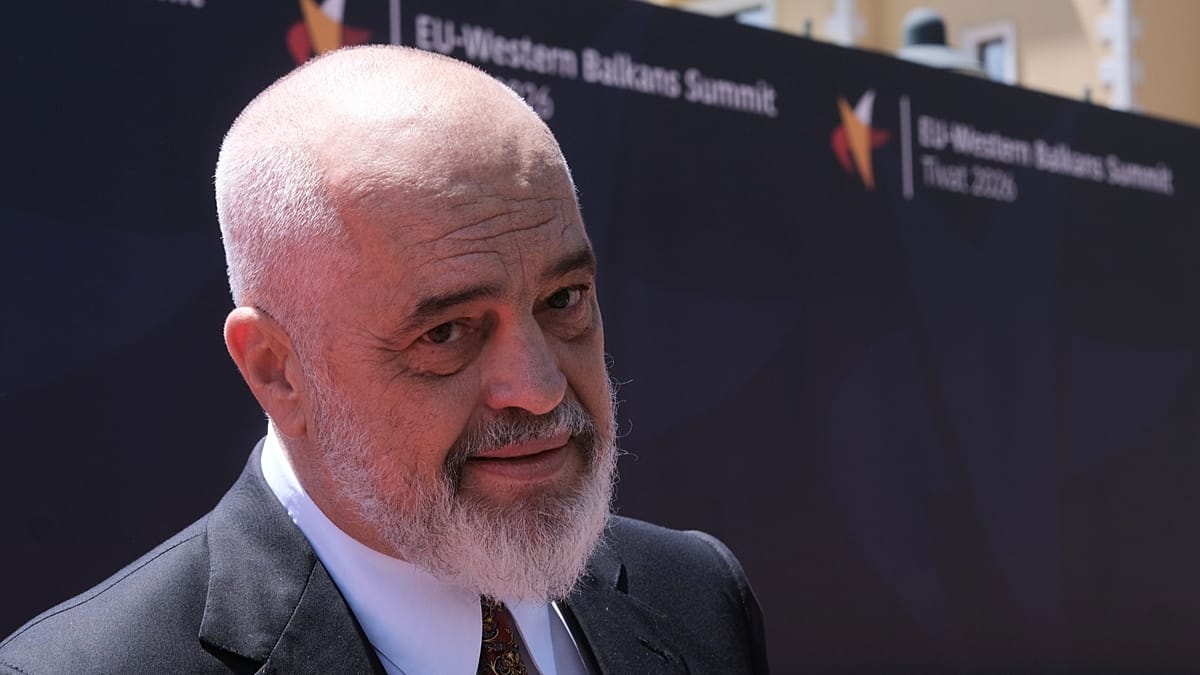
Albanian Prime Minister Edi Rama has reaffirmed his country's unwavering commitment to joining the European Union, declaring that there is "no alternative" to full membership. In an interview with Euronews on the sidelines of the EU–Western Balkans summit in Tivat, Montenegro, Rama described himself and his government as "fanatics of the EU faith," insisting that Tirana will not consider any other path.
"Whatever it takes, however it goes, we remain rooted in the EU faith," Rama said. "For us, there is no Plan B, no alternative, nothing."
Albania has been an official candidate since 2014 and opened accession negotiations in 2020, but progress has been slow. Rama acknowledged that the traditional enlargement process no longer works and called for a new approach. He invoked the legacy of former German Chancellor Helmut Kohl, arguing that the EU should prioritise political integration over technical criteria. "We need to find a different approach," he said. "One piece of the puzzle is missing — the Helmut Kohl piece: politics first, and then the rest follows."
A New Model for Enlargement
Rama's comments come as France and Germany, ahead of the summit, proposed a system of "structured gradual integration" for candidate countries. The idea is to offer Western Balkan nations earlier benefits of EU membership — such as access to certain policies or decision-making forums — while maintaining the existing merit-based framework. The Franco-German paper formed the basis of summit discussions and is seen as an attempt to inject momentum into the stalled enlargement process.
Rama's own vision aligns closely with this proposal. In a joint op-ed with Serbian President Aleksandar Vučić last March, he called for partial integration as an intermediate step. In the interview, he rejected labels like "associated membership" or "membership light," instead insisting on the concept of a united family where candidate countries sit at the table with current member states and participate in decision-making step by step.
"You cannot say to the kids: 'You have to stay somewhere in the neighbourhood and when you are ready, you will come into the family,'" Rama said, using a metaphor to describe the current dynamic. He credited European Commission President Ursula von der Leyen for re-engaging Europe with enlargement, contrasting her with her predecessor, who Rama said had declared enlargement off the table.
Warning Against Anti-EU Forces
Rama also highlighted the threat posed by "forces" and "third actors" in the Western Balkans that actively promote the narrative that EU accession will never happen. While he did not explicitly name Russia, he made clear that such disinformation undermines trust in the EU and could ultimately benefit Moscow. He pointed to Moldova as a cautionary example.
Moldova, which applied for EU membership in 2022 after Russia's full-scale invasion of Ukraine, was granted candidate status later that year and began accession talks in 2024. Pro-European President Maia Sandu has framed EU integration as a "matter of survival," but the country's path has been fraught. A 2025 referendum to enshrine the EU path in the constitution passed by an extremely slim margin, and Sandu's government has repeatedly accused Moscow of massive interference in domestic elections.
"Maia Sandu is telling the Moldovans, 'Come with me to Europe.' It's not happening," Rama said. "She resisted two elections. The third election, maybe she will not resist anymore, because the Russians can say, 'Are you crazy? It will never happen.'"
Rama argued that the only effective response is to allow candidate countries partial integration into the bloc. "It's very important to close the political border and say: 'This is a family. You have no room here to spread lies and to fuel hatred against the EU and to tell the people [accession] will never happen,'" he said.
Call for Dialogue with Russia
In a broader geopolitical context, Rama urged European leaders to begin talks with Russia to end the war in Ukraine. He dismissed suggestions that meaningful progress has been made or that European mindsets have shifted, and stressed that a diplomatic effort is essential despite Russia's hostile posture.
"I hope they start understanding each other on how this war can be stopped," Rama said. "Every democratic country, every democratic soul should seek peace no matter what." His comments come as Ukrainian President Volodymyr Zelenskyy has proposed a face-to-face meeting with Vladimir Putin, signalling a potential opening for a ceasefire.
Rama's interview underscores the deepening frustration among Western Balkan leaders with the slow pace of EU enlargement and the risks of leaving the region vulnerable to external influence. As the bloc debates how to reform its accession process, the Albanian prime minister's message is clear: without a credible path to membership, the EU risks losing the region to forces that do not share its values.