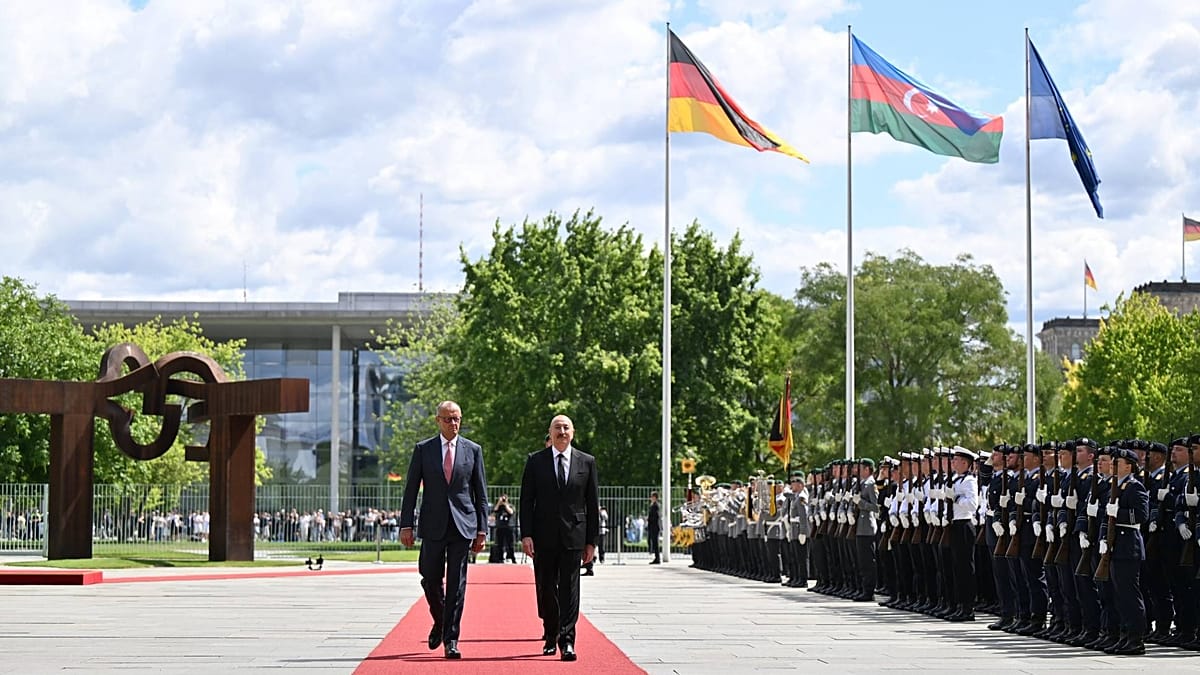
President Ilham Aliyev of Azerbaijan arrived in Berlin on Tuesday for his first state visit to Germany, where energy security and the development of the Middle Corridor trade route dominated discussions. The visit underscores Berlin's accelerating efforts to diversify away from Russian energy supplies following Moscow's full-scale invasion of Ukraine in 2022.
Aliyev met Chancellor Friedrich Merz for bilateral talks, followed by a broader session with German cabinet ministers. The two sides signed a joint declaration on a strategic partnership and a series of agreements covering energy, transport, infrastructure, trade and investment, and science and technology. Germany becomes the second European country, after Italy, to conclude such a comprehensive agreement with Baku. A joint business forum ran parallel to the political meetings.
“I would like to express my gratitude to President Ilham Aliyev,” Merz said. “You are creating an opportunity for us to receive larger volumes of gas from Azerbaijan. This issue is also reflected in the Joint Declaration that we signed today.”
Azerbaijan began supplying gas to Germany in 2024 via the Southern Gas Corridor and onward connections. Aliyev said he expects annual deliveries to reach 2 billion cubic metres by next year. Currently, Azerbaijan supplies around 12 billion cubic metres of gas per year to Europe, with Italy, Greece, Bulgaria, and Hungary among the largest recipients.
“Azerbaijan can supply the required volume of oil,” Aliyev said. “This can be done both through domestic sources and through the trading division of SOCAR.” He added that Baku is ready to increase energy supplies to Germany and other EU countries as Russia’s energy infrastructure continues to suffer damage from the war in Ukraine.
Beyond Energy: The Middle Corridor and Industrial Cooperation
The Middle Corridor — linking China to Europe via Kazakhstan, Azerbaijan, Georgia, and Turkey — featured prominently in the talks. Aliyev noted that Azerbaijan has invested heavily in expanding port capacity at Alat on the Caspian Sea, and that freight volumes through the corridor have grown significantly. Germany, as one of Europe's main industrial economies and a major importer of Asian goods, has a direct interest in reducing dependence on trans-Russian routes.
Aliyev also addressed the ongoing war between Iran and the United States, which has disrupted regional energy and trade flows and increased the importance of overland and Caspian routes as alternatives to the Strait of Hormuz. He said Azerbaijan had maintained a balanced position throughout the conflict and was ready to support any diplomatic efforts to restore stability.
Merz, in turn, lauded the Armenia-Azerbaijan peace process, expressing support for a lasting settlement and calling on both sides to finalise the peace agreement.
According to Orkhan Yolchuyev, director and co-founder of the CASPIA analytical think tank in Baku, the significance of the visit lies in the wider range of sectors included in the new strategic agenda. “For the first time at such a high level, bilateral cooperation includes green energy, low-carbon hydrogen, digital transformation, industrial modernisation, transport connectivity and innovation,” Yolchuyev said. “Germany increasingly sees Azerbaijan not only as an energy supplier but also as a partner for new industrial and logistics projects linking Europe, the South Caucasus and Central Asia.”
Shahin Ismayilov, a member of Azerbaijan’s parliament and chairman of the Youth and Sport Committee, said the agreements reached in Berlin could strengthen cooperation in energy, trade, transport, and investment. “President Ilham Aliyev’s visit to Germany marks an important step in further strengthening the strategic partnership between Azerbaijan and Germany,” he told Euronews. “Azerbaijan remains a reliable partner for Europe, particularly in ensuring stable energy supplies and advancing the Middle Corridor initiative.”
Aliyev also held a one-on-one meeting with German President Frank-Walter Steinmeier later on Tuesday to discuss bilateral cooperation. The visit signals a deepening of ties that go well beyond energy, as Germany seeks to anchor Azerbaijan as a long-term partner in a region increasingly central to European supply chain resilience.
For more on the broader context of EU energy diversification and trade routes, see our analysis of Azerbaijan and Germany Forge Deeper Industrial Ties Beyond Energy Supplies and the impact of Houthi threats to the Bab el-Mandeb Strait on global shipping and European trade.