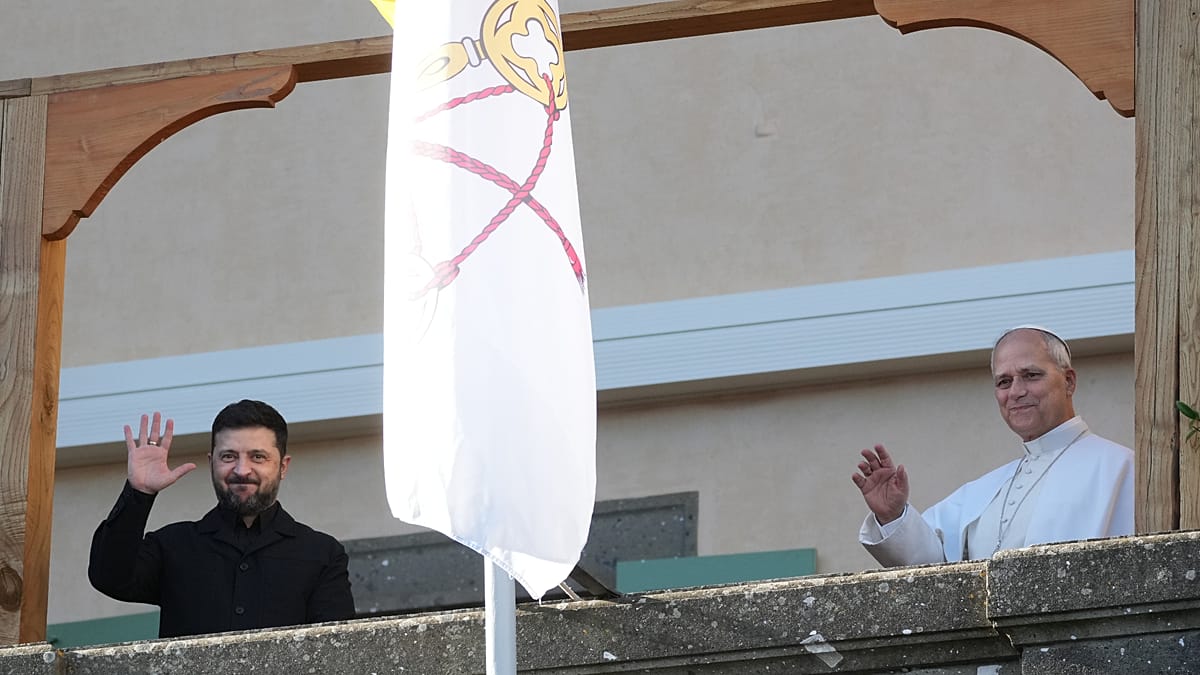
Pope Leo XIV spoke by telephone with Ukrainian President Volodymyr Zelenskyy on Monday afternoon, the Vatican confirmed, only days after making a parallel appeal to Vladimir Putin. The focus of both conversations was the same: the besieged city of Oleshky, on the occupied left bank of the Dnipro in the Kherson region.
According to a statement from the Vatican's press office, the pontiff used the call with Zelenskyy to press the case for a humanitarian pause that would let relief supplies into the city and allow residents to leave. He referred explicitly to the truce request already put to the Russian president, and said he hoped both sides would cooperate so that food and medicine could be delivered and a voluntary, safe evacuation of civilians arranged.
The appeal follows Leo's earlier request to Putin, in which the pope asked Moscow to halt operations around Oleshky long enough for aid convoys and evacuation routes to function.
Evacuation plans take shape
Kyiv's human rights commissioner, Dmytro Lubinets, said Ukraine and Russia are working through the practical details of a civilian evacuation covering Oleshky and six neighbouring settlements. Such arrangements have repeatedly stalled in the past, with each side accusing the other of obstructing agreed corridors, but the Vatican's direct involvement gives the current effort a diplomatic dimension that previous attempts lacked.
Oleshky sits directly across the Dnipro from the regional capital, Kherson, and has been under Russian control since the early months of the full-scale invasion. Its pre-war population of roughly 25,000 has been severely depleted, and residents who remain face shortages of food, clean water and medical care, with crossings of the river heavily restricted.
The Vatican did not say whether the two leaders discussed any broader framework for negotiations. Leo has kept up a steady rhythm of contact with Zelenskyy since his election, and the relationship has become one of the more visible diplomatic threads running between Rome and Kyiv.
A pope with a Chicago accent and a diplomatic brief
Born in Chicago and now 71, Leo has made humanitarian access a central theme of his pontificate rather than confining himself to general appeals for peace. His first telephone call with Zelenskyy came in May 2025, when the Ukrainian leader invited him to visit Kyiv and restated his willingness to negotiate.
The two met in person later that month, immediately after the Mass in St Peter's Square that opened Leo's ministry, and again on 9 July 2025 for a private audience at Villa Barberini, the papal residence at Castel Gandolfo, where they discussed the possibility of holding future peace talks at the Vatican. A further meeting at Castel Gandolfo on 9 December covered the importance of keeping dialogue open, the treatment of prisoners of war and the return of Ukrainian children deported to Russia. On 3 April this year, with Russian drone and missile strikes intensifying across Ukraine, the pope and Zelenskyy spoke once more.
Rome's willingness to host talks has been noted in Kyiv, where the search for venues acceptable to all parties remains unresolved. The Vatican's neutrality is not universally accepted — Moscow has its own channels to the Holy See, and Ukrainian officials have at times been wary of anything that could be read as equating aggressor and victim — but the pope's direct engagement with both capitals gives him a rare line of communication.
For now, the immediate test is narrower than any peace process. If the Oleshky truce holds long enough for aid to arrive and civilians to leave, it would be the most concrete result of Leo's diplomacy to date. If it does not, the episode will join a long list of humanitarian pauses announced and then quietly abandoned along the front line.