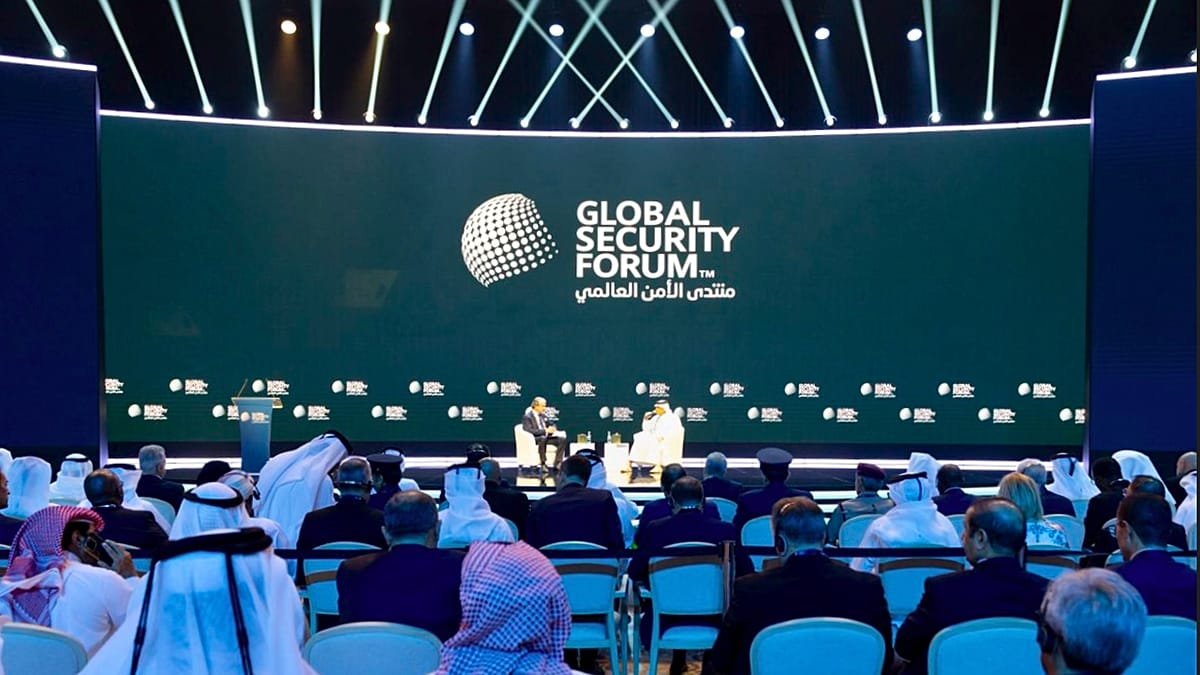
Doha is preparing to unveil a new regional defence partnership, according to Qatar's deputy prime minister and minister of state for defence affairs, Sheikh Saoud bin Abdulrahman Al Thani. Speaking at the Global Security Forum in Doha on Monday, he said the initiative would draw on lessons from the recent conflict with Iran to bolster the Gulf state's own defences and develop joint plans with neighbouring countries.
The planned partnership is designed to counter ballistic missiles, drones and cyberattacks, with a particular focus on water security. Sheikh Saoud also revealed that Qatar would soon announce a local defence production hub, involving domestic manufacturing or investments in defence companies, in cooperation with a regional partner and allies including the United States, Britain and France.
He credited decades of military investment, training and shared experience with Washington for the Gulf's success in intercepting more than 90% of Iranian attacks during the recent hostilities. The expansion of Al Udeid airbase, the largest US military facility in the Middle East, would continue in line with American needs, he added.
Dialogue with Tehran remains open
Despite the conflict, Doha has kept communication channels open with Tehran. "We never stop our communication," Sheikh Saoud told the forum. He called for talks between Iran and the six Gulf Cooperation Council (GCC) states, as well as Pakistan and Turkey, once Washington and Tehran reach a settlement. International allies should also be consulted, he said.
Until then, Qatar is working with Pakistan and Oman on mediation efforts, which he compared to a long-distance race requiring determination and resilience. The deputy prime minister argued that closer economic ties could help prevent another conflict, pointing to the joint work of France and Germany on Airbus as an example of how countries can build lasting bonds through commerce.
He also noted that Qatar and Iran share a major offshore gas field, giving both nations a vested interest in avoiding further disruption. This economic interdependence, he suggested, could serve as a foundation for trust-building and addressing security concerns on both sides, with a non-aggression agreement among possible next steps.
Energy warnings
Sheikh Saoud issued a stark warning about the global energy market, saying that ongoing disruptions continue to send shockwaves worldwide. "We haven't reached the peak with respect to energy," he said, predicting more difficulties "in the coming days and months." He stressed that crises in the region can disrupt the "chain of supply from east to west and also from west to east."
He rejected the idea of transit fees in the Strait of Hormuz, arguing that uncertainty over shipping would raise costs for consumers. The comments come as Eurozone inflation climbs to 3.8% as energy costs surge, adding to concerns across the continent. European households and businesses are already grappling with the fallout from the cost-of-living crisis, and any further energy price spikes would exacerbate the strain.
Despite the challenges, Sheikh Saoud expressed optimism that the Gulf countries could emerge from the conflict with stronger economies and new partnerships, as they have after previous crises. "Iran is our neighbour," he said, reiterating that dialogue and economic ties offer a route to lasting peace.
The announcement comes as European leaders seek to diversify energy supplies and reduce dependence on volatile regions. The carbon market rift exposes EU divisions on climate and energy, complicating efforts to craft a unified response. Meanwhile, some EU member states are pushing back on plans to phase out Russian energy by 2027, as Visegrád Four push back on EU's 2027 Russian energy exit plan.
Qatar's warning underscores the fragility of global energy markets and the interconnectedness of regional conflicts with European economic stability. As the Gulf state prepares to announce its defence partnership, the international community will be watching closely to see how it navigates the delicate balance between security and diplomacy.