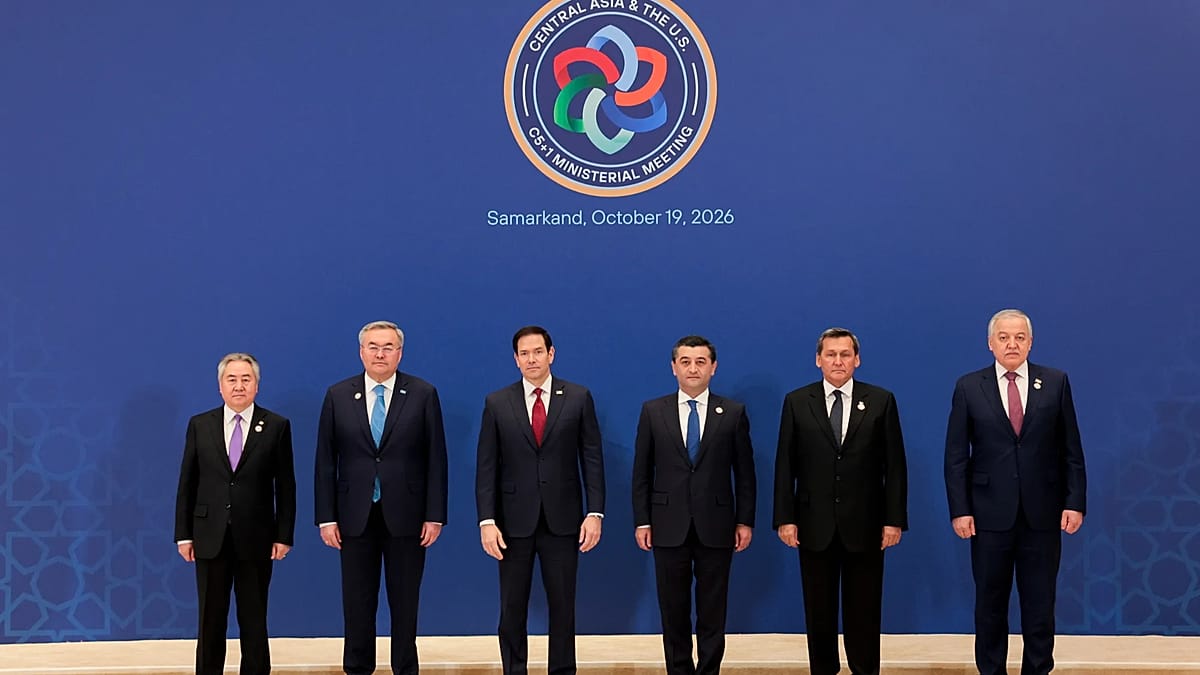
US Secretary of State Marco Rubio and the foreign ministers of Kazakhstan, Kyrgyzstan, Tajikistan, Turkmenistan, and Uzbekistan met in Samarkand on Monday for the C5+1 ministerial dialogue. The talks produced a joint statement backing investment in the Trans-Caspian trade route, closer industrial cooperation, and simplified customs procedures.
The Trans-Caspian corridor, also known as the Middle Corridor, connects Central Asia to European markets via the Caspian Sea, the South Caucasus, and Turkey, offering an alternative to routes through Russia. Rubio said Washington wants to enhance the infrastructure of this route and give partners more ways to reach American and Central Asian markets.
Critical minerals and industrial ties
The six governments identified mineral processing, energy cooperation, and cybersecurity as priorities, though no specific funding figures were announced. Uzbek Foreign Minister Bakhtiyor Saidov proposed cooperation spanning mineral exploration, processing, and local industrial clusters, and called for closer links between the C5+1 diplomatic forum and the B5+1 business platform to involve companies in identifying projects.
Rubio stressed that the US is seeking competition, not exclusivity, in the region. Speaking to Euronews in Samarkand, he said: "This is not about coming here to say, stop talking to somebody else or stop working with some other country."
The push comes as the five Central Asian states maintain extensive economic ties with both Russia and China. Washington's interest in critical minerals—used in energy technologies and advanced manufacturing—reflects a broader strategy to diversify supply chains.
Bilateral talks
Rubio held separate meetings with each of his Central Asian counterparts. With Kazakhstan's Foreign Minister Mukhtar Tileuberdi, he discussed trade, energy, critical minerals, and technology. Kazakhstan's Foreign Ministry said Rubio expressed interest in visiting the country after the G20 summit in Miami in December, though no date was set. The US State Department also noted discussions on Kazakhstan's commitment to join the Abraham Accords, a US-backed framework for normalising relations with Israel.
With Kyrgyzstan's Jeenbek Kulubaev, Rubio discussed bilateral cooperation. Tajikistan's Sirojiddin Muhriddin raised trade, investment, and regional security. With Turkmenistan's Rashid Meredov, the two countries prepared another round of political consultations in Ashgabat in November.
The Samarkand meeting underscores Washington's efforts to build a lasting economic foothold in Central Asia, a region increasingly important for European energy security and supply chain resilience. The Trans-Caspian route's development could offer European buyers an alternative to Russian energy supplies, a topic of ongoing interest in Brussels.
For more on the broader context of Central Asia's energy plans, see the region's gas ring project. And for a look at how the US is positioning itself in the region, read Rubio's Samarkand visit.