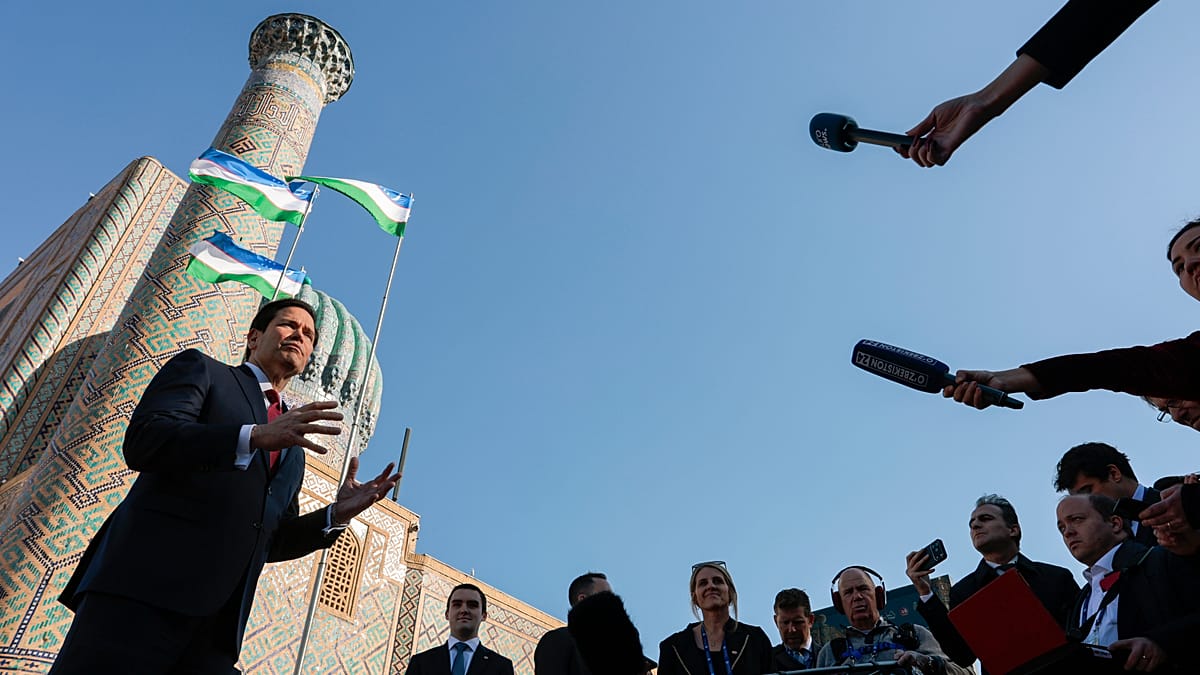
US Secretary of State Marco Rubio used a visit to Uzbekistan's historic city of Samarkand to signal a new phase in Washington's approach to Central Asia, telling Euronews that American companies are preparing to announce concrete commercial agreements in the region.
Speaking on Monday alongside a large business delegation, Rubio said the deals could be the beginning of a more sustained US economic presence in a part of the world that he believes has long been overlooked by American policymakers. “This is not the end. This is the beginning,” he said.
Nearly 300 US businesses were represented in Samarkand, according to Rubio, with discussions focused on agreements potentially worth billions of dollars. The State Department had earlier said more than 200 business leaders were accompanying the trip, though no final list of deals or their value had been released at the time of his remarks.
Critical minerals and strategic supply chains
Asked by Euronews about the potential for cooperation, Rubio identified critical minerals as a priority. “It's not smart just for the whole world to depend on one place for 100% of anything,” he said, without naming any specific country. He argued that the industries and technologies likely to define the 21st century will rely increasingly on these minerals, making supply-chain diversification a global priority rather than a purely American concern.
For resource-rich countries like Uzbekistan, Rubio suggested that developing mineral deposits and processing capacity responsibly could serve their own economic interests. “We're obviously going to explore that and I think we have a chance to do that here,” he told Euronews.
The topic was also on the agenda at the C5+1 summit hosted by US President Donald Trump in Washington in November 2025. Uzbekistan and its neighbours have been seeking additional investment and technology to develop their mineral resources, while the US and Europe are looking for alternatives to highly concentrated supply chains. The European Union has its own cross-border investment plans for the region.
Asked separately about China's growing economic influence in Central Asia, Rubio framed US involvement as competition rather than an attempt to force regional governments to choose sides. “This is not about coming here to say, stop talking to somebody else or stop working with some other country,” he said, praising Uzbekistan's openness to multiple economic partnerships and its recent growth.
Meetings in Samarkand
Rubio began his day with a morning tour of Registan Square, Samarkand's iconic architectural landmark, alongside Saida Mirziyoyeva, head of Uzbekistan's Presidential Administration. He called the city a centuries-old crossroads of trade and commerce.
His official schedule included talks with Uzbek Foreign Minister Bakhtiyor Saidov and a document-signing ceremony, followed by a meeting with Kazakhstan's Foreign Minister Mukhtar Tileuberdi and the C5+1 ministerial meeting involving Uzbekistan, Kazakhstan, Kyrgyzstan, Tajikistan and Turkmenistan. He was also due to meet President Shavkat Mirziyoyev and attend events of the Uzbekistan–US Business and Investment Council, co-chaired by Saida Mirziyoyeva and US Special Envoy Sergio Gor.
The visit follows last year's White House C5+1 summit, where more than $25bn (approximately €22bn) in commercial agreements and commitments were announced. Those commitments spanned several Central Asian countries and are at different stages of implementation. Uzbekistan has also been pursuing its own major energy projects, including new nuclear plants.
Rubio disputes Zelenskyy's account of intelligence pause
The trip also gave Rubio an opportunity to address rising tensions between Washington and Kyiv over Russia's war in Ukraine. Asked about Ukrainian claims that the US had briefly stopped sharing intelligence used to warn of Russian missile attacks, Rubio denied any interruption. “There has been no pause,” he told reporters.
Ukrainian President Volodymyr Zelenskyy had said on Sunday that intelligence sharing had resumed after a three-day suspension, leaving the two accounts at odds. Rubio urged both Russia and Ukraine to focus on ending the war, now in its fifth year. “What he should be focused on and what we want to be focused on is bringing an end to this war,” he said.
Trump had criticised Zelenskyy a day earlier, accusing him of lacking the will to end the conflict and blaming Ukrainian attacks on Russian oil refineries for disruption to global diesel markets. Trump has also defended temporary relief from some sanctions affecting Russian energy exports, saying it could help diplomacy. For more on the intelligence dispute, see our earlier report.