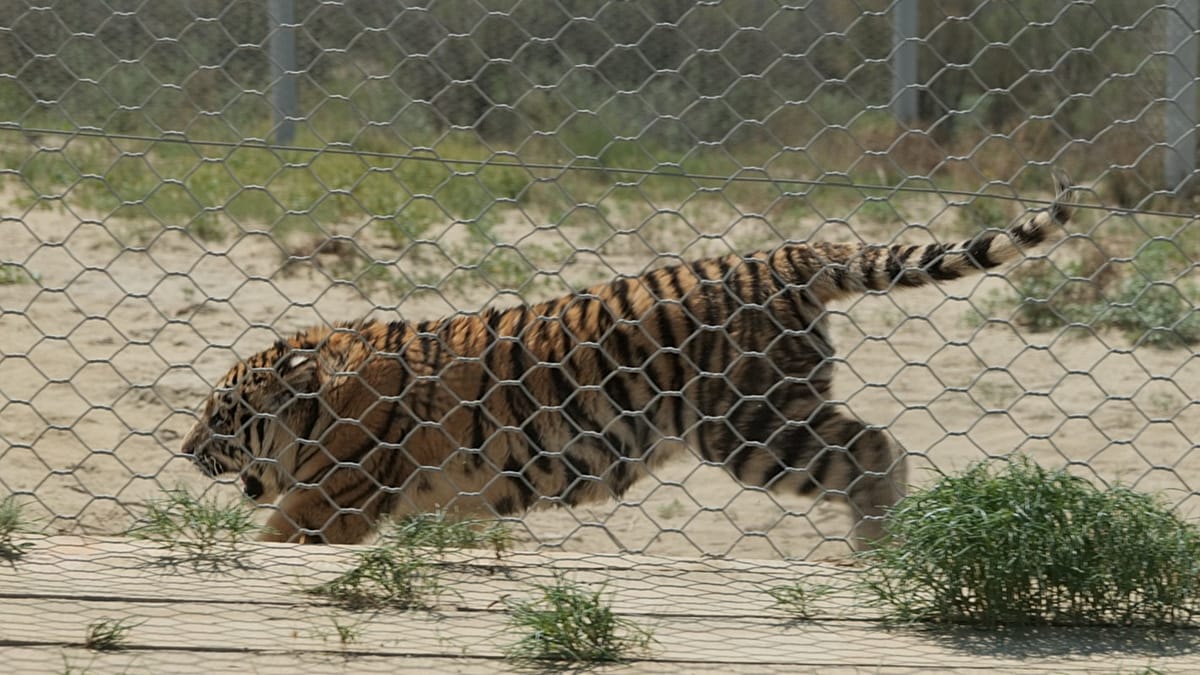
Kazakhstan has taken a significant step in ecological restoration with the release of four Amur tigers into the Ile-Balkhash Nature Reserve, a move designed to bring back a predator that vanished from Central Asia decades ago. The tigers, sourced from Russia's Khabarovsk region, were airlifted to Almaty and then transported by Mi-8 helicopter to the protected area in southeastern Kazakhstan.
The group comprises an adult male and female, both three to four years old, along with two cubs aged six to seven months. They were captured in the wild and relocated under an international programme that aims to re-establish a viable tiger population in the region. The animals have been fitted with satellite GPS collars, allowing specialists to monitor their movements and health around the clock, according to Daniyar Turgambayev, Chairman of the Committee of Forestry and Wildlife at Kazakhstan's Ministry of Ecology.
A Long-Term Vision for Rewilding
The reintroduction effort is not a short-term project. Turgambayev described it as a long-term commitment spanning the next 40 to 50 years. The designated area, along the Ile River in southern Balkhash, was once part of the historical range of the Turan tiger, a subspecies that disappeared from Central Asia in the mid-20th century. The last known wild Turanian tiger was killed in the 1950s in Uzbekistan.
Kazakhstan first announced its intention to reintroduce tigers at the inaugural International Tiger Conservation Forum in St. Petersburg in 2010. In 2024, two Amur tigers were relocated to the same reserve from the Netherlands, arriving from the Stichting Leeuw sanctuary at Landgoed Hoenderdaell Zoo. A joint roadmap signed between Kazakhstan and Russia in November 2025 formalized the transfer and adaptation support for the animals.
To prepare for the tigers' return, Kazakh officials established the protected reserve about a decade ago and released kulans, or wild asses, into the steppe to build a breeding prey base. The reserve now covers approximately 1.2 million hectares. “119 kulans have been released into the reserve. Moreover, local populations of wild animals such as wild boar and roe deer are present and have been reproducing. Today, the prey base allows tigers to live comfortably,” said Kazakhstan's Minister of Ecology Yerlan Nyssanbayev.
Scientific Basis and Conservation Context
Kazakh officials argue that the Amur tiger belongs to the same continental subspecies as the extinct Turan tiger, making the reintroduction scientifically viable. The Amur tiger, also known as the Siberian tiger, is the largest tiger subspecies and is listed on the International Red List of threatened species. Experts estimate that around 750 individuals remain in the wild in Russia.
The programme is part of broader conservation efforts in Kazakhstan, which has also seen initiatives like testing Central Asia's first air taxi and AI-driven government reforms to boost efficiency. The country's environmental strategy reflects a growing commitment to restoring biodiversity, even as it faces challenges such as drought, which has led to cloud seeding experiments.
The reintroduction of apex predators like the tiger is expected to have cascading benefits for the ecosystem, helping to regulate prey populations and maintain ecological balance. For now, the four Amur tigers are beginning their adaptation to a new home, with scientists closely watching their progress in the vast steppe of southeastern Kazakhstan.