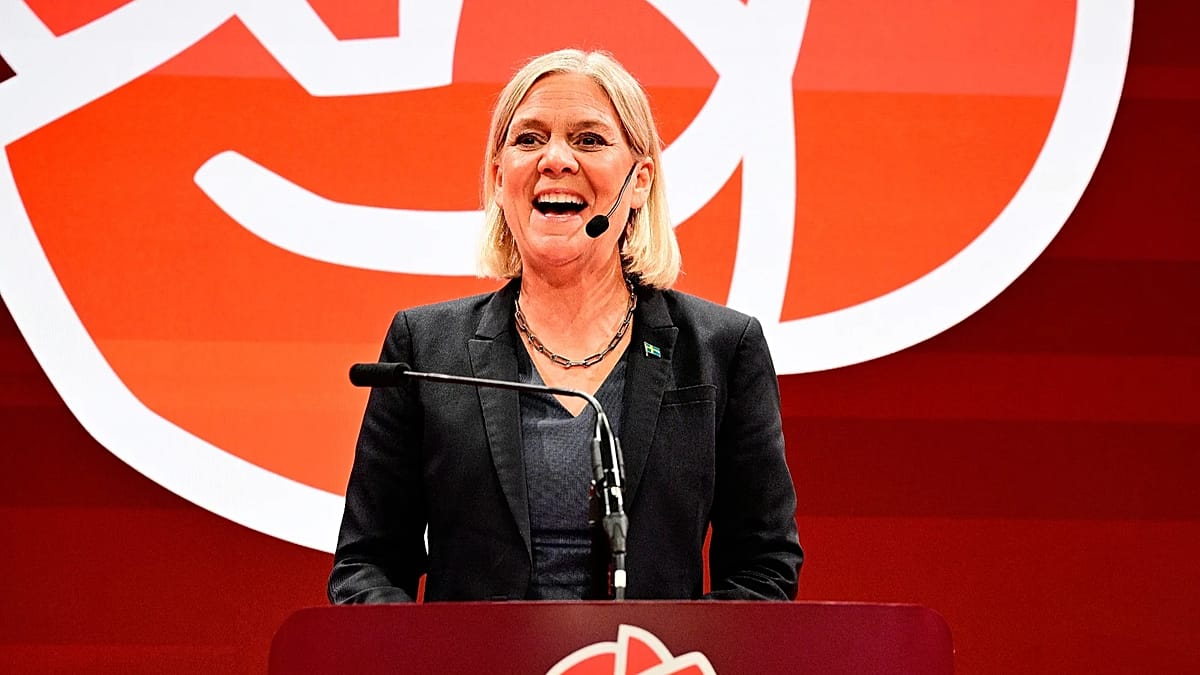
Sweden's Social Democrat leader Magdalena Andersson has conceded that she cannot assemble a governing coalition, returning the mandate to the speaker of the Riksdag just days after her centre-left bloc secured a narrow parliamentary majority. "I can conclude that there is currently no possibility for me to form a government," Andersson told reporters in Stockholm on Monday, adding that she would formally inform the speaker she was handing back the task entrusted to her on 18 September.
The announcement leaves Sweden in a familiar state of post-election limbo, with the speaker, Andreas Norlén, now responsible for finding a candidate who can command the confidence of the 349-seat parliament. Norlén, who was re-elected to his post on Monday, said he would hold talks with party leaders on Wednesday. "I envision that after those deliberations, I will be able to return with new information on how the process will move forward," he said.
A majority that cannot govern itself
The arithmetic looks favourable for the centre-left: Andersson's bloc, which includes the Social Democrats, the Left Party, the Centre Party and the Green Party, controls 176 seats against 173 for the right-wing alliance led by the outgoing prime minister, Ulf Kristersson. The Social Democrats remain the largest single party with 99 seats. But a three-seat cushion has proved insufficient to bridge the policy gaps inside the bloc, particularly over the role of the Left Party and the Centre Party's insistence on centrist economic and social positions.
Kristersson, who resigned after his right-wing bloc's election loss, is now expected to be asked to attempt to form a government. He has called for "constructive openness" across the political spectrum. "Discussions will need to be held with all parties to find ways around these impasses and create the conditions for a stable and capable government," he said after the vote. His most plausible route back to power would run through the Centre Party, once a member of the right-wing bloc, but its leader, Elisabeth Thand Ringqvist, has pledged to uphold centrist policies and has ruled out supporting a government that grants influence to parties on the fringes.
The impasse reflects a broader fragmentation of Swedish politics, where neither the traditional left-right blocs nor the newer centrist formations can easily command a working majority. The result is a parliament in which every seat matters and where the Centre Party and the Left Party, despite sitting on opposite sides of the chamber, both hold effective vetoes over the next government's programme.
What happens next
Under Sweden's constitution, the speaker has four attempts to get a prime minister approved by the Riksdag. If all four fail, a snap election must be called. Norlén's consultations on Wednesday will be the first test of whether a viable candidate exists. If Kristersson is formally asked to try, he will need to demonstrate that he can either reassemble his right-wing bloc or persuade enough centrist and independent-minded MPs to abstain or support him.
For Andersson, the decision to return the mandate is a tactical retreat rather than a withdrawal from frontline politics. She had signalled readiness to lead Sweden after the narrow centre-left win, but the failure to convert a numerical majority into a governing coalition underscores how difficult it is to translate votes into power in a parliament where the Centre Party and the Left Party pull in opposite directions.
The coming days will also test Norlén's ability to manage a process that has become increasingly unpredictable. His predecessor's record shows that Swedish government formation can take weeks, and occasionally months, even when the electoral result appears clear. With the Riksdag due to reconvene and the budget calendar looming, the pressure to produce a workable government is mounting.
For now, Sweden remains in the hands of a caretaker administration, with Kristersson's outgoing government continuing in a limited capacity. The country's European partners will be watching closely: Sweden is a member of NATO, a strong voice on climate policy and a key player in the EU's northern flank. A prolonged period of political drift in Stockholm would complicate decision-making in Brussels and beyond, at a time when security, energy and migration policy all demand firm national positions.
Whether Norlén can break the deadlock will depend on whether any party leader is willing to make the compromises that Andersson could not. If none steps forward, Sweden may be heading towards its first snap election in decades.