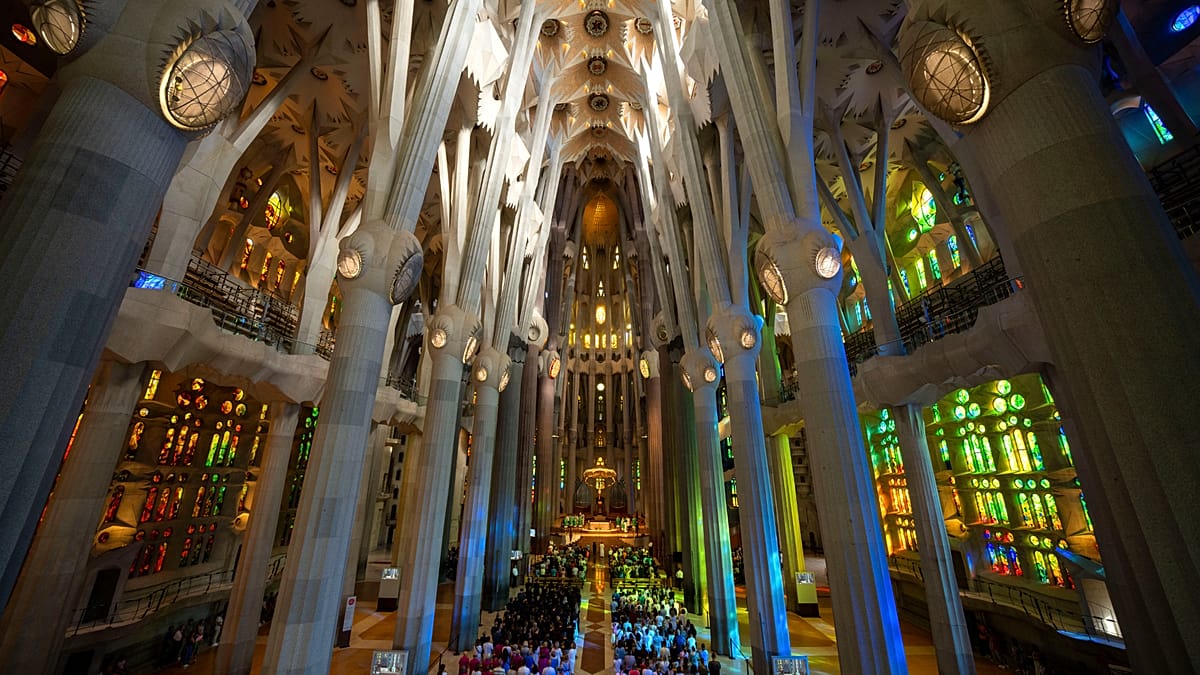
In a country house in Riudoms, a frail boy from a family of coppersmiths spent his days observing the natural world. That boy, Antoni Gaudí, would grow up to become an architect whose work still defines Barcelona and draws visitors from across the globe.
Gaudí's creations, built in the late 19th and early 20th centuries, draw on a wide range of influences—Catalan Modernisme, Art Nouveau, Byzantine, and Persian architecture. Yet his guiding principle was always nature. “Originality consists in returning to the origin,” he once said. His buildings are not just visually striking; they are also functional, thanks to his integration of modern engineering and science.
This June marks the centenary of Gaudí's death. All of his major works in Barcelona are UNESCO World Heritage sites. Here is a look at some of his most important masterpieces.
Casa Vicens (1883–1885)
Located on Carrer de les Carolines, Casa Vicens was Gaudí's first major commission after graduating. It is a vibrant mix of Spanish Mudejar, Persian, and Byzantine styles. The facade is covered in green tiles with yellow flowers, set against rust-coloured walls. Gaudí chose these colours after visiting the site and finding it covered in “little yellow flowers.” The entrance grille, shaped like palm fronds, was inspired by a palm tree he saw while designing the house.
Gaudí also paid careful attention to light and ventilation, as his notes from 1878 to 1883 show. This early work already reveals his fascination with the environment and his ability to blend aesthetics with practical design.
Casa Batlló (1904–1906)
If Casa Vicens shows Gaudí's early experimentation, Casa Batlló on Passeig de Gràcia is where his style fully matures. The building is a dreamscape inspired by the sea and organic forms. The facade features cell-like windows in shades of purple, blue, and green, while the lower half resembles a skeletal frame—earning it the nickname “House of Bones.” The roof is covered in scales that evoke a dragon's hide, a reference to the legend of Sant Jordi, Catalonia's patron saint.
Inside, ceilings shimmer like fish scales, and gauzy glass panes soften the outlines of rooms. The central light well is the most striking feature: it runs through multiple floors and is lined with blue tiles in a gradient—lighter at the bottom, darker at the top—to enhance the diffusion of natural light. Vents on each floor improve air circulation. Walking into Casa Batlló is like stepping into Gaudí's mind, where beauty and science are in constant dialogue.
The building's curved lines echo Gaudí's famous saying: “The straight line belongs to men, the curved line to God.”
Park Güell (1900–1914)
Originally planned as a residential estate for Barcelona's elite, Park Güell allowed Gaudí to push his ideas further. The project was not a commercial success, but it became a public park that showcases his organic style. The main terrace is supported by a colonnade of rough stone columns, and the famous serpentine bench is covered in colorful trencadís (broken tile mosaic). The park offers panoramic views of the city and the sea.
Gaudí's work in Park Güell reflects his belief that architecture should be integrated with nature. The structures seem to grow out of the landscape, and the use of local materials and traditional Catalan techniques gives the park a distinct sense of place.
For those planning a visit, it is worth noting that Barcelona has been grappling with overtourism. The city's mayor has proposed measures to limit hotel permits, a topic covered in our article on Athens' similar concerns. Despite the crowds, Gaudí's works remain essential for anyone interested in European architecture and design.