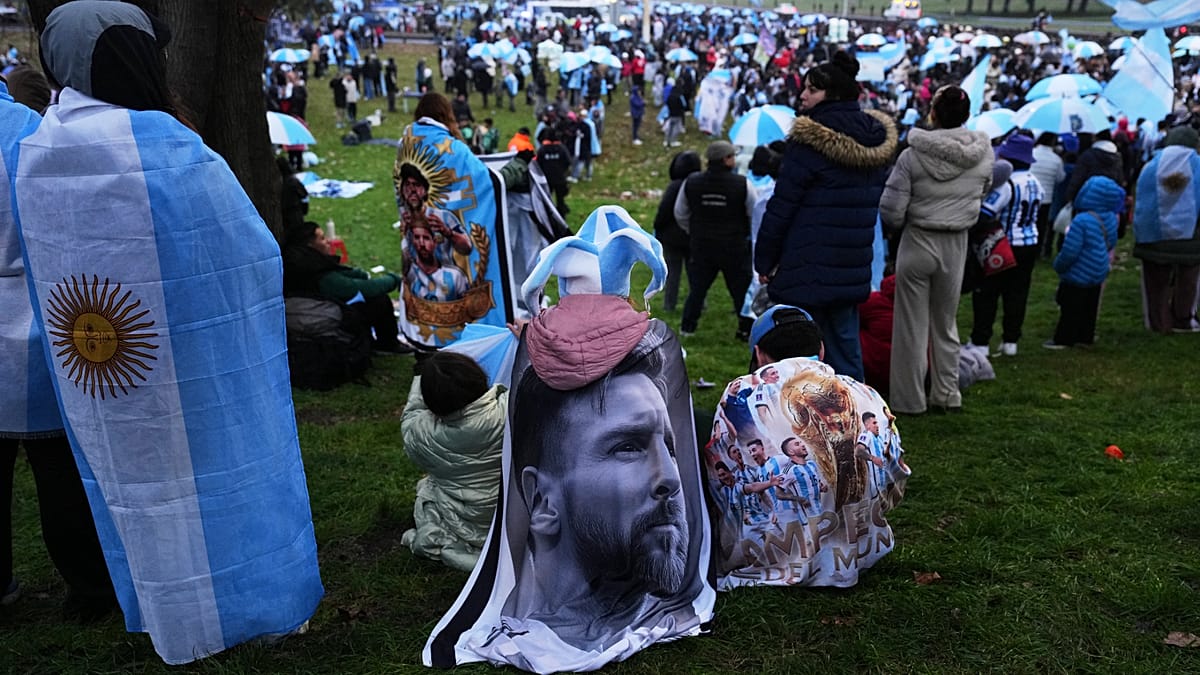
Spain's victory in the World Cup final was, for many, a logical outcome of superior teamwork and tactical discipline. Yet in Argentina, the loss has triggered an avalanche of conspiracy theories that reveal as much about the country's psyche as about the match itself.
Argentine television and social media have been flooded with elaborate narratives claiming the team was cheated. One theory suggests FIFA orchestrated the result to anoint Lamine Yamal, the 19-year-old Spanish striker, as the successor to Lionel Messi. Another posits that FIFA president Gianni Infantino wanted to diversify World Cup winners for commercial gain.
More outlandish claims involve the FBI preparing to arrest Argentine football association boss Claudio "Chiqui" Tapia, destabilising the squad. Messi's on-field comment to teammates — "Forget about everything, let's just play" — is cited as evidence of this fear. There is even a theory linking King Charles III to a punishment for Argentina's players over a banner reading "Las Malvinas son argentinas" (the Falklands belong to Argentina) waved during the semi-final against England.
Politically, some Argentines see the defeat as part of a global campaign to undermine President Javier Milei's austerity agenda, with Spanish "woke" propaganda allegedly backed by Russian bots and Bolivian activists. These narratives, while entertaining, are detached from reality.
The match statistics tell a clear story: Spain dominated possession with 68%, took 20 shots (11 on target), and doubled Argentina's passes with higher accuracy. Argentina's Leandro Paredes was sent off, while Spain's substitutions, notably Ferran Torres, proved decisive. Messi was largely absent from the game.
So why do these theories persist? As discussed on Europe Today, football in Latin America carries immense social and political weight. Losing is not just a sporting disappointment; it can feel like a national humiliation. This emotional intensity, combined with a tradition of theatricality, fuels a willingness to embrace alternative explanations.
Michael Reid, a Euronews contributor, noted the influence of Italian football culture on Argentina. The aggressive, defensive style known as catenaccio, perfected by Italian teams in the 1960s and 1970s, has been adopted by Argentine sides. He suggested that understanding this mindset might require a psychoanalyst — fittingly, Argentina has one of the highest ratios of psychoanalysts per capita in the world.
The conspiracy theories also highlight a broader post-truth phenomenon. In an era where misinformation spreads rapidly, even sporting events become battlegrounds for competing realities. The petition to expel Argentina from the World Cup, which has garnered millions of signatures, exemplifies how online outrage can amplify unfounded claims.
Meanwhile, FIFA has launched an investigation into the post-final clashes and the political banner, as reported in FIFA's probe into Argentina. The incident has also drawn condemnation from Spain's coach, who described the Argentine players' conduct as "intolerable" in his statement.
For all the drama, the conspiracy theories ultimately serve as a coping mechanism for a nation that invests so much of its identity in football. As one commentator put it, Argentina brings "the theatrics, the excess, the comedy and the tragedy" to the sport. In a world where facts are often secondary to narratives, that may be the most honest explanation of all.