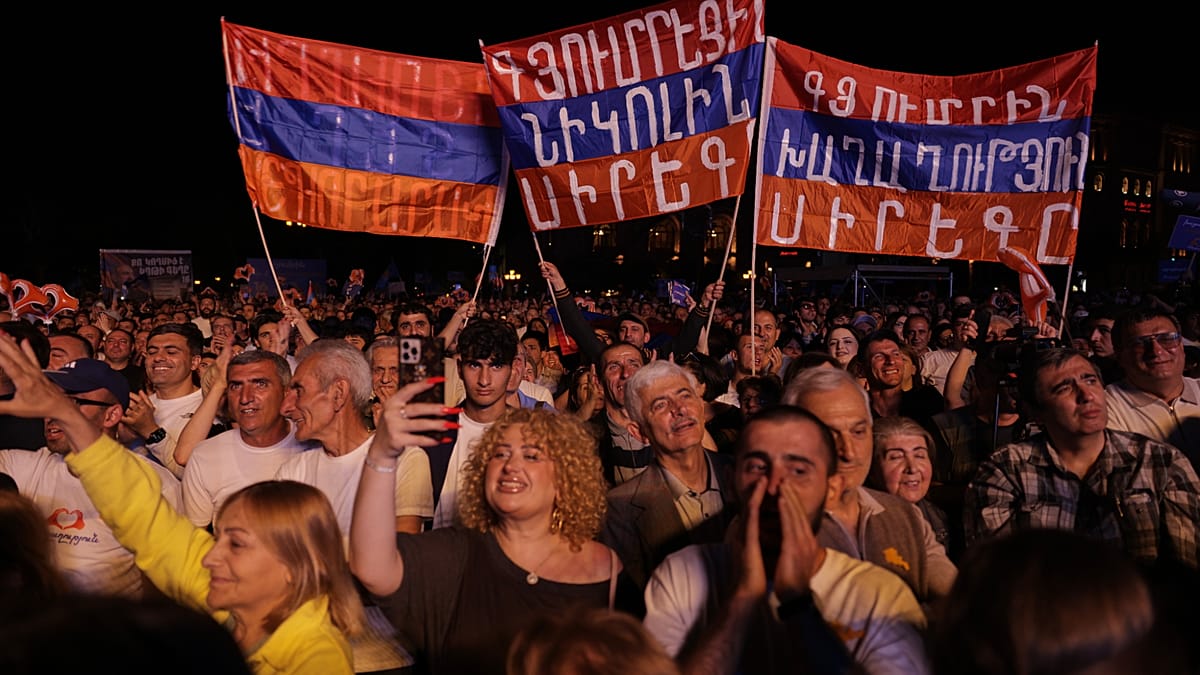
Armenians head to the polls on Sunday in a parliamentary election that will determine whether the South Caucasus nation continues its cautious realignment toward Europe or remains in Moscow's orbit. The vote pits Prime Minister Nikol Pashinyan's centrist Civil Contract party against a fractured pro-Russian opposition, with the Kremlin warning Yerevan of a potential 'Ukraine scenario' while the European Union and the United States have thrown their weight behind Pashinyan.
Pashinyan, who came to power after the 2018 Velvet Revolution, has staked his political future on a historic peace agreement with Azerbaijan signed last year at the White House. That deal, which ended decades of conflict over Nagorno-Karabakh, has been deeply controversial at home. Critics accuse him of betraying Armenian national interests, but Pashinyan has defended the move as essential for the country's survival.
'Abandoning Karabakh was my greatest service to Armenia,' Pashinyan said during a campaign rally in Yerevan. 'We were put in a trap and if we continued on that path, we would lose Armenia and Armenian statehood.' He added that 'we have no right to pass this bleeding wound from generation to generation, we must pass peace on to our children.'
Pro-Western Pivot Faces Russian Pressure
The election takes place against a backdrop of intensifying Russian economic pressure. Moscow has imposed export restrictions on Armenian goods and threatened cuts to vital oil and gas supplies. In response, the European Commission announced a support package for Armenia, with Commission President Ursula von der Leyen stating that Moscow has 'weaponised economic relations for political pressure.' She added, 'We know this playbook all too well. This is why Europe stands firmly with Armenia.'
The EU's support was detailed in a separate announcement, as the bloc unveiled a comprehensive aid package to help Yerevan weather Russian sanctions. US President Donald Trump also weighed in, calling on Armenians to 'Make Armenia Great Again' and declaring his 'complete and total endorsement' for Pashinyan's re-election—the first time a US president has endorsed a candidate in a country traditionally within Russia's sphere of influence.
Despite this Western backing, Pashinyan has taken care not to burn bridges with Moscow entirely. On Thursday, he agreed to travel to Moscow for talks with Russian President Vladimir Putin, stating that 'we will not engage in a war of words with Russia, we will calmly defend Armenia's positions.' He also described Armenia's EU membership bid as 'theoretical' for now and affirmed that Yerevan would continue working within the Eurasian Economic Union.
'Relations with Russia are in a transformational phase,' Pashinyan said. 'But I consider this process positive. Our relations remain open and sincere, and we have kept no dark corners in that relationship.'
Opposition Divided, Polls Favor Pashinyan
A Breavis poll published days before the vote projects Pashinyan winning over 60% of decided voters, with no opposition party expected to exceed 12%. The fragmented opposition includes the Strong Armenia party, led by Russian-Armenian billionaire Samvel Karapetyan—who is running while under house arrest—and former President Robert Kocharyan, both running on pro-Moscow platforms.
On the eve of the election, Armenia's Investigative Committee arrested six candidates from Strong Armenia on allegations of money laundering and material inducement, following judicial authorization from the Central Election Commission. Meanwhile, Armenian media and civil society groups have reported a sharp increase in Armenians arriving from Russia to vote, amid allegations of widespread Russian disinformation campaigns—charges Moscow denies.
The election's outcome will have profound implications not just for Armenia but for the entire South Caucasus region. A decisive Pashinyan victory would solidify the country's pro-Western trajectory and the peace deal with Azerbaijan, potentially opening the door to greater EU and US investment. But it would also set Yerevan on a collision course with the Kremlin, which views the South Caucasus as part of its traditional sphere of influence.
As Armenians cast their ballots, the choice is stark: continue with Pashinyan's vision of a peaceful, pro-Western future, or return to the orbit of a Russia that has shown it is willing to use economic and political pressure to keep its former Soviet republics in line.