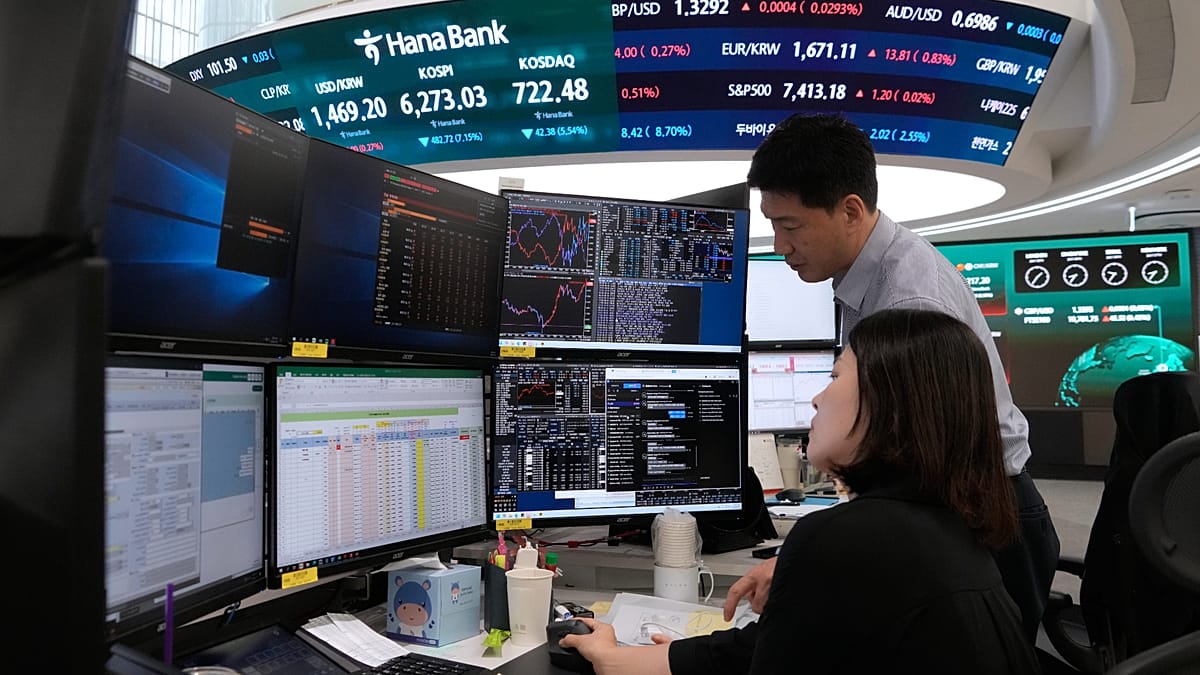
Asian equity markets took a sharp hit on Tuesday, led by a dramatic sell-off in semiconductor stocks that raised fresh questions about the sustainability of the artificial intelligence boom. South Korea's benchmark Kospi index plunged more than 10% in overnight trading, falling to its lowest level since April and triggering a temporary halt in trading. The decline was driven by heavy losses in the country's two largest chipmakers: Samsung Electronics fell 12%, while SK Hynix dropped 12.7%.
The rout extended across the region. Tokyo's Nikkei 225 slid 4%, Taiwan's Taiex lost 3.9%, and the Shanghai Composite shed 1%. Hong Kong's Hang Seng edged 0.1% lower. Only Australia's S&P/ASX 200 bucked the trend, gaining 0.6%.
Why chip stocks are under pressure
Analysts attribute the sell-off to growing concerns that the AI-driven rally in chip stocks may have overshot. A key catalyst is the perception that competition from Chinese AI startups and chipmakers could erode the market share and pricing power of established global players. The concern was underscored by the spectacular market debut of Chinese chipmaker CXMT on Monday, whose shares surged 466% on Shanghai's STAR exchange. CXMT raised at least $8.6 billion (€7.6 billion) in its initial public offering, signaling strong investor appetite for domestic alternatives.
“The market is reassessing the valuation of AI-related stocks in light of potential supply-side disruptions and new entrants,” said one Seoul-based analyst. “If Chinese firms can produce competitive chips at lower cost, the profit margins of incumbents like Samsung and SK Hynix could come under pressure.”
The sell-off in Asia has implications for European markets, where semiconductor companies such as ASML (based in Veldhoven, Netherlands), Infineon (Munich), and STMicroelectronics (Geneva) are heavily exposed to the same global trends. European indices are expected to open lower as investors digest the news. The tech-heavy Frankfurt Stock Exchange and Paris's CAC 40 are likely to be particularly affected.
Meanwhile, oil prices continued to decline as geopolitical tensions in the Middle East eased. Brent crude fell 0.8% to $85.16 a barrel, and US benchmark crude lost 0.9% to $81.86, after mediators reported progress in bringing the US and Iran back to negotiations. The relative calm in energy markets has done little to offset the broader risk-off sentiment.
For European investors, the Asian sell-off serves as a reminder of the interconnected nature of global tech supply chains. The continent's own chip industry, which has benefited from EU efforts to boost domestic production through the European Chips Act, may face headwinds if demand for AI-related hardware falters. However, some analysts argue that European semiconductor firms are less exposed to the consumer electronics cycle than their Asian counterparts and could prove more resilient.
As the trading day unfolds in Europe, all eyes will be on how the region's tech-heavy indices react. The coming days will test whether the AI boom has further room to run or whether the market is entering a correction phase.