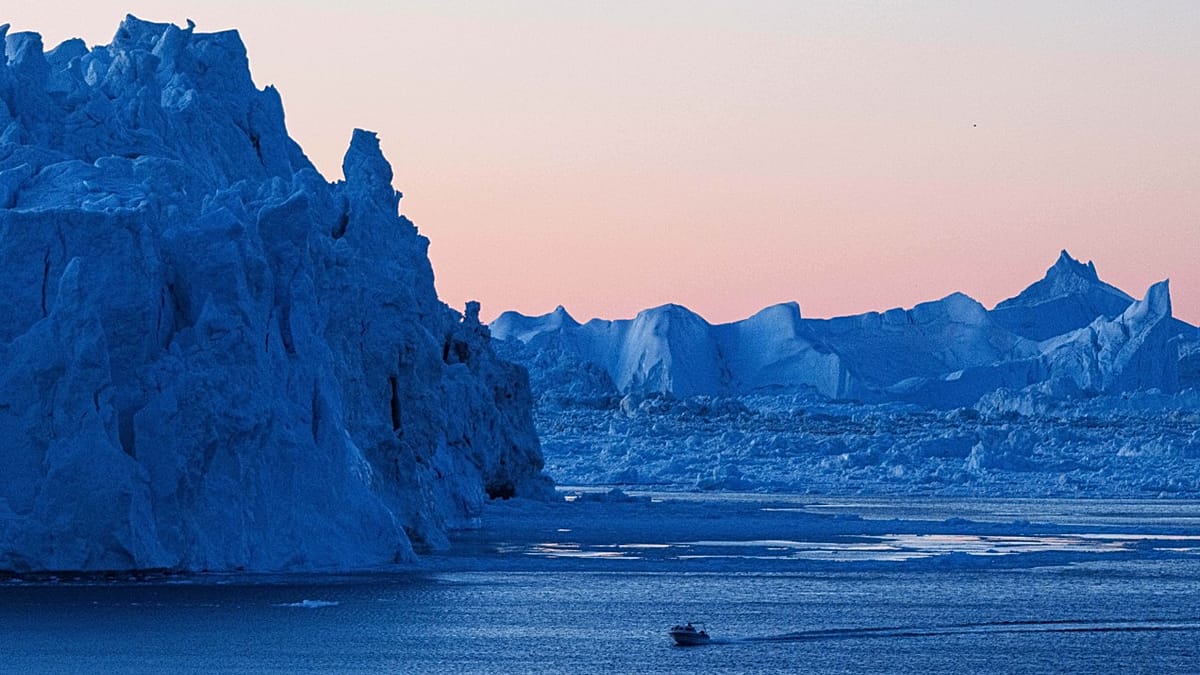
In the North Atlantic, south of Greenland, a patch of ocean has been defying global warming trends: the so-called 'cold blob,' the only region on Earth where sea surface temperatures have actually dropped over recent decades. A new study led by Prof. Dr. Stefan Rahmstorf of the Potsdam Institute for Climate Impact Research (PIK), published in Geophysical Research Letters, provides fresh evidence that this anomaly is a direct consequence of a weakening Atlantic Meridional Overturning Circulation (AMOC).
The AMOC is a vast system of ocean currents that transports warm water northward along the Atlantic surface and cold water southward along the seabed. It is one of the planet's most critical heat-distribution mechanisms, and its slowdown has long been a concern for climate scientists. The study's analysis of temperature data from the North Atlantic concludes that changes in ocean heat transport are the primary driver of the cold blob, not atmospheric factors.
“This is a cause for concern, as any further weakening of Atlantic heat transport in the course of future climate change could have severe impacts on climate and weather conditions in Europe and other parts of the world,” the researchers write. The findings align with earlier research suggesting that melting ice sheets—by altering the salinity and density of seawater—can disrupt the sinking of surface water that drives the AMOC. Freshwater from melting ice reduces salinity, making water less dense and slowing the current.
What an AMOC Collapse Would Mean for Europe
The implications for Europe are stark. In February, the Nordic Council—whose members include Denmark, Iceland, Norway, Sweden, and Finland, with Åland, the Faroe Islands, and Greenland as associates—warned that winter temperatures in Iceland could plummet to minus 45 degrees Celsius, encasing the island in ice for the first time since the Viking Age. Such a scenario would not be isolated; northern Europe could face dramatically colder winters, while sea levels along the U.S. east coast would rise rapidly as the current no longer pushes water away from the land. Atlantic storms would also intensify.
The study speaks of “early warning signals” that the AMOC is approaching a tipping point, with “clear evidence of a weakening AMOC.” The authors stress that “this risk requires urgent attention from policymakers.” Historical precedents, such as the Younger Dryas cold period around 12,500 years ago, show that it took about 100 years for the AMOC to fully recover, with Greenland’s temperatures needing 40 years to rebound from glacial conditions.
This research adds to a growing body of evidence that Europe’s climate is more fragile than previously assumed. As human-driven climate change makes rare coastal floods 12 times more likely, the potential for an AMOC collapse underscores the interconnected risks facing the continent. The cold blob is not just a scientific curiosity—it is a warning signal that demands a coordinated European response.