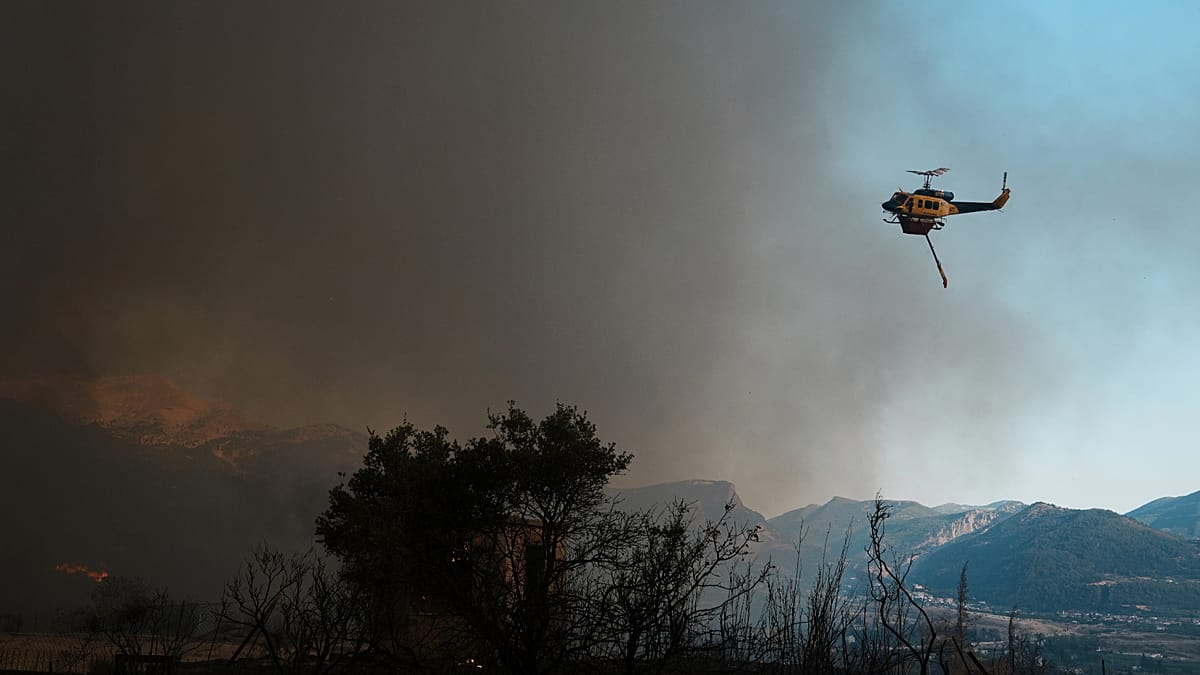
A wildfire erupted on Friday afternoon in a forested area near Athens, forcing authorities to issue evacuation alerts and mobilise a substantial firefighting operation. The blaze started at approximately 15:29 local time on the slopes of Mount Poikilo, in the Aspropyrgos area west of the Greek capital, and was reported to be advancing southwards.
The Greek fire service said that 108 firefighters, supported by six ground teams from the 1st EMODE special wildfire unit and 27 vehicles, are working to contain the flames. Aerial support includes five aircraft and six helicopters, one of which is coordinating operations. Municipal water tankers from Aspropyrgos, Fyli, Petroupoli and Peristeri have also been deployed to assist.
Two alerts were sent through the 112 emergency system. The first, at 16:03, informed residents in the wider area about the fire. A second message at 16:22 specifically urged people in Afaia Haidariou and Ano Dasos Haidariou to move towards Peristeri via Athinon Avenue. An earlier alert had advised residents to remain on standby.
The fire service noted that the region is classified as Category 4, indicating a very high risk of wildfires. The Western Attica Arson Crimes Investigation Unit has been activated to determine the cause of the blaze.
Greece's wildfire season intensifies
This incident adds to a challenging summer for southern Europe, where rising wildfire risk has become a recurring concern despite overall fewer blazes. Greece, like its neighbours, has faced repeated outbreaks, often exacerbated by heatwaves and strong winds.
The response in Aspropyrgos reflects the country's heightened preparedness, with specialised units and aerial assets deployed rapidly. However, the activation of the arson investigation unit underscores the authorities' concern about deliberate or negligent ignition sources.
Across the Mediterranean, similar scenes have unfolded this summer. In Turkey, five active wildfires have been burning amid persistent heat and wind, prompting evacuations along the Aegean and Mediterranean coasts. In France, a blaze near Brignoles in Provence forced the Clooneys to flee their home, while in Spain, wildfire season has fuelled false claims about solar farms and funding.
European officials have repeatedly warned about the growing threat. The EU's crisis management chief has called wildfires a wake-up call, and climate deniers have faced backlash for downplaying the risks. Teresa Ribera, Spain's ecological transition minister, has accused climate deniers of endangering lives as wildfires scorch the continent.
For now, the immediate priority in Aspropyrgos is to protect lives and property. The fire service has urged residents to follow instructions from authorities and to stay alert. The cause of the blaze remains under investigation, but the conditions are ripe for rapid spread.
As the climate continues to warm, southern European nations are bracing for longer and more intense fire seasons. The events near Athens are a stark reminder of the challenges ahead, and of the need for robust prevention and response strategies across the continent.