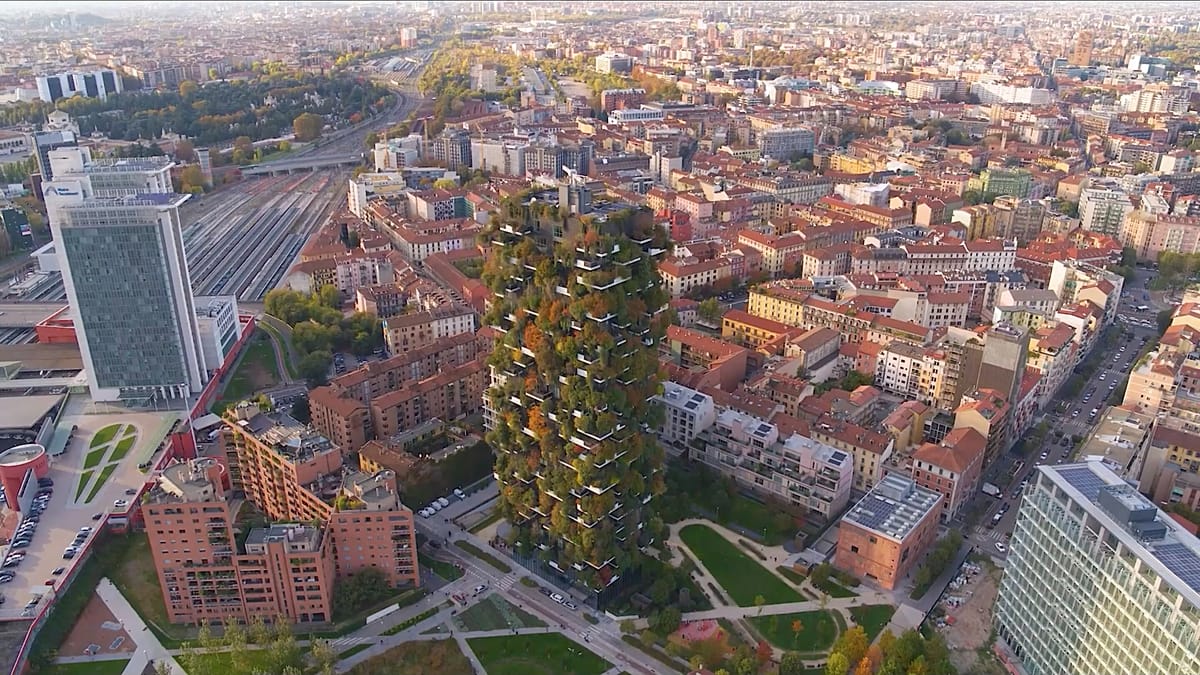
Milan, once synonymous with smog and industrial grit, is now being held up as a global model for bringing nature back into the urban fabric. The city's ambitious reforestation programme, Forestami, has been named a UN World Restoration Flagship, the only European project to receive the honour at this year's biodiversity summit in Yerevan, Armenia.
The recognition, announced on 29 October during COP17, highlights how the Lombard capital is tackling its notorious air pollution. An October ranking by IQAir placed Milan seventh among the world's ten most polluted cities, the sole European entry. Its position in the Po Basin, a low-lying plain that traps air, combined with heavy industry and intensive agriculture, creates a persistent brown haze over the city's historic rooftops.
Forestami, launched in 2019, is the brainchild of architect Stefano Boeri, who designed Milan's celebrated Bosco Verticale, or Vertical Forest, a pair of residential towers draped in thousands of trees and shrubs. The project's goal is to plant one tree for every resident, roughly three million trees and shrubs by 2030. So far, nearly 640,000 have taken root across streets, courtyards, former industrial lots, and even on building facades.
“Greenery is the cheapest and most effective filter for fine dust, a natural coolant for the city, and a proven boost to mental and physical wellbeing,” says a spokesperson for Fondazione Forestami, the organisation behind the initiative. The UN Environment Programme (UNEP) estimates that the project has restored an area equivalent to 350 football pitches of degraded urban land, including disused parking lots and storage yards.
A European first for urban restoration
The UN World Restoration Flagship status, awarded to only five projects globally, recognises “ambitious and promising examples of large-scale, long-term restoration.” Milan joins initiatives in Colombia, the United States, Ethiopia, and China, but stands out as the sole European representative. UNEP praised the project for “expanding access to green space, engaging schoolchildren, and restoring sites including former industrial areas, parking lots and storage yards.”
Boeri, who received a European Lung Foundation award earlier this year for his work on air quality, sees the UN recognition as a vindication of a broader vision. “We are not just planting trees; we are rebuilding a relationship between the city and its natural environment,” he said in a statement. The project has also become a civic movement, with residents, schools, and businesses participating in planting days and maintenance workshops.
The Milanese model is being watched closely by other European cities struggling with air pollution, from Italian cities facing cost-of-living pressures to industrial hubs in Poland and Germany. While the project's immediate focus is on Milan, its principles—integrating green infrastructure into dense urban planning—are transferable across the continent.
UNEP's broader assessment of global restoration efforts, released on the same day, offers a sobering counterpoint. While 252 million hectares are now under restoration across 149 countries, the largest documented effort to date, the pace remains insufficient. “We are witnessing the makings of one of the largest movements for nature in recorded history,” said Inger Andersen, UNEP's Executive Director. “Yet, at the halfway point of the UN Decade on Ecosystem Restoration, we are still not restoring nature at the scale or speed required.”
The report highlights uneven progress towards the '30x30' target of protecting 30 per cent of degraded land and sea by 2030. Terrestrial restoration has reached nearly half the global goal, but freshwater, marine, and coastal ecosystems—which are degrading fastest—lag behind. Annual restoration finance would need to more than quadruple to meet the challenge.
Astrid Schomaker, Executive Secretary of the Convention on Biological Diversity, warned that restoration cannot succeed while destruction continues. “We cannot expect to fix nature with one hand while we destroy it with the other one,” she said. “Governments must address the drivers of ecosystem degradation and invest in monitoring mechanisms to ensure the durability of the restoration movement to date.”
For Milan, the UN flag is both an accolade and a challenge. The city has committed to planting the remaining 2.4 million trees by 2030, a task that will require sustained political will and public engagement. But as Boeri points out, the benefits extend far beyond cleaner air. “A greener Milan is a more resilient, more liveable city,” he said. “It is a blueprint for how Europe's urban centres can adapt to the climate crisis.”
The project's success also resonates with other European restoration efforts, from heritage restoration in Pompeii to nature-based tourism awards in Montenegro. As the continent grapples with heatwaves, flooding, and biodiversity loss, Milan's example offers a practical, scalable answer.