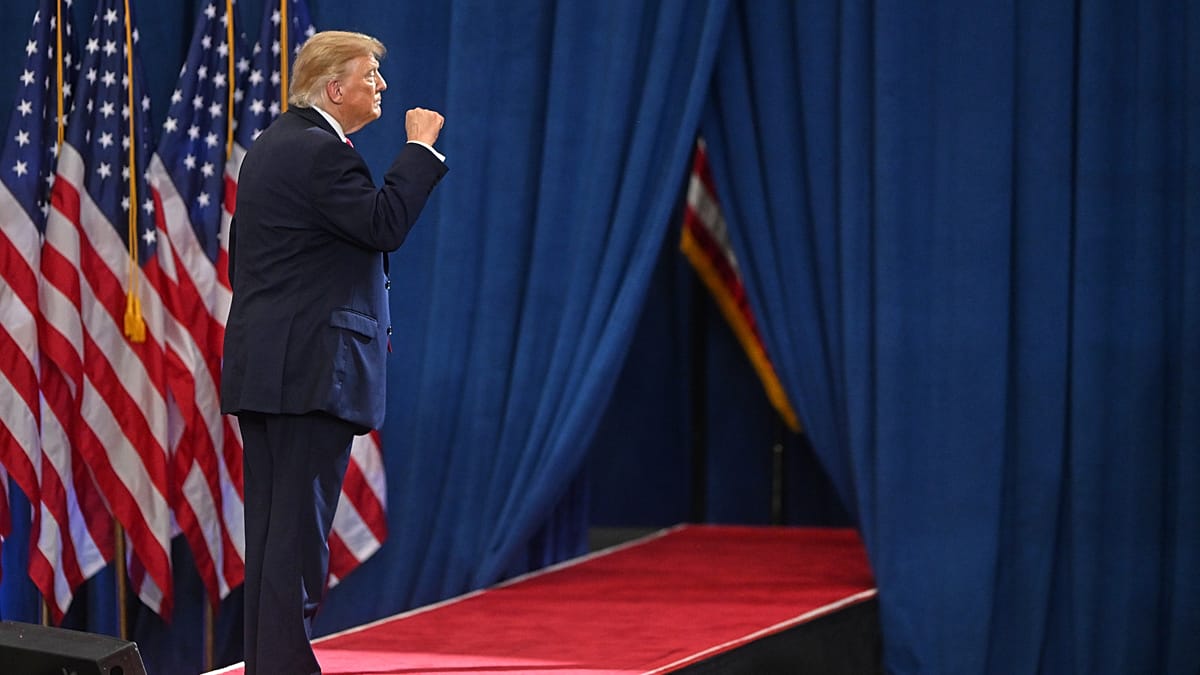
President Donald Trump has announced the termination of federal methane regulations for the US oil and gas industry, a move that reverses one of the previous administration's key climate policies. Speaking at a rally in Lubbock, Texas, on Tuesday, Trump declared, "Tonight, I'm officially terminating Biden's expensive and unnecessary methane regulations to save consumers and energy producers $45 billion."
The regulations, introduced under former President Joe Biden, required oil and gas companies to monitor and fix methane leaks, which are a major source of greenhouse gas emissions. Trump told the cheering crowd that the decision would "unlock vast quantities of Texas natural gas," a state that leads the US in fossil fuel production.
The Environmental Protection Agency (EPA) had earlier this month estimated the savings at $45 billion (around €39 billion), though it did not provide a detailed breakdown. EPA administrator Lee Zeldin defended the move, saying, "Americans must be able to afford to heat their homes in the winter and fill up their car and drive to work. They can't do that when the people producing the energy are weighed down by unnecessary burdens."
Methane's role in global warming
Methane, the primary component of natural gas, is the second-largest contributor to global warming after carbon dioxide. It accounts for roughly a third of the rise in global temperatures since pre-industrial times, or about 0.5°C. Although methane traps significantly more heat than CO₂, it has a much shorter atmospheric lifetime—just seven to 12 years—compared with centuries for CO₂.
According to the International Energy Agency (IEA), the United States is the world's largest source of methane emissions from oil and gas production, followed by Russia. The rollback comes as Trump seeks to lower energy costs ahead of next week's midterm elections, with rising oil prices linked to the US conflict with Iran fueling voter frustration.
Environmental groups and climate experts have criticized the decision, arguing that it undermines efforts to meet global climate targets. The European Union, which has been tightening its own methane regulations, may face increased pressure to address transatlantic emissions. The EU's enlargement debates and its broader climate diplomacy could be affected by the US policy shift.
The rollback also has implications for international energy markets. European countries, which have been diversifying their energy supplies since the war in Ukraine, may see US liquefied natural gas (LNG) exports as less climate-friendly. This could influence decisions in Brussels and national capitals about future energy imports.
While the EPA's savings estimate is contested, the administration argues that the rule would reduce compliance costs for producers, potentially lowering energy prices for consumers. However, independent analysts note that methane leaks represent wasted product, and fixing them can be cost-effective in the long run.
The move is part of a broader pattern of deregulation under the Trump administration, which has also rolled back other environmental protections. As the US heads to the polls, the decision is likely to become a talking point in the midterm campaigns, with Republicans touting it as a win for energy independence and Democrats warning of climate consequences.
For Europe, the development underscores the challenge of coordinating climate policy with a US administration that has repeatedly questioned the scientific consensus on global warming. The EU's own methane strategy, which aims to reduce emissions by 30% by 2030, may now face a more difficult international landscape.