Scientists have issued a stark warning about the growing intensity of fire-promoting weather across southern Europe, even as the number of wildfires declines. A new study published in Scientific Reports reveals that in parts of France and Spain, the conditions that fuel wildfires—hot, dry, and windy weather—have intensified by up to 50 percent over the past decade compared with the 1981–2010 baseline.
The research, which analysed national wildfire records from Portugal, Spain, France, Italy and Greece alongside climate data from 1981 to 2025, found that the number of summer days with highly fire-promoting conditions has more than doubled in some regions, from fewer than ten days per summer to around 25 days in recent years. The authors link this increase to large-scale climate patterns, including El Niño, and note that smaller air-pressure differences across the North Atlantic have coincided with more fire-promoting weather in Greece, Italy, Corsica and Spain.
While human-caused climate change—driven by fossil fuel burning—has raised global surface temperatures by roughly 1.3–1.5°C above pre-industrial levels, El Niño events have added a temporary boost of about 0.2°C. Europe, according to the EU’s Copernicus Climate Change Service, is warming twice as fast as the global average. A separate attribution analysis from World Weather Attribution found that the June 2025 heatwave, which pushed temperatures to 40°C in several countries, would have been virtually impossible just 50 years ago.
Fewer fires, but greater danger
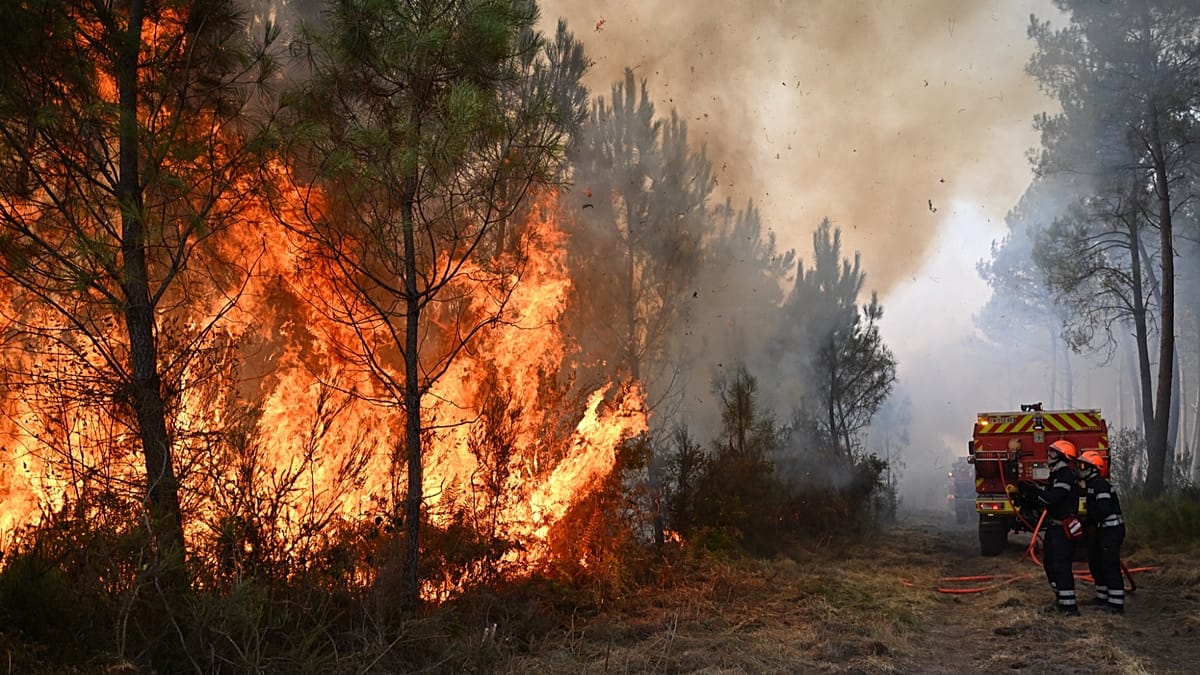
Despite the worsening weather conditions, the annual number of wildfires across the five countries has dropped by roughly 40 percent over the past decade compared with the 1981–2010 period. This suggests that fire management efforts—including better training for brigades, improved public awareness, and more effective early warning systems—are paying off. However, the blazes that do occur are becoming more intense and harder to control. In recent weeks, uncontained fires have swept across Spain and France, scorching more than 120,000 hectares and forcing over 300,000 people to evacuate—the largest such operation since World War II. In southwest France, a fire four times the size of Paris threatened to surge again in late July, while three firefighters died on the Greek island of Crete.
The EU’s firefighting capacity is struggling to keep pace. Some fires have grown so powerful that they have generated their own thunderstorms, a phenomenon that complicates suppression efforts. The bloc’s emergency response systems have helped contain some spread, but the increasing intensity of blazes is testing the limits of current resources.
Solutions on the ground
Experts argue that while tackling climate change by transitioning to clean energy is essential, there are immediate measures that can reduce wildfire risk. Prescribed burns—intentionally setting fire to designated areas under controlled conditions—can clear dead vegetation and reduce the severity of subsequent wildfires by an average of 16 percent, according to a 2025 Stanford University study. The same research found that such burns also cut net smoke pollution by 14 percent.
Sustainable land-use management is another critical tool. The World Wildlife Fund (WWF) stresses the importance of regulating land-use change and updating zoning guidance to prevent development in high-risk areas. After a fire, rehabilitating burned land with climate-adapted vegetation can reduce the risk of floods and soil erosion.
Restoring wetlands and healthy water systems also offers a natural defence. Wetlands and rivers absorb, store and slowly release water, acting as natural fire breaks. However, depleting water levels and degradation are weakening their ability to stop the spread of blazes. Reintroducing species such as beavers, which create wetland habitats that can slow fire progression, is also being considered by some environmental groups.
As Europe braces for yet another heatwave, the message from scientists and environmental organisations is clear: the continent must adapt to a new reality of heightened wildfire risk, even as it works to reduce the number of fires. The combination of better management, landscape restoration, and climate action offers the best hope for protecting lives, property, and ecosystems.