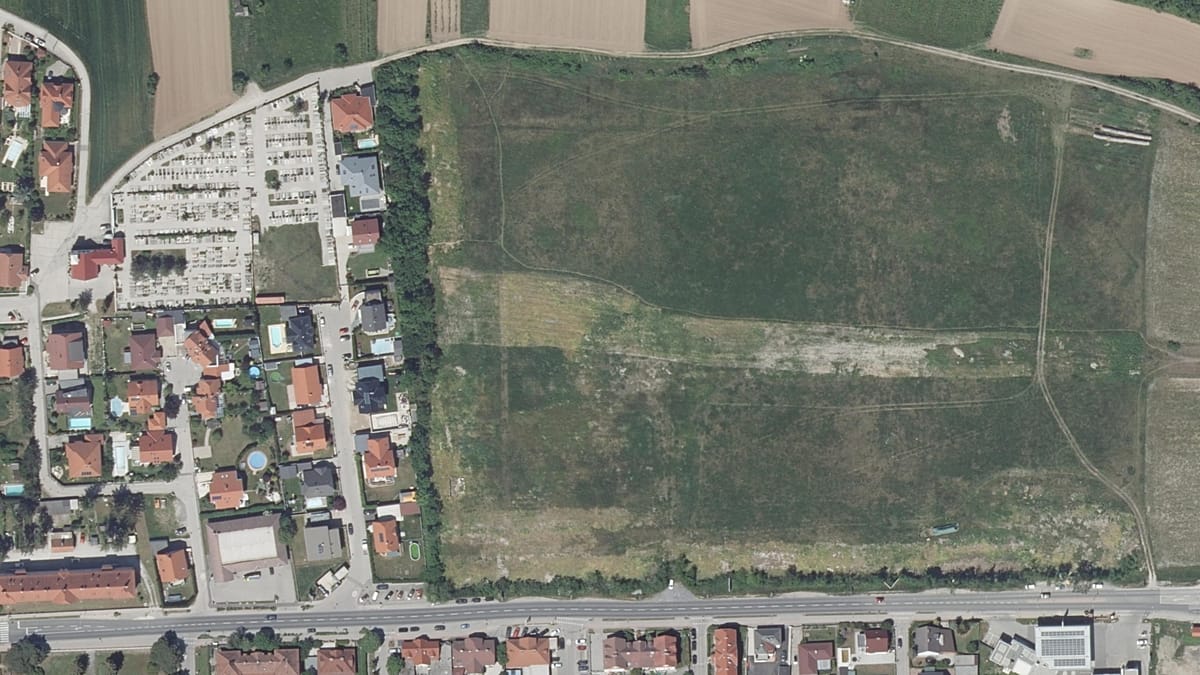
In the Austrian town of Leobersdorf, about 40 kilometres south of Vienna, a few crumbling concrete blocks in an overgrown field are the last visible remnants of what was once a sprawling Nazi forced-labour complex. Now, construction of a business park on that land—including a cold storage warehouse and a Lidl supermarket—has reignited a painful debate about Austria's handling of its Nazi past.
“For me, it's a sad feeling, because a place burdened by history is being built over, sacrificed to the economy,” said Erich Strobl, who leads a local campaign to preserve part of the site. His words capture the mood of many who see the development as a betrayal of memory.
A site of female suffering
After Nazi Germany annexed Austria in 1938, the Weinberglager complex was used to hold thousands of prisoners of war and forced labourers. Later, it became home to the Hirtenberg subcamp of the Mauthausen concentration camp—one of Austria's largest camps exclusively for women. Between September 1944 and April 1945, around 400 women, mainly from the Soviet Union but also from Italy and Poland, were imprisoned there and forced to produce infantry munitions at a nearby factory.
Although some factory ruins survive, the camp barracks and most other structures were demolished, repurposed, or destroyed in the decades after the war. The site's historical significance, however, remains. Bertrand Perz, a historian specialising in the Mauthausen camp, told AFP that Hirtenberg is “historically important,” partly because “women prisoners in Mauthausen have been marginalised in the culture of remembrance.”
The plans for the business park were made public in 2024. Archaeological investigations have identified surviving traces of the camp, but Austria's Federal Monuments Office concluded that the remains were “not sufficient” for monument protection. With bulldozers now on site, activists have renewed their calls for preservation.
“A former concentration camp must not be built over with new structures,” said the International Mauthausen Committee.
Standing in front of the site, where grey columns already rise from the ground, Josef Pumberger, a board member of the Mauthausen Committee Austria, expressed his frustration: “Grief, anger, rage, that something like this can happen in Austria in the year 2026.”
Political entanglements
The controversy is deepened by the land's ownership history. The plot was previously owned by a company linked to the local mayor, Andreas Ramharter, which sold it in 2022 and 2023 for more than €15 million, according to local media reports. Austrian company TRA LEO GmbH & Co KG, which bought the land, told AFP it had offered to support the creation of a memorial on the site. Lidl confirmed plans to open a store in the business park but stressed that it would be located “not directly on the site of the former concentration camp, but on an adjacent plot of land.”
This episode comes as Austria continues to grapple with its historical legacy. For decades after the Second World War, the country portrayed itself as a victim of Nazi Germany, ignoring the complicity of many Austrians. It was only from the late 1980s that Austria began to seriously examine its responsibility in the Holocaust. Perz noted that a debate like the one over Hirtenberg “would have been impossible in the 1980s,” and that there is now “more sensitivity” towards former Nazi sites.
Yet in contemporary Austria, demands for remembrance increasingly clash with “the opposite tendency, namely to say: 'Now this really has to stop',” he added. The far-right FPÖ, founded by former Nazis, topped Austria's 2024 parliamentary election, though it failed to find partners to govern. It is, however, part of the governing coalition in five of the country's nine states.
In central Leobersdorf, locals approached by AFP had either not heard about the development or did not want to discuss it. A stele memorial was erected in 2024 to commemorate the victims of the Hirtenberg camp, but for Pumberger that is not enough. “It is very important to have tangible evidence of the buildings in which the Nazis imprisoned people, tortured them, killed them,” he said.
The situation in Leobersdorf echoes broader European debates about how to balance development with remembrance. As climate change reshapes Austria's landscape, the country is also being forced to confront its historical landscape. The outcome of this dispute could set a precedent for how other former Nazi sites are treated across the continent.