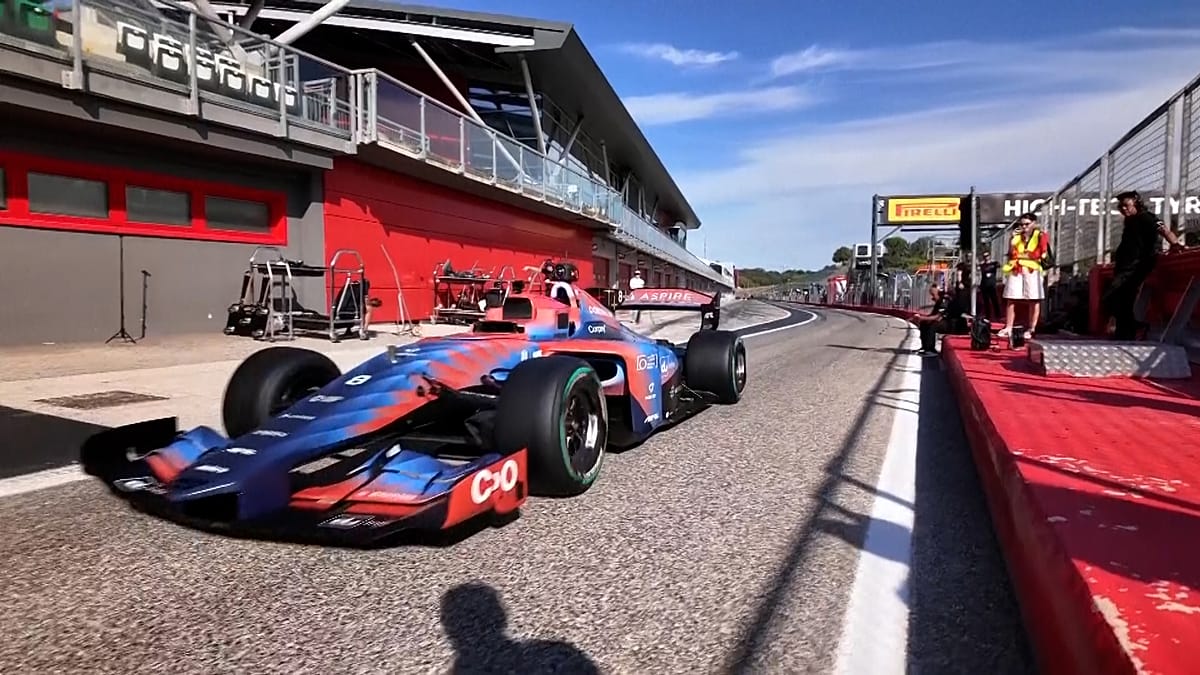
Imola, the storied circuit that has hosted Formula 1 grands prix, witnessed a different kind of motorsport milestone on Saturday: Europe's first multi-car race for fully autonomous vehicles. Five teams from the Abu Dhabi Autonomous Racing League (A2RL) brought their driverless single-seaters to the Italian track, competing without steering wheels, pedals, or human pilots.
The teams represented Germany, Italy, and the United Arab Emirates, each fielding the same SF23 chassis built by Dallara for Japan's Super Formula series—one of the fastest racing categories outside Formula 1. But the human controls were stripped out, replaced by a suite of cameras, radar, and lidar sensors feeding an onboard computer that handles all driving decisions.
Despite the absence of drivers, the paddock felt familiar: mechanics tweaked suspension, engines roared, and engineers scrutinized telemetry streams. The difference is that the "driver" is a software stack developed over months of simulation and testing.
Programming as the new pit lane
For the teams, victory is won long before the lights go out. "The competition is fought largely through programming, simulator sessions and the constant search for a balance between speed and risk," said Alexander Winkler, A2RL's head of sporting. Racing wheel-to-wheel at high speeds, he explained, creates scenarios and data that are nearly impossible to replicate on public roads.
Marko Bertogna, a professor at the University of Modena and Reggio Emilia, described the challenge in stark terms: "To me, as a professor, this is probably one of the most difficult engineering problems you have today. It is not just autonomous driving, but autonomous driving at the very, very limit of handling."
Once the race begins, engineers must step back. "When the race starts, it's hands off," said Sascha Buettner, team lead of TUM, the Technical University of Munich's entry. "And so this is basically just letting a child do its thing and just looking at them and, you know, wishing them all the best, essentially hoping to be proud. But, of course, that can go wrong. Our AI driver can stumble, it is all possible."
The 12-lap race was won by Kinetiz, a team from the UAE. But for the organisers, the result is secondary to a broader mission: demonstrating that autonomous systems can be trusted.
Building trust in AI
"Create trust. I think this is the biggest issue we will have with AI going forward," said Stephane Timpano, CEO of ASPIRE, the organisation behind A2RL. "A lot of people are reluctant to engage with AI, are worried about what is going to happen with their jobs, their life and what AI is able to do."
By putting autonomous cars on a familiar racing stage, the league hopes to show that AI can handle extreme, unpredictable situations—and, by extension, that it can be reliable in everyday contexts. Timpano acknowledged that the technology still cannot replicate the full creativity of a human driver. "Still today, this car is not able to reproduce the fantasy of a driver. You don't see that in the car," he said. "With time, it may get there. But I see it the other way around. Our human pilot can use AI to have a better performance in the safest way."
The event comes as Europe grapples with the broader implications of artificial intelligence, from medical research to geopolitical competition. For the teams at Imola, the race is a proving ground—not just for software, but for the idea that machines can be trusted at the edge of their capabilities.
A2RL, founded in 2023 and based in Abu Dhabi, plans to expand the series, with future events likely to test the limits of autonomous racing even further. For now, Imola has set a precedent: the next generation of motorsport may not need a human at the wheel, but it still needs a team of brilliant minds behind the code.