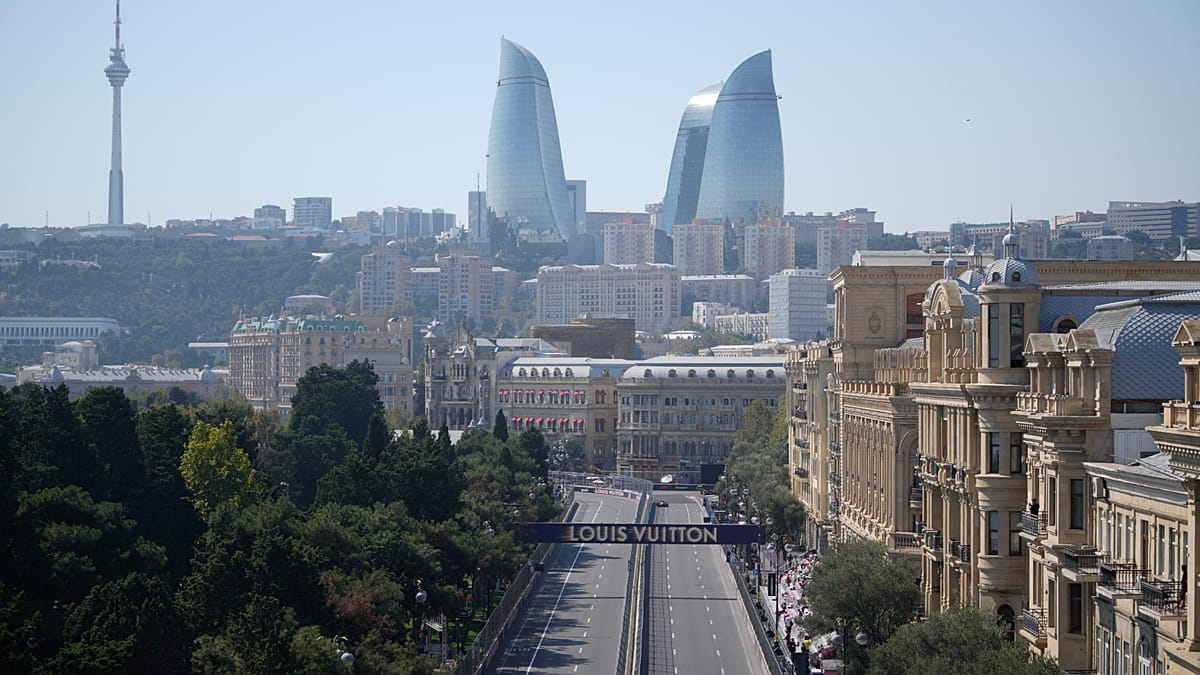
Baku has just concluded one of its most intense weeks of the year, blending high-speed motorsport with high-level diplomacy and a fresh wave of international investment. The Azerbaijan Grand Prix transformed the Caspian city into a racing hub, while the Baku Security Forum drew delegates from over 100 countries to discuss emerging threats. The climax came with the second Azerbaijan International Investment Forum (AIIF), which opened on 25 September at the Baku Convention Centre.
The two-day forum was framed as an effort to reshape global investment architecture and to position the South Caucasus as a key connector between Europe and Asia. For Azerbaijan, the message was clear: the country wants to be seen not just as an energy exporter, but as a gateway for trade, capital, and technology across the wider region.
From racing to reinvestment
Keyu Jin, a finance professor at the Hong Kong University of Science and Technology, was among the international attendees. She told Euronews she was “remarkably impressed” by the city and the organisation of the events, noting that “from the Formula One to the security conference to the AIIF conference really bring a flow of people around the world and really placing Azerbaijan on the global map”. She added that the country’s blend of forward-looking ambition and respect for its past “is really what makes this place really special”.
Economy Minister Mikayil Jabbarov used his address to stress that “reliability of partners and the resilience of supply chains carry even greater weight in economic decision-making”. He pointed to a pattern of reinvestment: “Most foreign companies operating in our country choose to reinvest their profits back here and especially along with traditional energy production also to renewable one.”
The forum delivered a string of agreements. The Ministry of Economy partnered with Vietnam’s ROX Group on construction and development, and signed a memorandum with Microsoft to advance Azerbaijan’s digital economy. In energy, the Ministry of Energy teamed up with ROX subsidiaries to evaluate utility-scale solar and wind projects. Other deals included a pharmaceutical manufacturing pact with Slovakia’s Saneca Pharmaceuticals, a veterinary vaccine project with Turkey’s VETAL, and a poultry venture in Aghdam with Czech and local partners. Azerbaijan Investment Holding and the Oman Investment Authority agreed to set up a direct investment fund, while SOCAR and UAE-based Esyasoft Technologies signed a tripartite deal to assess local water meter production.
A growing role for the Middle Corridor
The pull of the Middle Corridor—the trade route linking China and Central Asia to Europe via the Caucasus—was a recurring theme. The World Bank estimates that with sufficient investment, trade flows along the route could triple by 2030 and journey times could halve. Uzbekistan’s Investment Minister Laziz Kudratov said his country sees the corridor as “an efficient alternative transport route for our export-import operations”. He noted that bilateral trade with Azerbaijan has reached “almost $1 billion”, with a target to double it. Shipments via Azerbaijan have more than doubled in three years, and growth is running “above 30% these six months of this year”. The two governments are now setting up a joint transport and logistics venture to invest in ferries and infrastructure through the Nakhchivan and Zangezur corridors.
Montenegro’s Investment Agency director Mirjana Koic called Azerbaijan “a really special and important country”, citing existing Azerbaijani investments on the Montenegrin coast. The forum also drew attention from beyond the immediate region, with economist Nouriel Roubini praising Azerbaijan’s “good governance, good macroeconomic policies” and its vision for integrating into a broader regional economy. He noted that in a world where energy demand remains critical, Azerbaijan is going “from strength to strength”.
The momentum builds on last year’s inaugural forum, which saw investment agreements worth over $10 billion (€8.8 billion), with more than $7 billion (€6.1 billion) directed to the non-oil sector. This week’s deals suggest that diversification is not just a slogan but a practical strategy. As Europe looks to secure alternative energy and trade routes, Baku is positioning itself as a reliable partner—one that is increasingly hard to ignore.