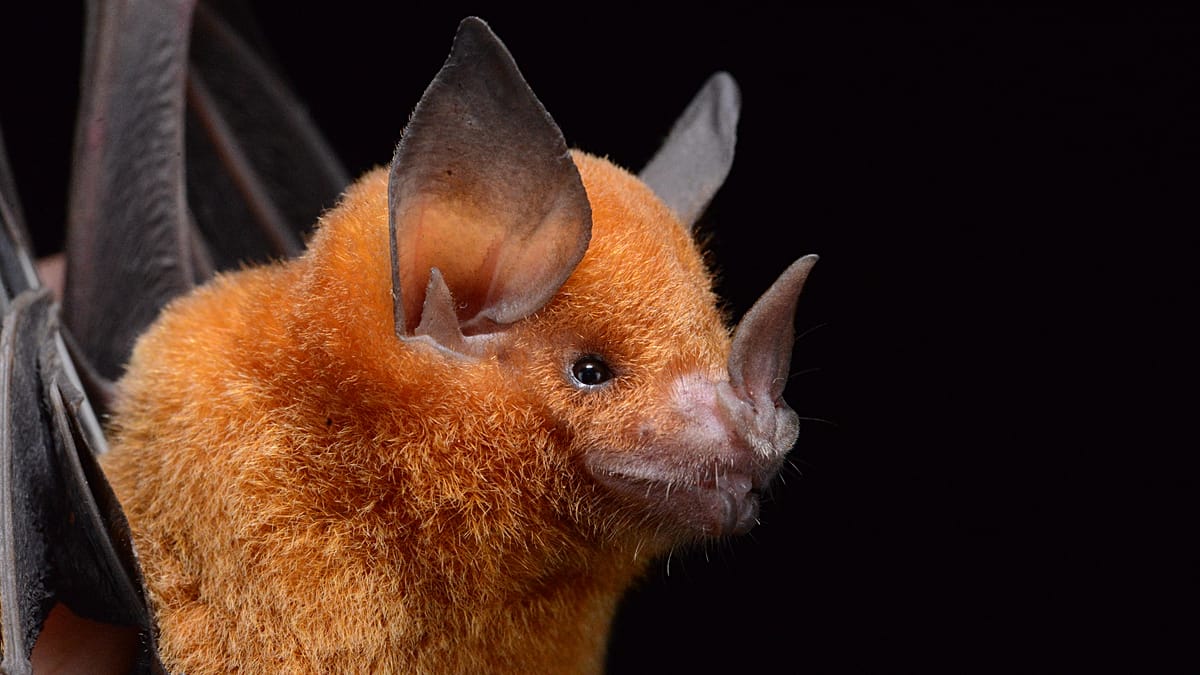
For decades, scientists assumed that bats first appeared in Asia, Africa, or the Americas. A new study, published in Nature, challenges that view. By analyzing the genomes of 103 bat species and 44 fossils, researchers conclude that the lineage arose in Europe around 65 million years ago—at the twilight of the dinosaurs—and then spread across the globe.
The study, part of the Bat1K consortium, is the most comprehensive genetic analysis of bats to date. Spanish researchers from the National Museum of Natural Sciences (MNCN-CSIC) and the University of Granada contributed to the work, which also involved institutions in Germany, Ireland, the United States, and elsewhere.
A European origin, a global dispersal
Using a method that jointly models the evolution of fossil and living species, the team placed the oldest known bat fossils within a genomic framework. The results suggest that the first bats lived in Europe, and their descendants dispersed into Africa, forming a Euro-African core. From there, bats eventually reached Asia, the Americas, and Australia.
Ismael Galván, a researcher at MNCN, highlighted the significance of the achievement: "This is the first time the genome of a flying mammal has been reconstructed, offering a solid framework to investigate the genes behind their most distinctive traits." He added that this research could eventually inform studies on aging, immunity, and disease resistance in humans.
Professor Liliana M. Dávalos of Stony Brook University explained that the new approach "allows us to place the oldest fossil bats while taking genomic data into account, determining when and where the group appeared."
Flight and echolocation from the start
One of the most striking findings is that powered flight and echolocation—two defining features of bats—did not evolve later but were present near the very origin of the group. The position of the fossil genus Vielasia, considered an ancestor of modern bats, on the oldest branch of the family tree supports this conclusion. This may explain the evolutionary success of bats over 65 million years.
Michael Hiller of the Senckenberg Institute in Frankfurt described the technical approach: "We used state-of-the-art DNA sequencing combined with computational methods to generate and compare genomes, identify genes, and cross-reference that information with 44 fossils collected worldwide."
Professor Emma Teeling of University College Dublin noted that the result is "a robust phylogenetic tree" after decades of conflicting findings.
Diverse species, remarkable adaptations
To assemble the sample set, the team turned to little-known species from remote locations: the bumblebee bat from Thailand and Myanmar, one of the smallest mammals on Earth; the Madagascar sucker-footed bat, which clings to smooth leaves using tiny suction cups; and the lesser short-tailed bat from New Zealand, which uses its folded wings as forelegs to move along the forest floor.
With more than 1,500 species worldwide, bats represent one-fifth of all living mammals. They play crucial ecological roles: pollinating plants, dispersing seeds, and controlling insect populations. Their resistance to disease and remarkable longevity relative to their size make them particularly interesting for biomedical research.
Professor David Ray of Texas Tech University emphasized the value of the data: "The volume of information will allow scientists to track genomic variation, from single-base changes to the absence of entire segments in one lineage that are present in another." These differences help explain the enormous diversity of bats and the origins of their unique traits—work whose relevance extends beyond this group of mammals.
The findings also resonate with broader questions about evolution and adaptation. As Europe continues to invest in genomic research, this study underscores the continent's role in uncovering the deep history of life on Earth.