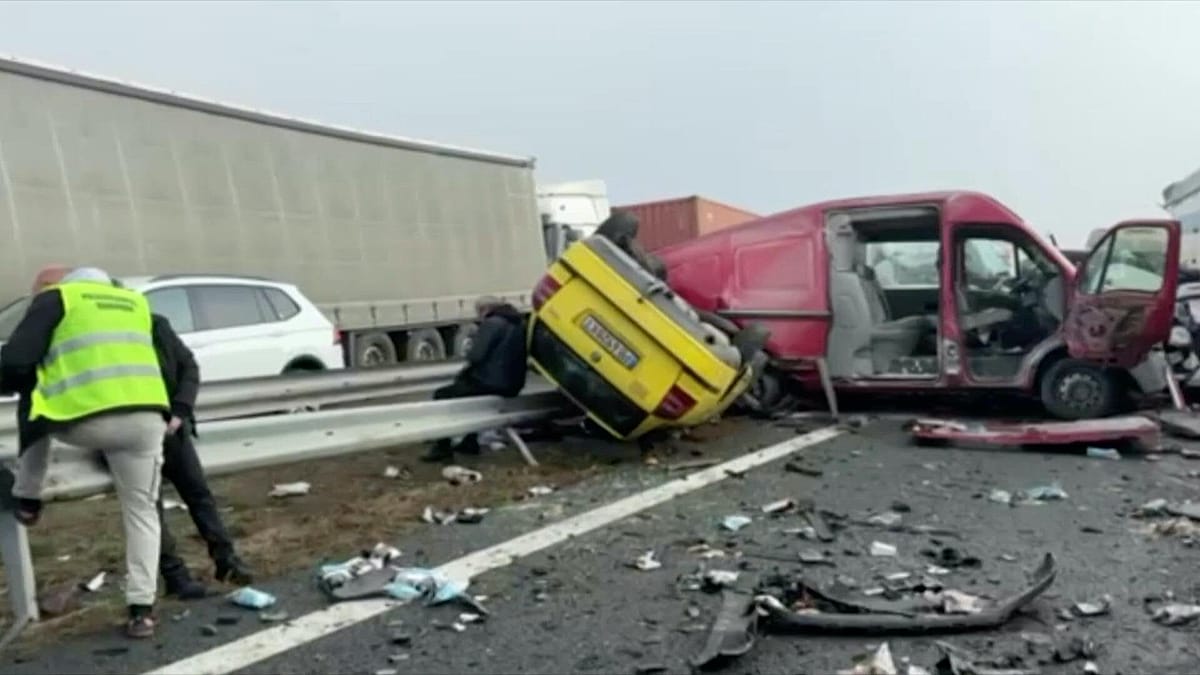
New aerial footage has laid bare the scale of a catastrophic multi-vehicle collision on a Bulgarian motorway, where at least 11 people lost their lives and dozens more were injured in thick fog. The drone images, released by state media, show a tangled mass of cars, trucks, and wreckage stretching across the asphalt near the southeastern town of Yambol, a scene that underscores the dangers of driving in sudden, dense fog.
The pile-up occurred on the Trakia motorway, a key artery linking Sofia with the Black Sea port of Burgas. According to Bulgarian authorities, the crash involved dozens of vehicles, including passenger cars and heavy lorries, which collided in a chain reaction after visibility dropped to near zero. Emergency services worked for hours to extricate victims from the wreckage, with helicopters airlifting the most seriously injured to hospitals in Yambol and Stara Zagora.
Fog and speed: a deadly combination
Initial reports suggest that poor visibility, combined with excessive speed, played a decisive role in the tragedy. Local police have launched an investigation into the exact sequence of events, but witnesses described a sudden wall of fog that descended on the motorway, catching drivers off guard. "It was like driving into a white curtain," one survivor told Bulgarian national television. "Brakes were screeching everywhere, but there was nowhere to go."
The incident has reignited concerns about road safety in Bulgaria, which has one of the highest road fatality rates in the European Union. According to the European Transport Safety Council, Bulgaria recorded 82 road deaths per million inhabitants in 2023, more than double the EU average. The country has been under pressure to improve its infrastructure and enforcement, particularly on high-speed motorways that connect major cities.
In the aftermath, Bulgarian Prime Minister expressed condolences to the families of the victims and promised a full review of safety measures on the Trakia motorway. "We must ensure that such a tragedy never repeats itself," he said in a statement. "Every life lost on our roads is one too many."
The crash also drew attention to the broader issue of extreme weather events, which are becoming more frequent across Europe. Fog, though a natural phenomenon, can be exacerbated by temperature inversions and local topography, creating sudden hazards even on well-maintained highways. Meteorologists in Bulgaria had issued a fog warning earlier that morning, but many drivers were reportedly unaware of the severity.
This is not the first time Bulgaria has faced such a disaster. In 2017, a similar pile-up on the same motorway killed seven people and injured dozens. That incident led to calls for better signage and speed management, but critics say little has changed. "We see the same mistakes repeated," said Georgi Petrov, a transport analyst based in Sofia. "The authorities need to invest in intelligent traffic systems and enforce speed limits more strictly, especially in fog-prone areas."
The European Union has been supporting Bulgaria's road safety efforts through funding for infrastructure upgrades and awareness campaigns. However, experts argue that more needs to be done at the national level, including the installation of variable speed limit signs and fog detection sensors along high-risk stretches. The EU's recent pledge of €50 million for a Black Sea maritime security hub in Romania and Bulgaria highlights the bloc's broader engagement with the region, but road safety remains a separate, urgent challenge.
Meanwhile, the human toll of the crash is being felt across the country. Hospitals in Yambol and surrounding areas have been overwhelmed, with medical teams working around the clock to treat the injured. Many of the victims were Bulgarian nationals, but the motorway also serves as a transit route for international traffic, and authorities have not ruled out foreign casualties. The Bulgarian Red Cross has set up a support center for families seeking information about loved ones.
As the investigation continues, the aerial footage has become a stark reminder of the fragility of life on the road. It also echoes similar tragedies elsewhere in Europe, such as the devastating boat wreckage off Senegal that highlighted the perils of migration, and the Russian strike on a Ukrainian shelter that showed the brutal reality of war. In each case, visual evidence has brought the scale of suffering into sharp focus.
For Bulgaria, the immediate priority is to support the victims and their families, but the longer-term challenge is to prevent such disasters from happening again. The Trakia motorway, like many roads in Europe, is a vital economic link, but it must also be a safe one. As the country prepares for its next parliamentary elections, road safety is likely to become a campaign issue, with voters demanding action.
In the meantime, the drone footage serves as a somber testament to the lives lost. The images, which have been broadcast across European media, show the twisted metal and scattered debris that once were vehicles carrying people to work, home, or holiday. It is a scene that no community should have to endure, and one that will not be easily forgotten.