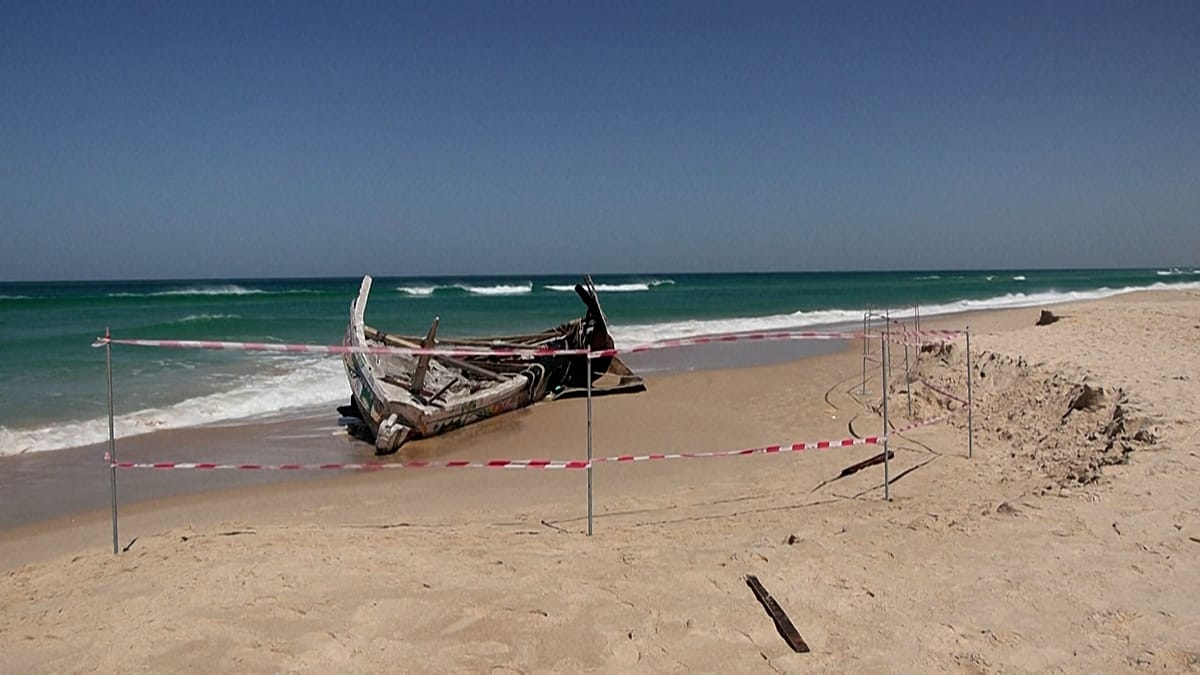
Newly released footage from Senegal's Atlantic coast shows the shattered remains of a wooden boat that sank with dozens of migrants on board, killing at least 39 people. The vessel, which had set off from the West African nation in hopes of reaching Europe, was found broken apart on a beach near the town of Kébémer, north of Dakar.
The images, captured by local journalists and shared widely on social media, reveal the hull split open and debris scattered across the sand. Rescue teams have been combing the shoreline and waters for additional victims, though the exact number of passengers remains unclear. Survivors told officials that the boat had been at sea for several days before it began taking on water.
A deadly route that keeps claiming lives
The Atlantic migration route from West Africa to the Canary Islands has become one of the most lethal in the world. According to the International Organization for Migration, more than 1,000 people have died or gone missing on this route in 2024 alone. The Spanish archipelago, a gateway to the European Union, has seen a surge in arrivals, with many boats departing from Senegal, Mauritania, and Morocco.
This latest disaster follows a similar tragedy in July, when at least 21 people died off the coast of Kébémer. That incident, which also involved a boat bound for the Canaries, highlighted the persistent dangers faced by migrants. The Senegal migrant boat disaster prompted calls for more legal migration pathways and better search-and-rescue coordination.
European authorities have been under pressure to respond. Spain's maritime rescue service has been stretched thin, with the Canary Islands receiving thousands of arrivals each month. In a recent operation, Spain rescued 854 migrants off El Hierro, underscoring the scale of the challenge. The European Union has pledged support, but critics argue that border externalization and deterrence policies have not reduced the number of deadly crossings.
Local communities and the human cost
In Senegal, the loss has reverberated through coastal communities where fishing villages have long been a source of migrants. Many young Senegalese see irregular migration as the only way to escape poverty and unemployment. The boat that sank was reportedly carrying people from several villages in the Kébémer region, a known departure point.
Local authorities have opened an investigation into the incident, but families are left waiting for news. "We don't know how many were on board," said a local official who spoke on condition of anonymity. "The boat was overloaded, and the sea was rough. It's a miracle anyone survived."
Survivors are being cared for in a nearby health center, where they described harrowing scenes of panic as the vessel began to break apart. "People were screaming, trying to grab anything that floated," one survivor told a local radio station. "The waves were too strong."
Europe's response under scrutiny
The tragedy has reignited debate in Brussels about migration policy. While the EU has focused on preventing departures through agreements with countries like Senegal, humanitarian organizations argue that more must be done to save lives at sea. The weekend toll in the Mediterranean, where twelve migrants were found dead off Crete, shows that the problem is not limited to the Atlantic.
Some European leaders have called for a more coordinated approach, including increased legal migration channels and investment in West African economies. Others have pushed for stricter border controls, a stance that has gained traction in several member states. The UK's recent tightening of settlement rules reflects a broader trend toward restrictive measures.
For now, the focus remains on the victims. The wreckage on the Senegalese beach is a stark reminder of the human cost of a crisis that Europe cannot ignore. As rescuers continue their search, the families of the missing wait in anguish, hoping for news that may never come.