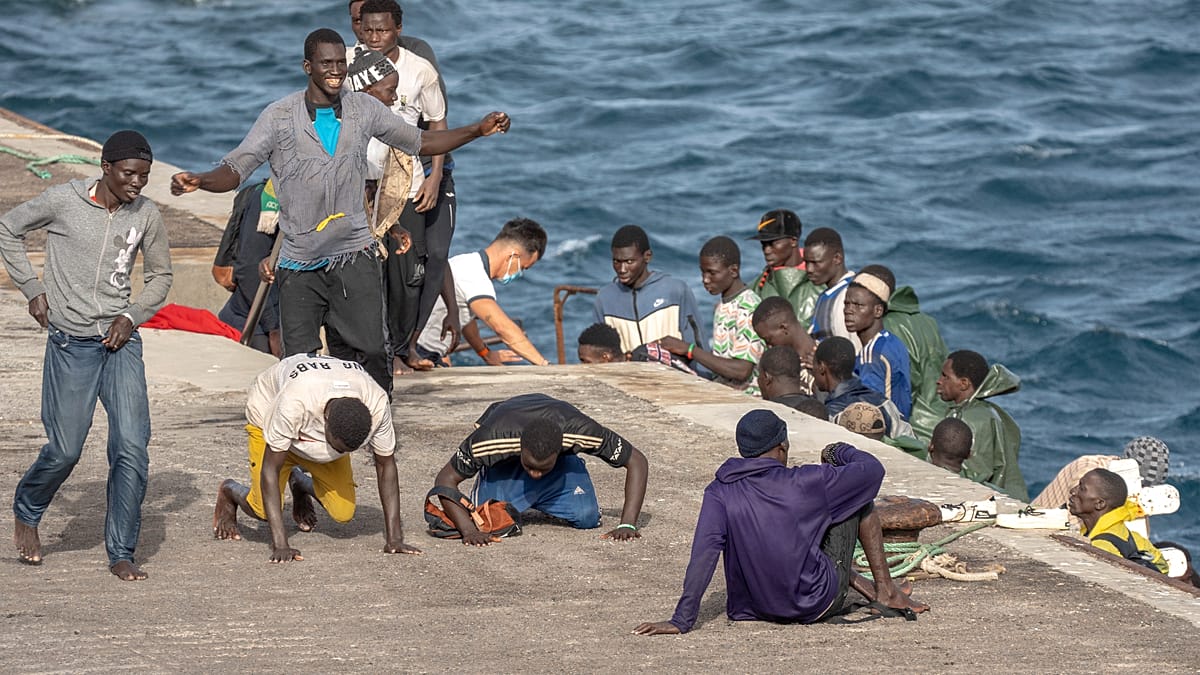
Spain's maritime rescue service, Salvamento Marítimo, brought 854 people ashore on the Canary Island of El Hierro on Friday after intercepting seven small, open motorised fishing vessels in waters off the island. The operation, which began in the early hours and continued into the afternoon, ranks among the largest single-day arrivals recorded on the archipelago's westernmost island.
The boats were escorted into the harbour of La Restinga, in the municipality of El Pinar, where those on board received initial medical and humanitarian attention. Three Salvamento Marítimo vessels took part: Salvamar Navia, Diphda and Mizar.
Staggered arrivals through the morning
The first interception took place four miles from La Restinga, where Salvamar Navia located a boat and escorted it to the quay, arriving at around 1:00 am with 134 people aboard. A second vessel docked at 4:45 am carrying 174 people, followed fifteen minutes later by a third with 166 on board.
The largest boat of the day reached the harbour at 8:30 am with 235 people. A fifth arrived at roughly 9 am with 54 people, a sixth at about 10:15 am with 39, and the final vessel at 12:30 pm with 52. The passengers were described by health and emergency services as being of sub-Saharan African origin, mostly men, though women and minors were also among them. Their departure points and specific nationalities have not yet been established.
Authorities planned to move 350 people to Tenerife on the scheduled morning ferry, with a further 350 due to follow on the afternoon crossing, in an effort to ease pressure on El Hierro's reception capacity. Nine people remain at the island's Nuestra Señora de los Reyes Hospital after arriving on different vessels in recent days, suffering from a range of health problems.
Reception and processing on El Hierro
The response at La Restinga involved the Red Cross Immediate Emergency Response Team (ERIE), the Canary Islands Emergency Service (SUC), port security staff, the Civil Guard and the National Police. After initial assistance, arrivals were taken to the Temporary Foreign Nationals Reception Centre (CATE) in San Andrés, in the municipality of Valverde, where the NGO Corazón Naranja-Ebrima Sonko provides support. They remain in police custody pending transfer to facilities elsewhere in Spain.
The Canary Islands route has remained the most active irregular entry point into Spain, sustained by departures from the West African coast to islands such as El Hierro, Gran Canaria and Lanzarote. The pressure is not confined to El Hierro: on Thursday evening, Salvamento Marítimo brought an as-yet unconfirmed number of people ashore at Arguineguín, on the southern coast of Gran Canaria. On Lanzarote, two groups arrived between 9 pm on Thursday and 8:30 am on Friday — the first consisting of 27 men of North African origin in a small boat, the second of 61 people.
The recurring nature of these landings has made reception logistics a persistent challenge for the Canary Islands government, which has repeatedly asked Madrid for additional resources and for a more predictable mechanism to share responsibility for unaccompanied minors and other arrivals with mainland regions. Friday's operation, with hundreds moved to Tenerife within hours, illustrates how quickly local facilities can be stretched.
For the wider European Union, the Canary route sits at the intersection of migration policy, border management and relations with West African states. Spain has sought to combine sea rescues with cooperation agreements aimed at disrupting smuggling networks, while human rights organisations continue to document the risks faced by those making the Atlantic crossing in small, unseaworthy vessels.