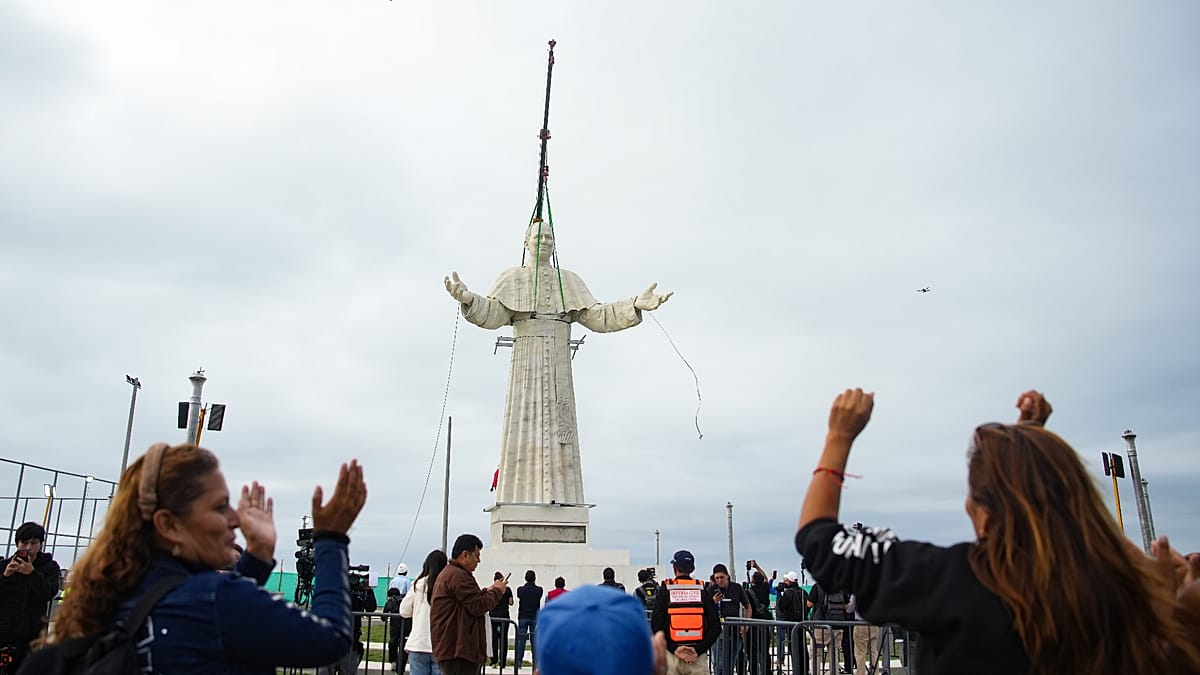
In the port city of Callao, just outside Lima, a towering statue of Pope Leo XIV now stands as a permanent tribute to a pontiff with deep roots in Peru. The monument was unveiled this week, days before the Pope is scheduled to arrive in the country as part of his broader South American tour.
The statue, which rises several metres above the plaza where it was placed, depicts the Pope in his white cassock with a gentle expression, one hand raised in a gesture of blessing. Local officials and Catholic leaders attended the ceremony, alongside residents who gathered to catch a first glimpse of the work.
A pope with Peruvian ties
Pope Leo XIV, born in Italy but long associated with Latin America, served as a missionary in Peru in his younger years and later as bishop of a diocese in the Andean region. That personal history has made his upcoming visit particularly resonant for Peruvian Catholics, many of whom see him as one of their own.
“He knows our country, our people, our struggles,” said María Fernanda Rojas, a parishioner who attended the unveiling. “This statue is a way of saying thank you for not forgetting us.”
The choice of Callao as the site for the monument is symbolic: the city has long been a gateway for missionaries and pilgrims arriving by sea, and it is also where the Pope is expected to land when his plane touches down in Peru.
The visit comes at a time when the Catholic Church in Latin America is grappling with declining attendance and social challenges, from inequality to political instability. The Pope’s itinerary includes meetings with indigenous leaders, young people, and local clergy, as well as a mass expected to draw hundreds of thousands of faithful.
Peru is the latest stop on a tour that has already taken the Pope to Argentina and Uruguay, where he paid tribute to women and warned against femicides. In Buenos Aires, he landed for the first papal visit in decades, and in Claypole he drew large crowds during a pastoral visit.
The statue in Callao is not the first public artwork dedicated to the Pope, but it is among the largest in the region. Local artist Jorge Quispe, who spent three months sculpting the figure from bronze and stone, said he wanted to capture both the Pope’s authority and his approachability.
“He is a leader, but also a pastor who walks with his people,” Quispe told reporters. “I tried to show that in the lines of the face, in the way he stands.”
The unveiling has also sparked conversations about the role of public religious monuments in a country that is officially secular but deeply Catholic. Some residents welcomed the statue as a cultural landmark, while others questioned the use of public space for a figure associated with a specific faith.
City officials defended the decision, noting that the statue was funded by private donations and that it celebrates a historic visit rather than endorsing a particular doctrine. “This is about welcoming a world leader who happens to be the head of the Catholic Church,” said Callao’s mayor, Pedro López.
As the papal visit approaches, security preparations are underway across Lima and Callao. Streets are being repaved, banners hung, and thousands of police officers deployed. The Pope’s schedule also includes a meeting with President Dina Boluarte and a visit to a shantytown on the outskirts of the capital.
For many Peruvians, the statue is a reminder of the Pope’s personal connection to their country—a connection that sets this visit apart from those of his predecessors. Whether the monument will endure as a beloved landmark or become a point of contention remains to be seen, but for now it stands as a symbol of a homecoming.