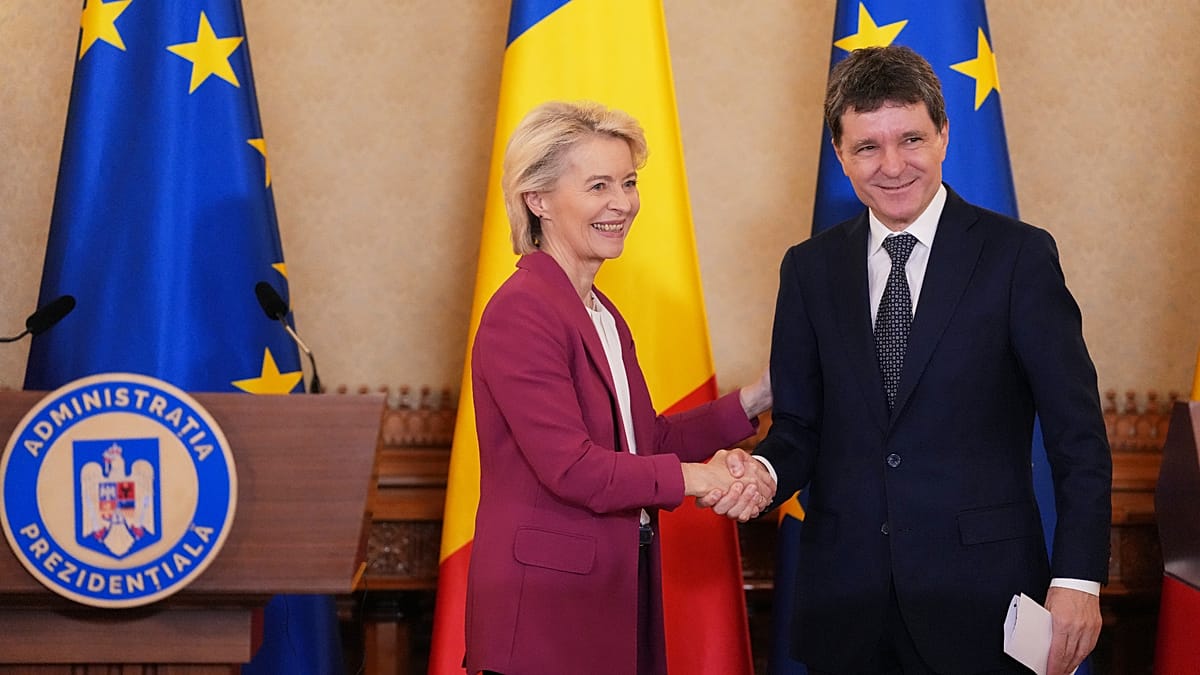
The European Commission has announced an additional €50 million to accelerate the development of a maritime security hub in the Black Sea, a project that will be based in the Romanian port of Constanța and the Bulgarian city of Varna. The funding, unveiled by Commission President Ursula von der Leyen during a meeting with Romanian President Nicușor Dan, underscores the bloc's commitment to shoring up its eastern flank amid ongoing Russian aggression in the region.
Speaking in Brussels, von der Leyen expressed the EU's "full solidarity" with Romania and assured that the country can "count on a firm and united European response." She highlighted the immediate support Europe can provide through satellite imagery from the Copernicus programme, which will enhance surveillance and early warning capabilities in the Black Sea.
"We will now accelerate work on the Black Sea Maritime Security Hub, with a clear timeline for completion, and dedicated funding of 50 million euros," von der Leyen said. According to Euronews, the hub could become operational in the first half of next year.
Three core objectives
The hub is designed to fulfil three primary missions: protecting critical infrastructure, facilitating information sharing between Romania and Bulgaria, and supporting commercial shipping and trade. Florentina Lazar, Euronews correspondent in Romania, explained that the initiative aims to create a coordinated response to maritime threats, ranging from mines to hybrid attacks.
President Dan stressed the strategic importance of the Black Sea for global trade and Europe's energy security. "We have had numerous incidents in the Black Sea in recent times, a whole spectrum of hybrid warfare, in which, obviously, Russia is attempting to escalate the conflict it started five years ago in Ukraine and involve European countries in this conflict," he said. Dan added that a stable peace in Ukraine and an effective reconstruction process would be impossible without a secure Black Sea.
The funding announcement comes against a backdrop of diplomatic friction between Sofia and Bucharest. Bulgarian Prime Minister Rumen Radev recently accused Romania of being indirectly responsible for attacks on commercial ships in the Black Sea, claiming that Bucharest had blamed Russia without providing evidence. The remarks have added a layer of tension to the bilateral cooperation on maritime security.
Meanwhile, the European Parliament has adopted a resolution condemning attacks on civilian vessels in the Black Sea and holding Russia responsible. The resolution aligns with the EU's broader stance, which has consistently pointed to Moscow's role in destabilising the region. This position is echoed in the bloc's rejection of any US-Russia plan to reshape European security without Brussels, a move that underscores the EU's insistence on being a central player in regional security discussions.
The Black Sea has become a flashpoint since Russia's full-scale invasion of Ukraine in 2022, with frequent drone and missile attacks on ports and grain ships. The EU's investment in the maritime security hub is part of a broader effort to bolster resilience along the eastern frontier, a priority that has gained urgency amid calls from Poland and other frontline states not to sideline Eastern security in Ukraine negotiations.
Beyond the immediate security benefits, the hub is expected to facilitate the safe passage of commercial vessels, which is vital for Ukraine's grain exports and the region's economic stability. The port of Constanța has already become a key alternative route for Ukrainian grain, and the new infrastructure aims to protect that lifeline.
The EU's commitment also signals a long-term strategic interest in the Black Sea, which is increasingly viewed as a critical arena for European security. As von der Leyen noted, the bloc's response must be both firm and united, a message that resonates across the continent.