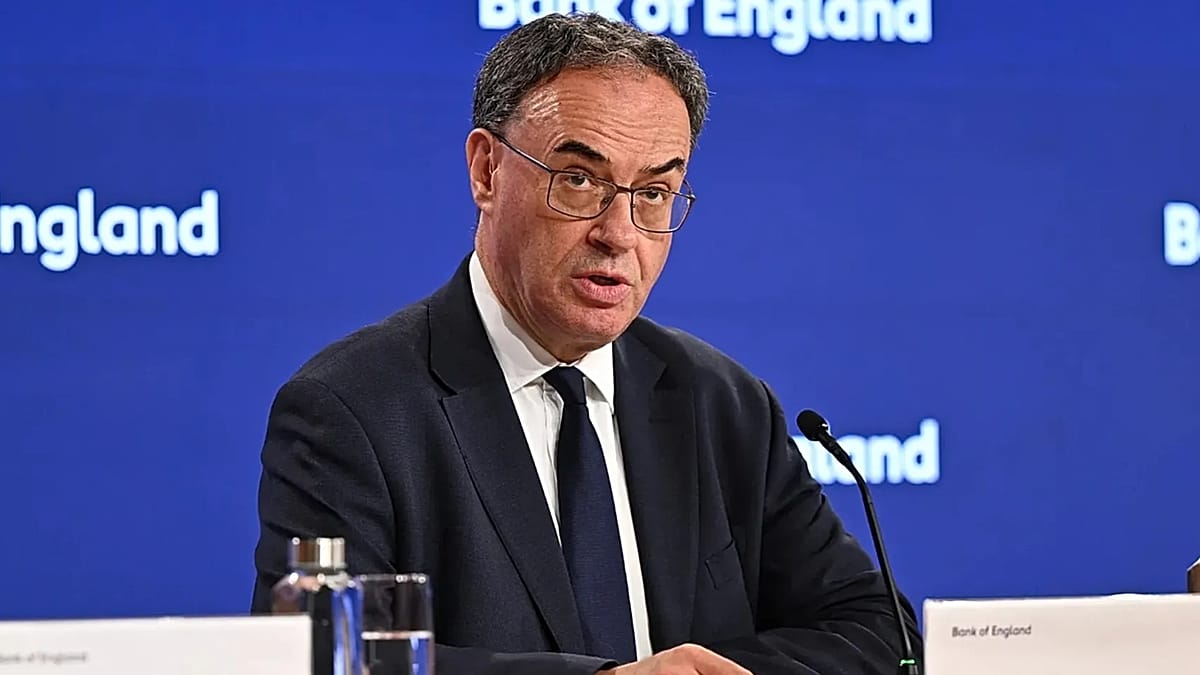
The head of the Bank of England has issued a stark warning that a new generation of artificial intelligence models could destabilise the global economy, urging policymakers to shore up defences before it is too late.
Andrew Bailey, who also chairs the Financial Stability Board (FSB), wrote to G20 finance ministers and central bankers on 28 August, ahead of their meeting in Asheville, North Carolina. His letter, published this week, argues that frontier AI systems are becoming sophisticated enough to identify and exploit vulnerabilities in critical infrastructure, from banking networks to energy grids, with potentially catastrophic consequences.
“Frontier AI may have the ability materially to alter the speed, scale and economics of cyber risk, which could undermine market confidence system-wide, especially due to highly concentrated third-party service providers,” Bailey wrote.
The warning lands at a moment of acute global uncertainty. Rising energy prices linked to Middle East tensions are feeding inflation, while massive AI investment in the United States adds further price pressure. At the same time, unpredictable trade decisions from Washington are making the economic outlook harder to read.
Bailey stressed that AI does not respect national borders. Even if one country tightens its own rules, a disruption originating elsewhere could ricochet across the world. “Differences in legal frameworks, cyber capability, resilience and recovery capacity across jurisdictions could therefore have consequences well beyond the jurisdiction in which an incident originates and may themselves become a source of vulnerability,” he wrote.
The FSB chair called for a coordinated international push to ensure that AI models are released and deployed safely. “Taking appropriate steps to support safe and responsible model release and deployment on a global basis should in my view be a priority and would benefit all sectors of the economy, including by supporting financial stability and economic growth,” he added.
An emerging threat landscape
Bailey’s letter points to a future where cyberattacks become faster, cheaper and more scalable. He urged firms and regulators to prepare for “a threat environment characterised by a higher volume of vulnerabilities and a faster pace of patching” and to adapt their safety systems accordingly.
One example cited in the letter is Mythos, a model developed by Anthropic, which has advanced autonomous coding and cybersecurity capabilities. Unveiled in April 2026, it remains unavailable for public use because of the significant risks it poses.
European officials have already begun to grapple with these issues. The EU’s AI Act, which entered into force in stages, imposes strict obligations on high-risk systems, but Bailey’s warning suggests that more needs to be done at the global level. Economic policy is also a live issue in European elections, with candidates across the continent debating how to balance innovation with security.
The next G20 meeting is scheduled for 14-15 December in Miami, Florida, where AI governance is expected to be high on the agenda. Bailey’s letter makes clear that the FSB will remain “focused on identifying emerging vulnerabilities, strengthening resilience and ensuring that innovation is consistent with financial stability.”
For European readers, the message is direct: the continent’s banks, energy providers and digital infrastructure are all potential targets. As geopolitical tensions continue to disrupt supply chains, the risk of a cascading cyber event that hits multiple countries at once is no longer hypothetical.
Bailey’s intervention is a reminder that the AI revolution, for all its promise, carries systemic risks that no single government can manage alone. The question now is whether the world’s financial leaders will act on his advice before the next crisis strikes.