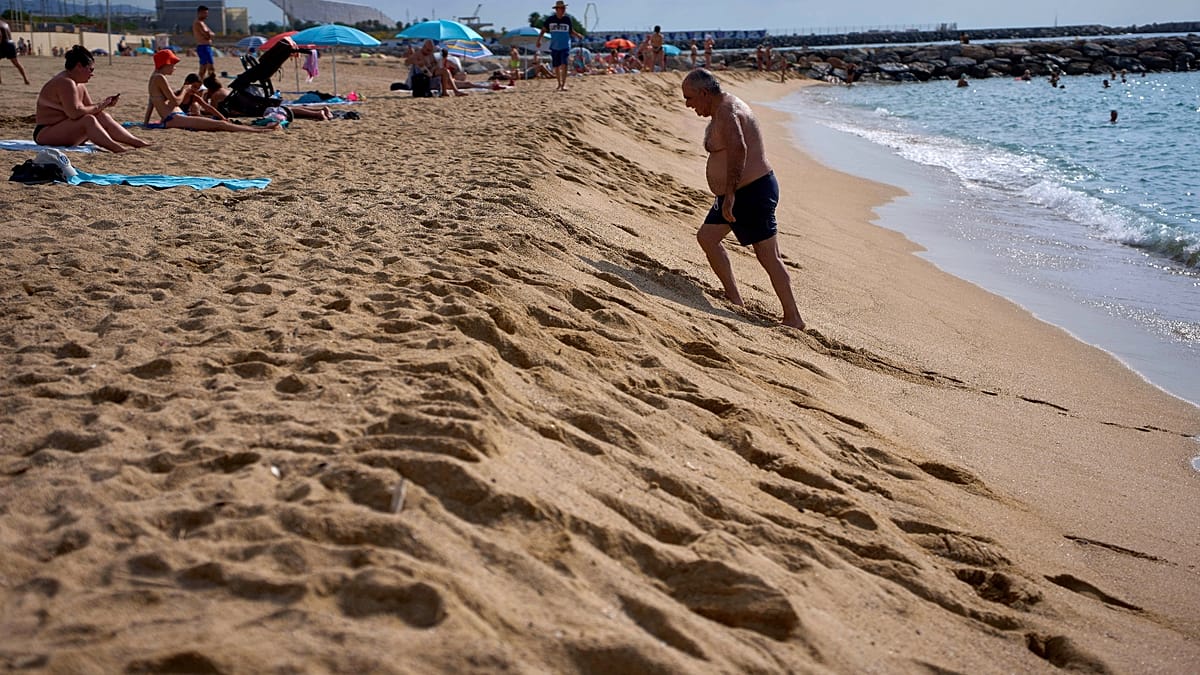
Barcelona, a city known for its architectural daring, is now applying that same ambition to its coastline. This summer, the Catalan capital recorded its highest temperature in over a century, a stark reminder that the Mediterranean is warming roughly 20 per cent faster than the global average. Warmer seas are intensifying storms, accelerating sea-level rise, and eroding beaches—pressures that became all too real in 2023 when a storm-damaged stretch of promenade on the city's northeast coast collapsed. About 70 per cent of the artificial sand added to that area in 2010 has since washed away.
In response, Barcelona has unveiled a €150 million plan to reimagine its most heavily used urban shoreline. The project, centred on the Sant Martí seafront, will create 22 hectares of climate-adapted public space—roughly the size of 31 football pitches—by integrating restored marine habitats, natural coastal defences, and improved waterfront access. The city hopes this will serve as a model for coastal communities worldwide grappling with rising seas, extreme heat, and biodiversity loss.
A finalist for the Earthshot Prize
Barcelona's initiative has been selected as a finalist for The Earthshot Prize in the Revive Our Oceans category. Launched in 2020 by Prince William, the awards celebrate innovative solutions to environmental challenges. The city is among 15 finalists chosen from nearly 7,000 nominations across 169 countries. Winners in each of the five categories will receive £1 million (€1.17 million) to scale their work.
“Every year, our Finalists give me renewed optimism,” said Prince William, President and Founder of The Earthshot Prize. “They show us that, even as the environmental challenges remain urgent, extraordinary people around the world are already proving that progress is possible.”
The selection process this year also recognised “positive tipping points”—innovations where progress builds on itself, costs fall with scale, and recovery becomes self-propelling. Barcelona's project fits that description: by moving parts of the waterfront inland, including relocating a popular seafront football pitch and shifting sea walls back, the city is not just defending against the sea but creating space for it.
“The choice facing coastal cities is no longer whether to adapt, but how,” said María Buhigas, Chief City Architect of Barcelona. “This is not a defensive structure added to the edge of the city; it is a new piece of climate-resilient public infrastructure designed for everyone to enjoy.”
What the project involves
Scheduled for completion in spring 2027, the Passeig Marítim de la Mar Bella will feature a 12-metre-wide pedestrian path and dedicated bike lanes stretching to the Fòrum, with solar pergolas that generate energy along the way. A 15,000-square-metre linear park will boost air quality and biodiversity, while wider beaches will act as natural buffers, absorbing wave energy and providing refuge during heatwaves.
Barcelona's approach is deliberately different from the repeated rebuilding of vulnerable stretches of coast. Instead, it is embracing a strategy of managed retreat and ecological restoration—a shift that many experts say is essential for urban resilience. The project also aligns with broader European efforts to adapt to climate change, such as the EU's recent court ruling on child protection (though unrelated, it shows the bloc's evolving legal landscape).
Other European finalists for the Earthshot Prize include Ørsted, the Danish renewable energy company behind some of the world's largest offshore wind farms, and PFAS-Free France, a campaign that helped secure a phaseout of 'forever chemicals' in everyday products. Further afield, Argentina's Satellites on Fire uses AI to detect wildfires, while the zero-emission shipping alliance ZEMBA and India's Mahindra Last Mile Mobility are also contenders. In North America, the Yellowstone to Yukon conservation initiative aims to reconnect a vast mountain landscape for wildlife.
Barcelona's bid is not just about protecting its own shoreline; it is about demonstrating that cities can adapt in ways that improve quality of life. As Prince William noted, “Seeing solutions work gives us all confidence to act. When they succeed, they inspire others and accelerate change.”
For a city that has long been a pioneer in urban design—from the Eixample grid to the transformation of the waterfront for the 1992 Olympics—this project could be its next legacy. And with the Earthshot Prize's global platform, the lessons learned in Barcelona may soon be applied far beyond the Mediterranean.