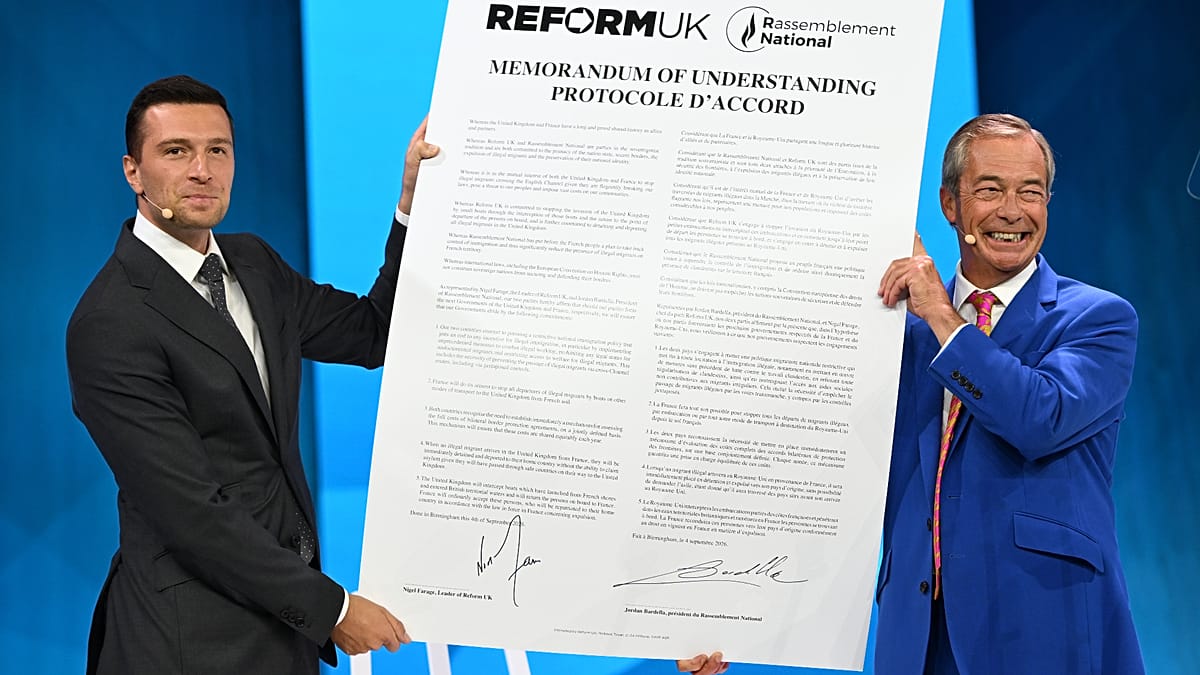
At Reform UK's annual conference in Birmingham on Friday, Jordan Bardella, leader of France's far-right National Rally, joined Nigel Farage on stage to sign a memorandum of understanding aimed at ending irregular migrant crossings across the English Channel. The agreement, which both leaders said would be implemented if their parties came to power, was hailed by Farage as a "genuine new entente cordiale" between Britain and France.
Bardella, who is positioning himself as a future prime minister of France, delivered his speech in English—a rare departure for him—and accused President Emmanuel Macron of failing to protect French borders. He insisted that "the United Kingdom must not be the destination for illegal immigrants entering France. They must be sent back to their countries of origin." In a later press conference, conducted in French, he argued that "if France managed its borders better, no one would leave Calais."
The meeting came a day after Macron visited London, where he met with British Prime Minister Andy Burnham to discuss intensifying cooperation on migration and strengthening UK-France ties. The Labour government noted that the number of small boat arrivals this summer was the lowest since 2019, though crossings remain a politically charged issue on both sides of the Channel.
An uneasy alliance
Farage and Bardella's relationship has not always been smooth. They last met in December at a private members' club in London, but Farage's history with the National Rally—formerly the National Front—has been fraught. In 2014, Marine Le Pen accused Farage of "aggression" after he refused to form a European Parliament alliance with her party, citing its "anti-Semitism and general prejudice."
On Friday, Farage acknowledged his early wariness, saying he had been "nervous" about the party under its founder, Jean-Marie Le Pen, when he entered the European Parliament in 1999. He credited Marine Le Pen with transforming the party: "When Marine took over, I observed the situation; I didn't get involved right away. What she has accomplished, namely ridding the party of those extremist elements and bringing it into the mainstream, is a considerable achievement."
The pact underscores the deepening ties between Europe's nationalist right, a trend that has been gaining momentum across the continent. Both leaders share a eurosceptic vision and have sought to position themselves as defenders of national sovereignty against Brussels and mass migration.
However, the timing of the agreement is awkward for Reform UK. The party led national polls for over a year until July, but its support has slumped in recent weeks amid a series of scandals. Hours before the conference began, Reform UK was reported to the Metropolitan Police and the Electoral Commission over alleged illegal donations, adding to the party's troubles. The police complaint threatens to overshadow the carefully staged event.
For Bardella, the pact offers a chance to burnish his international credentials ahead of a potential bid for the French premiership. His National Rally has made significant electoral gains in recent years, and he has sought to present himself as a credible alternative to Macron's centrist government. Yet his overtures to Farage, a polarizing figure in British politics, may raise eyebrows among French voters who view the Brexit architect with suspicion.
The agreement itself is largely symbolic—neither party is in power, and the mechanics of stopping small boat crossings "forever" remain vague. But the symbolism is potent: a Franco-British axis on migration, forged outside the traditional channels of EU cooperation. Whether it will translate into policy remains to be seen, but the spectacle of two nationalist leaders shaking hands in Birmingham sends a clear message to their supporters and opponents alike.
As Europe grapples with migration challenges, the Bardella-Farage pact reflects a broader realignment. With the UK outside the EU and France facing its own political uncertainties, the two countries' approaches to border control are increasingly intertwined. The coming months will test whether this entente cordiale can move beyond rhetoric and into practice.