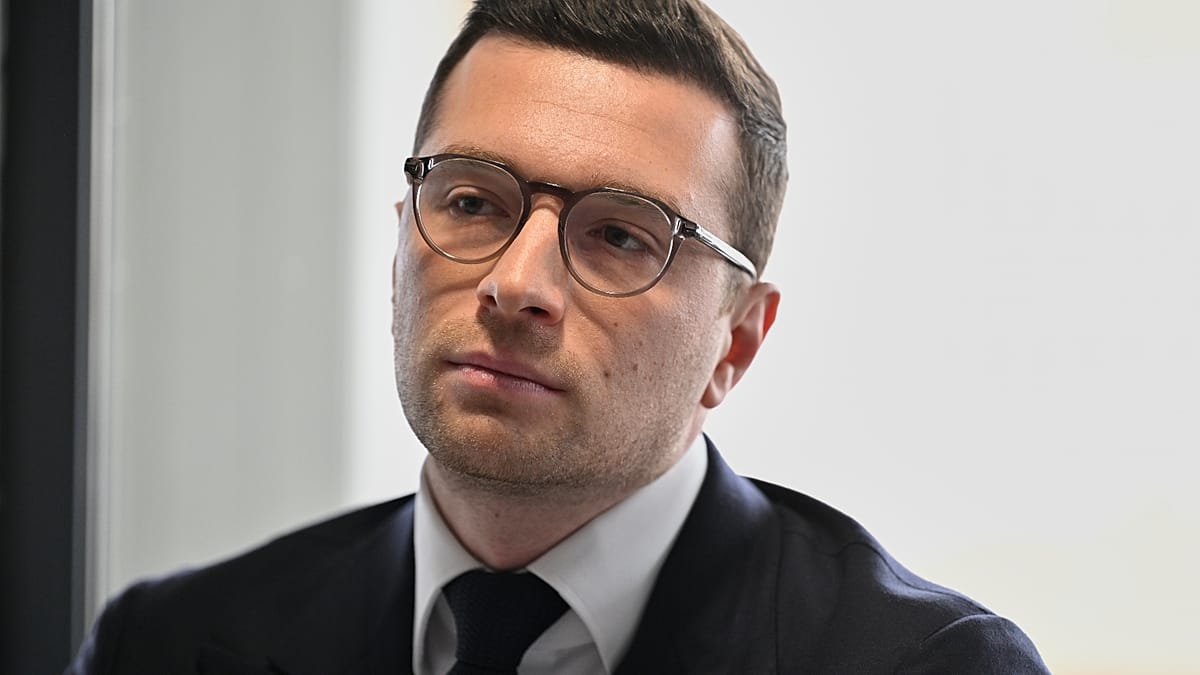
Jordan Bardella, president of France's hard-right National Rally (RN), has forcefully denied an investigative report that alleges he made antisemitic and conspiratorial remarks during his early years in politics. The report, published by the French investigative outlet Mediapart on Monday, has reignited debate over the party's history and the current presidential campaign.
According to Mediapart, Bardella made a series of antisemitic and conspiratorial comments in private conversations between 2013 and 2015, when he was a teenager and just beginning his political ascent. Bardella turned 18 in September 2013 and became the National Front's departmental secretary in Seine-Saint-Denis a year later.
The outlet claims to have obtained dozens of written exchanges in which Bardella allegedly promoted conspiracy theories targeting Jewish political figures or individuals perceived as linked to Israel. In one conversation, he is reported to have said: "The Jew must dominate other peoples, crush them and rob them; a Zionist is necessarily a Jew, and one through and through." In another, he allegedly stated: "And that is what they want: a New World Order dominated by Israel, with Jerusalem, of course, as its capital."
Bardella, who was contacted by Mediapart before publication, "formally" denied the allegations, according to the outlet. In a post on X, he called the report "blatant fabrications" and said: "I formally refute the accusations levelled against me by Mediapart, which attribute to me delusional and antisemitic remarks that I allegedly made whilst I was a minor."
He went further, framing the report as a political attack: "At a time when the victory of our ideas has never been so close, certain militant sections of the press are prepared to orchestrate smear campaigns to destabilise the presidential campaign and undermine my reputation." He added that he had instructed a lawyer to "take all necessary legal action against Mediapart."
Marine Le Pen, the RN's parliamentary leader and Bardella's political mentor, rushed to his defence. Speaking at a construction trade fair in Paris on Monday, she said she could not "believe such nonsense" and accused Mediapart of resorting to "dirty tricks" and "smear campaigns." Her support underscores the tight bond between the two figures, with Bardella widely seen as her chosen successor.
Edwy Plenel, a cofounder of Mediapart, defended the investigation, saying it was the "result of an investigation lasting several months, based on dozens of written conversations – which we have been able to independently verify – drawn from a wider body of evidence, supplemented by witness accounts."
Political context and broader implications
The allegations come at a delicate moment for Bardella, who has emerged as one of the RN's most prominent figures and a close ally of Le Pen. The party has sought to shed its extremist image, but this report threatens to revive questions about its past and the views of its leadership.
The controversy also resonates beyond France, as nationalist and far-right parties across Europe face scrutiny over their rhetoric and history. In a continent where Macron has urged Europe to resist nationalist resurgence, the episode highlights the ongoing tensions between mainstream politics and populist movements.
Bardella's legal threat against Mediapart is likely to prolong the story, and the outlet has indicated it stands by its reporting. The case also raises questions about the accountability of political figures for statements made in their youth, a debate that has played out in other European countries as well.
For now, the RN is closing ranks, but the report has already added a new layer of complexity to the French political landscape ahead of upcoming elections. Whether the allegations will dent Bardella's popularity remains to be seen, but the episode is a reminder of the challenges facing parties that seek to rebrand themselves while their pasts remain under scrutiny.