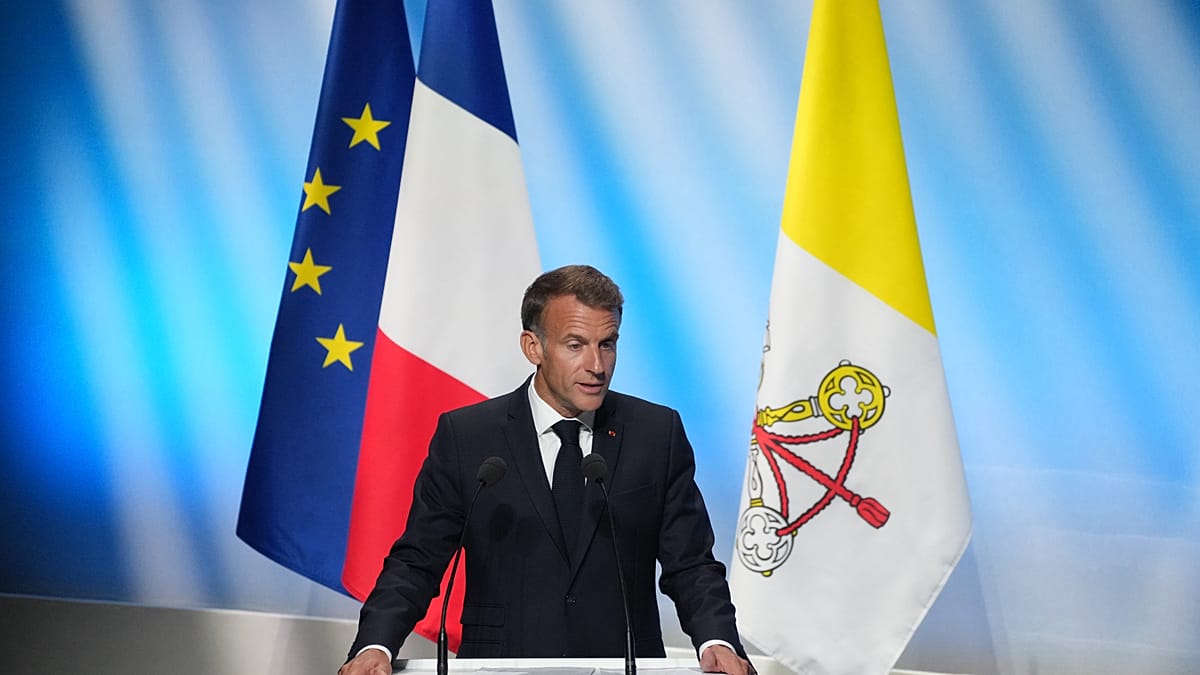
French President Emmanuel Macron used a public appearance in Metz on Saturday to issue a stark warning against the resurgence of nationalist politics across Europe. Speaking during a visit by Pope Leo XIV to France, Macron called on the continent to rediscover the courage of its post-war architects and to defend the values that underpinned European integration.
“Europe must remain a force for peace, independence, and democracy,” Macron said, addressing an audience that included civic leaders and members of the Catholic community. His remarks came at a moment when populist and nationalist movements have gained ground in several member states, from Hungary and Poland to Italy and the Netherlands.
The French president cautioned against the temptation to turn inward, describing nationalism as a threat that could unravel decades of cooperation. “We must resist the return of nationalisms,” he insisted, warning that such forces often feed on fear of others and undermine the solidarity that defines the European project.
Macron’s speech was part of a broader engagement with the papal visit, which has included discussions on secularism, artificial intelligence, and bioethics at the Élysée. The meeting in Metz, however, focused squarely on European integration and the imperative of maintaining unity in a fragmented geopolitical landscape.
A call to defend democratic ideals
The French leader’s remarks resonate beyond France’s borders. With the European Parliament elections now a distant memory, the political landscape across the EU remains volatile. Macron’s appeal can be seen as an attempt to rally pro-European forces ahead of national elections in several countries, including Germany and Poland, where nationalist rhetoric has become more pronounced.
He also referenced the founding fathers of Europe—figures like Robert Schuman, Jean Monnet, and Konrad Adenauer—whose vision was forged in the ashes of World War II. Macron argued that their courage must be matched today, not by military might, but by a steadfast commitment to democratic principles and mutual respect.
“Europe cannot be a fortress of suspicion,” Macron said. “It must be a beacon of hope, open to the world but anchored in its values.” His words were met with applause from the crowd, many of whom had gathered to see the Pope, who earlier urged the French Church to persist in its fight against abuse.
The timing of Macron’s speech is significant. As the EU grapples with energy security, migration, and the ongoing war in Ukraine, nationalist parties have sought to exploit public anxieties. Macron’s message is a direct counter to that narrative, emphasizing that unity, not division, is the only viable path forward.
His call for a “united and democratic Europe” echoes the language of the EU’s founding treaties, but it also carries a contemporary urgency. With the bloc facing external pressures from Russia and internal strains over rule-of-law disputes, the French president’s appeal is both a warning and a rallying cry.
Observers note that Macron has long positioned himself as a champion of European sovereignty. His recent adjustment of plans to join the Pope’s closing mass in Metz underscores the diplomatic tightrope he walks, balancing secular governance with the symbolic weight of a papal visit.
As Europe looks ahead, Macron’s words in Metz may serve as a touchstone for pro-European forces. Whether they will be heeded remains uncertain, but the message is clear: the continent must not surrender to the allure of nationalism, lest it betray the very ideals that gave it birth.