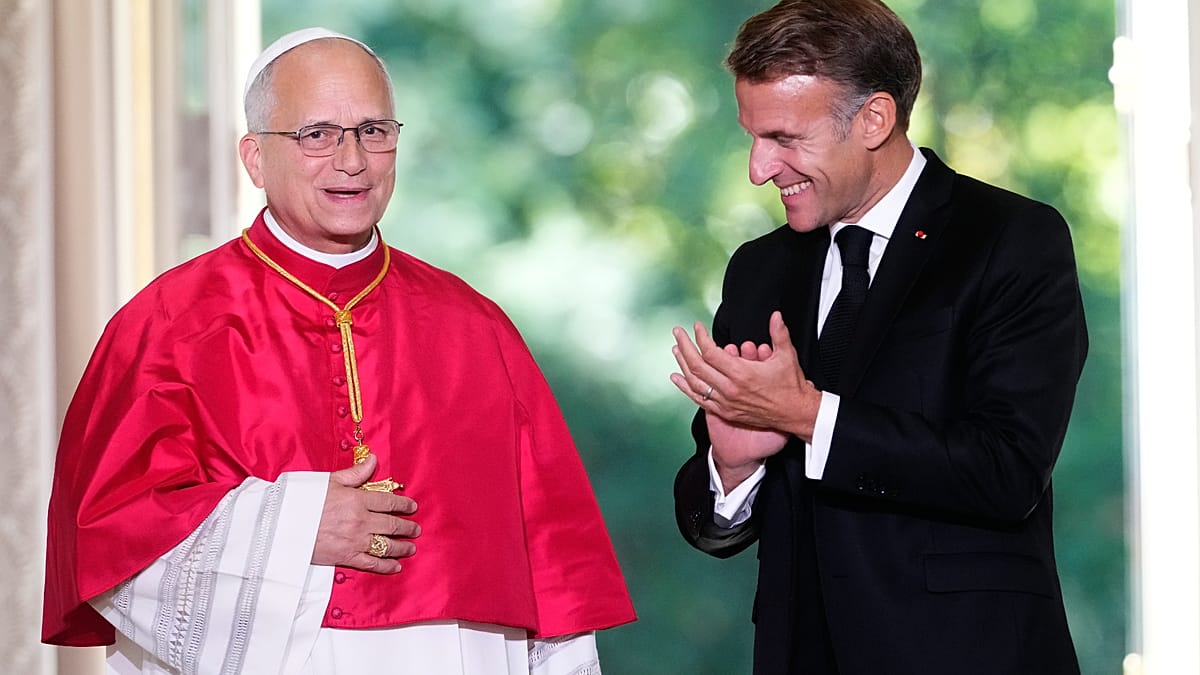
When Pope Leo XIV stepped onto the tarmac at Orly airport on Friday, he began a four-day pastoral visit that immediately thrust the Vatican into the heart of French political debate. His first stop was the Élysée Palace, where President Emmanuel Macron welcomed him for talks that exposed starkly different world views on secularism, artificial intelligence, and the sanctity of life.
Macron framed the encounter as part of the long-standing dialogue between the French Republic and the Holy See, while reaffirming the principles that underpin French secularism. He insisted that laïcité is not about pushing religion out of public life but about guaranteeing freedom of conscience for all. "Secularism is the framework that allows everyone to express themselves freely," he said, addressing the assembled dignitaries.
The meeting came at a moment when both leaders identify AI as a defining challenge of our era. The Élysée noted that climate change and artificial intelligence topped the agenda during their talks, reflecting a shared concern about the rapid pace of technological change and its societal implications.
Two visions of AI and human dignity
Pope Leo XIV, who has made AI ethics a hallmark of his pontificate, used his address to warn against the dangers of unchecked technological power. Speaking earlier this week to the Pontifical Academy of Sciences, he cautioned that AI could be used "for purposes of surveillance, manipulation and discrimination." He insisted that technological progress must remain subject to human responsibility, adding: "The greater our power to transform the world, the greater must be our ability to discern what truly serves human dignity."
Macron, by contrast, emphasized France's role as a champion of peace and multilateralism on the global stage. "Every life is worth the same, and all peoples must be defended," he declared, referencing the wars in Ukraine and the Middle East. He affirmed that France stands "on the side of peace, active multilateralism, respect for international law and the United Nations Charter."
The Pope, however, assigned France a special responsibility in a world marked by conflict. "Faced with the sound of marching boots and the multifaceted crises shaking our world, France has the vocation to remain a tireless artisan of peace and multilateralism," he said. He also challenged the notion that nuclear weapons provide security, calling for a halt to the arms race and a renewed focus on dialogue and justice.
On secularism, Leo XIV offered a vision that diverges from the strict French model. "True secularism does not consist in excluding religion from the public space," he argued, suggesting that religious convictions have a legitimate place in civic life. This stance directly contrasts with the French interpretation, which often seeks to keep religion firmly in the private sphere.
The most contentious exchanges centered on bioethics. The Pope took aim at France's recently adopted assisted dying legislation, reaffirming the Vatican's opposition to euthanasia and surrogacy. His speech, whose guiding thread was the defense of human dignity, implicitly criticized French policy on end-of-life care and reproductive rights.
After the Élysée meeting, the Pope traveled to UNESCO headquarters to address AI, youth, peace, and interreligious dialogue. He then headed to Notre-Dame Cathedral for vespers, followed by a prayer vigil with young people at the Stade de France.
On Saturday, he will visit the Bakhita House, a center for social integration, before celebrating Mass at Place de la Concorde. He will then depart for Lourdes, where he will lead services on Sunday. His tour concludes on Monday in Metz, with an interreligious meeting and a session on the "roots of Europe for peace and unity," followed by a final Mass at Saint-Étienne Cathedral.
The visit underscores the complex relationship between Paris and the Vatican, where shared concerns over global stability and technology coexist with deep disagreements on moral and social issues. As Macron and Leo XIV navigate these tensions, their exchanges will resonate far beyond the walls of the Élysée, shaping the discourse on faith, ethics, and governance in Europe.